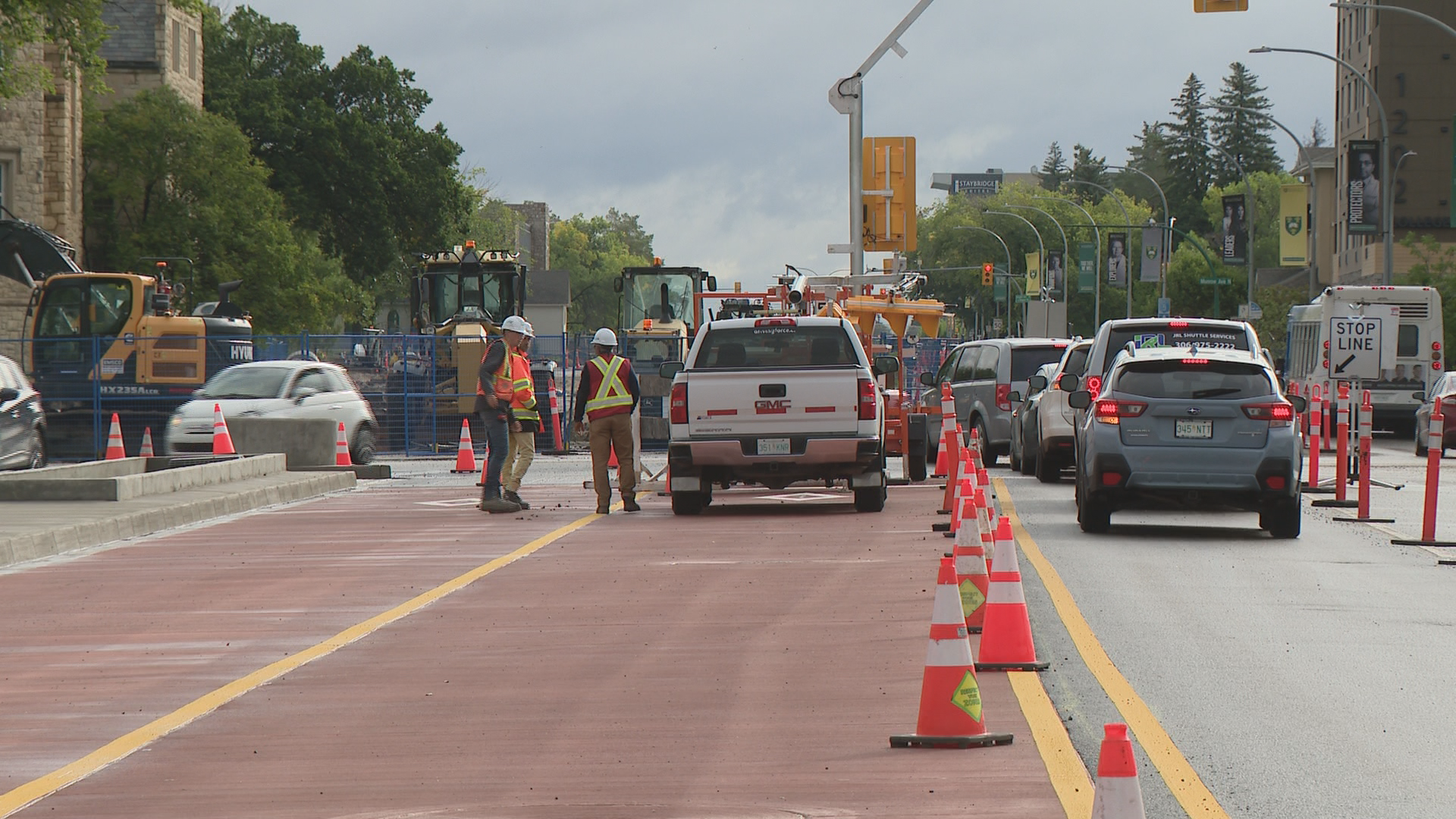
Every autumn, the local media rolls out the exact same tired script. Saskatoon drivers fume, radio hosts take irate calls about gridlock on College Drive, and civic leaders offer hollow apologies about roadwork near the University of Saskatchewan and Royal University Hospital. The lazy consensus is simple and predictable. Construction is a failure of planning. Municipal incompetence strikes again. Commuters are victims of bad timing.
It is a comforting narrative for anyone who wants to blame city hall. It is also completely wrong.
I have spent decades watching urban cores choke themselves while planners pretend to be surprised. What everyone calls a transit failure is actually an intentional, if rarely articulated, exercise in demand management. The constant digging, lane reductions, and restricted corridors are not accidents of scheduling. They are the brutal, frictionless mechanics of spatial rationing. When a city refuses to price road access properly, concrete barrels and amber flashers become the market’s substitute for tolls.
Let us dispense with the amateur hour analysis right now.
The Economics of Asphalt Friction
When the headline screams about construction snarling traffic for USask students and hospital staff, it relies on a childlike view of urban infrastructure. The underlying assumption is that asphalt should function like an open-source highway, free and infinite for anyone who wants to turn a key at eight in the morning.
Economics destroys that fantasy. When a good is priced at zero, demand expands until congestion matches the value of the wait.
The university precinct and the hospital district form a massive, concentrated employment and education hub. Tens of thousands of people converge on a tight geographic footprint daily. If you keep parking cheap, arterial roads clear, and transit secondary, you get a predictable outcome. Gridlock. The construction crews tearing up the pavement are not breaking the system. They are absorbing the shock of a system that refuses to charge drivers the true economic cost of occupying municipal space with a two-ton steel box.
Consider what happens when a lane drops from two to one near the campus gates. Velocity drops, throughput stutters, and the commute stretches from fifteen minutes to forty-five. Drivers curse the backhoes. But notice who bears the brunt of that friction. Single-occupancy vehicles. The nurse or the undergrad driving solo absorb a penalty in time.
If the city wanted to finish these utility upgrades and road rehabilitations in two weeks instead of two months, it could triple the labor budget, run triple shifts under floodlights, and shut down entire quadrants overnight. It never does. Why? Because municipal budgets treat citizen convenience as a secondary variable compared to overtime caps and contractor availability. The slow-roll construction schedule is a feature of public sector procurement. It spreads the pain across a season rather than concentrating it into a financial shockwave.
The Hospital Access Fallacy
The emotional core of the commuter complaint always centers on the hospital. How dare the city dig up roads when medical staff and emergency vehicles need to reach Royal University Hospital?
It is a powerful rhetorical shield. Who wants to sound callous about cardiac arrest patients trapped behind a steamroller?
Yet this argument relies on a category error. A hospital is an intensive urban anchor. Surrounding it with high-speed, multi-lane arterial roads designed to funnel suburban commuters past its emergency doors is an urban planning disaster. The traffic snarls around the hospital precinct are not caused by the construction crews fixing a sewer main. They are caused by the thousands of private vehicles trying to use a medical district as a shortcut to the bridge.
If we were serious about hospital access, we would ban non-essential passenger cars from the immediate hospital ring during peak hours entirely. We would reserve those lanes for transit, ambulances, and patients with mobility placards. Instead, we allow thousands of single-occupant sedans to clog the exact same asphalt that an ambulance needs, and then we blame the orange cones for the delay.
The construction zone actually exposes the absurdity of our car dependency. When normal traffic flow breaks down, alternative modes suddenly reveal their hidden efficiency.
The Transit Myth and Spatial Reality
Every time traffic seizes up, transit advocates pipe up with the same tired refrain. If only more people took the bus, the gridlock would vanish.
That claim ignores the structural layout of Saskatoon and the reality of transit economics. Saskatoon is a sprawling prairie city built around the personal automobile. Bus routes designed to collect commuters from low-density suburbs and drop them at the U of S campus take three times longer than driving.
When construction hits College Drive or the Edgemont approaches, the buses get stuck in the exact same traffic as the Honda Civics. Express lanes are rare, signal priority for transit is minimal, and the transit union contracts prevent radical shifts in scheduling flexibility. Telling a nursing shift worker who lives twenty kilometers away to take a forty-five-minute multi-transfer bus ride is not a solution. It is a dismissal of their reality.
The bottleneck persists because the city refuses to make the hard choice. You cannot have cheap parking, free-flowing traffic, low municipal taxes, and a pristine campus environment all at the same time. Pick two.
What the Data Actually Tells Us
Look at the traffic counts before and after a major construction season near the university. Total vehicle trips do not vanish; they disperse. Some drivers leave earlier. Some shift their routes to secondary residential streets, infuriating homeowners in the Varsity View neighborhood. Others consolidate trips or work remotely two days a week.
The construction acts as a harsh, blunt-force regulator of human behavior. It forces adjustments that economists drool over and motorists despise.
When people complain that construction season is too long in Saskatchewan, they forget the brutal physics of our climate. We have a four-month window where asphalt can be laid without freezing into a brittle sponge. Crews are working against a thermodynamic deadline, not just a bureaucratic one. To demand that every underground pipe replacement, fiber optic run, and surface repaving happen simultaneously and instantly during a prairie summer is economically illiterate.
The disruption is the price of maintaining a high-infrastructure lifestyle on a mid-sized city tax base. We want suburban tax structures to fund urban-scale institutional corridors, and then we act shocked when the concrete crumbles under the weight.
The Uncomfortable Prescription
If you want to fix the Saskatoon commuter crunch around USask and the hospital, stop whining about the construction schedules and start attacking the structural subsidies that created the traffic in the first place.
First, eliminate free and heavily subsidized parking on institutional lands. Every parking stall on campus or hospital grounds is a financial transfer from taxpayers to drivers, encouraging the exact congestion everyone complains about. Price parking at market rates, and watch single-occupancy vehicle counts drop by twenty percent within a month.
Second, stop treating residential side streets as overflow valves for frustrated commuters. If cars divert through Varsity View to bypass construction, install permanent diverters that make cut-through driving impossible. Force the traffic to stay on the arterials where it belongs, absorbing the delay it generates.
Third, privatize road maintenance contracts with strict performance bonuses and penalties. If a contractor misses a deadline by a week, dock fifty percent of their margin. If they finish early, double it. Watch how fast those backhoes move when capital is actually on the line.
Until then, stop blaming the orange barrels. They are just holding up a mirror to our own stubborn refusal to pay the real cost of driving.