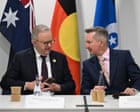
The room was supposed to be safe. It was filled with familiar faces, warm lighting, and the low hum of relaxed voices winding down after a high-pressure summit. Anthony Albanese stood near a cluster of colleagues, his body language relaxed, his posture far removed from the stiff, guarded stance he adopts at a podium.
Then came the audio feed.
It takes less than half a second for a piece of sound to travel from a lapel microphone to a sound mixing desk, through a broadcast truck, and straight into millions of homes. When that sound carries an off-guard remark from a prime minister, the distance between private banter and a national political storm vanishes instantly.
A hot mic does not merely record words. It strips away the carefully constructed armor of leadership, exposing the unvarnished human underneath to a public that demands absolute discipline.
The Friction Between Public Persona and Private Speech
Political life operates under an unwritten contract. The public expects calculated precision, measured tone, and strategic calm. Behind closed doors, however, politicians are people dealing with exhaustion, camaraderie, and the impulse to blow off steam.
When those two worlds collide, the reaction is rarely subtle.
The Coalition seized upon the leaked audio immediately, framing the unguarded exchange as "locker-room talk" unworthy of the office. The phrasing was intentional. It invoked a specific archetype of casual dismissiveness, transforming a fleeting moment of informal chatter into a test of character and judgment.
The pressure on Albanese built by the hour. A public apology followed, delivered with the grave, deliberate tone reserved for major parliamentary statements. Yet the contrast between the apology and the original remark highlighted a recurring tension in modern governance: can a leader ever truly step off the stage?
Consider the sheer exhaustion of contemporary political campaigns and international travel. Flight schedules run around the clock. Meetings blur into press conferences. In those rare seconds between official engagements, the instinct to relax is almost overwhelming. But in the digital age, privacy is not a room with a closed door; it is an environment where every ceiling might conceal an active pickup pattern.
The Machinery of the Leaked Moment
To understand why a stray sentence triggers days of political warfare, look at how modern media digests audio.
A written quote on a page lacks context, inflection, and warmth. Audio, by contrast, feels intimately authentic. Listeners hear the cadence, the light chuckle, the tone of casual confidence. Because it feels raw, the audience assumes it reveals a deeper truth than any prepared speech ever could.
The opposition understood this dynamic perfectly.
- The initial clip circulates on social channels, stripped of the preceding conversation.
- The commentary machine framing the remark takes hold before official responses can be drafted.
- The formal apology becomes mandatory, turning a minor lapse into a multi-day news cycle.
This sequence plays out with predictable regularity across global politics. The scandal is rarely the sentence itself; it is the glimpse behind the curtain. It exposes the reality that leaders do not talk like press secretaries when they think the cameras are off.
The Strategic Anatomy of an Apology
When Albanese stepped up to address the criticism, the stakes extended beyond a single news story. A poorly handled apology can prolong a crisis, while a swift, direct acknowledgment can drain the controversy of its momentum.
He chose directness. He acknowledged the slip, expressed regret for the language used, and attempted to pivot back to policy matters.
Yet the event left an mark on his public posture. Every subsequent public appearance demands an extra layer of caution. The subtle relaxation of the shoulders, the quick joke with a staffer, the quiet side-comment during a photo opportunity—all are now filtered through the memory of that open channel.
Leaders forced into this position face a difficult choice. They can retreat entirely into scripted rigidity, becoming bulletproof but utterly unrelatable. Or they can continue to project informal warmth, risking another moment where the microphone catches more than it should.
The Mirage of the Off-The-Record Era
Decades ago, informal agreements between journalists and politicians created quiet zones where leaders could speak freely without fear of immediate broadcast. Those boundaries have dissolved.
Today, every phone is a recorder, every event is streamed, and every lapel wire remains potentially live until physically detached. The boundary between official statement and private thought has not just blurred; it has been erased by technology.
The Coalition’s critique tapped into a broader cultural conversation about accountability and conversational boundaries. What one group views as harmless informal banter, another views as evidence of poor discipline. In a hyper-connected environment, the audience for any remark is no longer just the person standing next to you—it is the entire country.
Albanese moved on, the news cycle shifted toward economic figures and legislative debates, and the immediate political pressure eased. But the fundamental reality of modern public life remains unchanged. The silence after a speech is no longer a guarantee of privacy. The microphone is always listening, waiting for the one second when the guard drops.