The sky over the Alborz Mountains doesn't just turn dark; it turns heavy. On the nights when the air raid sirens cut through the crisp mountain air, the sound isn't merely a warning. It is a vibration that settles into the marrow of the bone. For a family in a North Tehran apartment, the routine is practiced and weary. They don't panic. They move with the rhythmic, exhausted efficiency of people who have been told for forty years that the end is coming, only to wake up the next morning to the same smell of toasted sangak bread and diesel fumes.
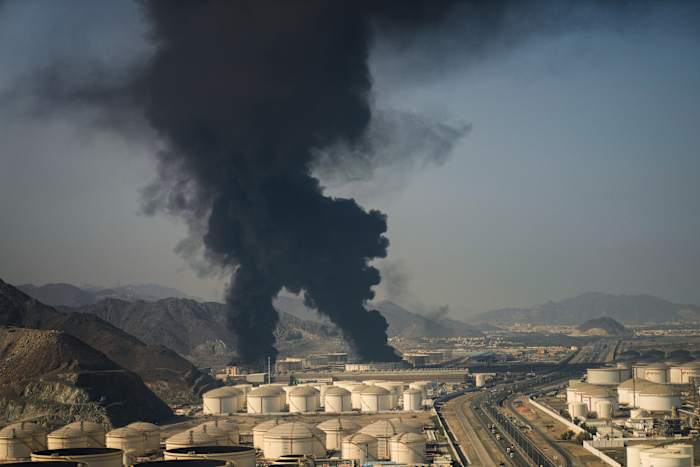
To the analysts in Washington and Tel Aviv, Iran is a map of coordinates. It is a series of hardened silos, uranium enrichment centrifuges, and logistical hubs. When the missiles fly and the explosions bloom like lethal flowers across the Iranian plateau, the data points change. A radar array is "neutralized." A battery is "degraded."
But maps don't bleed. Maps don't have memories.
The recent waves of US and Israeli strikes were designed to do more than just break hardware. They were intended to break a will. The logic of modern warfare suggests that if you strip away a nation’s shield, the nation will eventually drop its sword. Yet, as the smoke clears over the Karaj dam and the outskirts of Isfahan, a different reality emerges. The sword is still held high, gripped by a hand that has grown calloused from decades of pressure.
The Anatomy of Defiance
Consider a hypothetical engineer named Reza. He is forty-five, educated in Europe, and works at a facility that the West views as a threat and he views as a workplace. When the precision-guided munitions strike the perimeter, Reza doesn't see a geopolitical shift. He sees the shattered glass of his office and the charred remains of a project he spent a decade building.
In the calculus of high-stakes diplomacy, this destruction is supposed to lead to a calculation: This is too expensive. We must stop.
Instead, the human psychology of the region often flips the script. In the wake of the fire, the grievance becomes the fuel. The Iranian state has spent decades weaving a narrative of "sacred defense," a cultural identity forged in the furnace of the Iran-Iraq War. For the leadership in Tehran, surviving a strike isn't just a military outcome. It is a divine validation. Every missile that lands and fails to topple the system is held up as proof of a fundamental, stubborn durability.
The strikes were massive. They were precise. They took out air defense systems that were supposed to be the crown jewels of Iranian security. By any standard military metric, the Iranian "foe" should be reeling, looking for an exit ramp, or at least lowering its voice.
The silence that followed was not the silence of defeat. It was the silence of a boxer resetting his feet.
The Invisible Stakes of the Grey Zone
War today isn't a binary of "on" or "off." It exists in a permanent grey twilight. While the headlines focus on the thunder of the explosions, the real conflict is fought in the quiet spaces: the bank accounts, the shipping manifests, and the minds of the youth in the cafes of Shiraz.
The West often operates on the assumption that the Iranian people are a separate entity from the Iranian state. There is truth there. Millions of Iranians are exhausted by the morality police, the stifling economic inflation, and the isolation from the global community. They want high-speed internet and the ability to travel to Paris. They want a future that isn't defined by a 1979 revolution they weren't alive to see.
However, when a foreign power strikes the soil, the internal fractures often seal shut with the heat of the blast.
A student who spent the afternoon complaining about the price of eggs finds herself feeling a sharp, involuntary sting of pride when she sees her country’s flag over a smoldering site. It is a complicated, messy emotion. It is the feeling of being bullied by a giant. Even if you hate your own government, you hate being told what to do by a predator in the sky even more. This is the miscalculation that haunt's the "maximum pressure" strategy. It assumes that pain leads to pivot. Often, pain only leads to scar tissue.
The Architecture of the Underground
The Iranian military strategy is not built on winning a fair fight. They know they cannot match the F-35s or the sheer electronic wizardry of the Israeli Defense Forces. So, they have built a civilization of shadows.
Deep beneath the Zagros Mountains lie "missile cities." These are not just bunkers; they are sprawling, subterranean metropolises of ballistics. You can blow up the doorways, but the tunnels go for miles. This physical reality mirrors the political reality. The Iranian influence in the region—the so-called "Axis of Resistance"—is not a centralized army. It is a franchise model.
When the US and Israel strike targets inside Iran, they are hitting the brain. But the limbs—the Houthis in Yemen, Hezbollah in Lebanon, the militias in Iraq—have their own nervous systems. They have their own local grievances and their own local power bases.
Imagine trying to kill a vine by pruning the leaves in the center. The vine simply grows faster at the edges. The strikes may have "stubborned" the foe, but they have also forced that foe to innovate. Deprived of a modern air force, Iran became the world leader in low-cost, high-impact drone technology. They turned a weakness—the inability to buy expensive jets—into a terrifying strength that now keeps global shipping lanes on edge.
The Ghost of 1953
To understand why Iran remains a "stubborn foe," you have to walk through the halls of history, which in Tehran, are very long and very crowded. The collective memory of the 1953 coup—where the CIA and MI6 overthrew a democratically elected prime minister to secure oil interests—isn't a history lesson. It’s a fresh wound.
Every time a US official speaks about "regime change" or "supporting the people," the elders in the room hear the echoes of 1953. They see a pattern. They believe that no matter what they do, the goal of the West is their total erasure.
When you believe your opponent wants you dead, you don't negotiate. You dig in.
The stubbornness is not just a policy choice. It is an existential stance. For the hardliners in the Iranian Revolutionary Guard Corps, the conflict is the point. It justifies their budget. It justifies their grip on the economy. It justifies the suppression of dissent. In a strange, dark irony, the massive attacks from the outside provide the perfect internal justification for the very thing the West wants to stop.
The Price of a Stalemate
We are currently witnessing a masterclass in the limits of kinetic power. You can drop a million dollars worth of explosives on a five-hundred-dollar drone factory, and by the time the dust settles, the factory has moved to a basement three blocks away.
The Iranian economy is a shambles. The rial is worth less than the paper it’s printed on in some markets. People are selling their kidneys to pay off debts. This is the "stubbornness" that the headlines miss—the quiet, desperate stubbornness of a population trying to survive while two giants trade blows over their heads.
The invisible stakes are the lives of a generation. A young woman named Elham, an artist in Isfahan, watches the news and sees the maps of the strike zones. She knows that every time a missile hits, her chances of ever seeing the world outside the borders of Iran shrink. The borders close tighter. The internet gets slower. The world becomes a smaller, more dangerous room.
She is the collateral damage of a stubbornness she didn't choose.
The Echo of the Last Blast
The most recent attacks were described as a "message." But messages require a common language to be understood.
The West speaks the language of deterrence—the idea that if I hurt you enough, you will stop.
Iran speaks the language of endurance—the idea that if I survive your hurt, I have won.
These two languages do not translate. They only collide.
As the sun rises over Tehran, the city wakes up. The traffic jams begin to clog the Valiasr Street. The vendors set out their fruit. The scars of the latest strikes are hidden behind military cordons or cleared away by work crews with a speed that suggests this is just another Tuesday.
The foe remains. Not because it is stronger than the combined might of its enemies, but because it has nowhere else to go. It is a nation that has defined itself by what it resists.
The tragedy of the "stubborn foe" isn't that they won't change. It's that the tools being used to force that change are the very things that keep them frozen in place, a statue of defiance carved from the debris of a thousand explosions, standing in a desert that has seen empires come and go, while the people below just try to find enough bread for the morning.
The fire hasn't melted the stone. It has only turned it into glass—hard, sharp, and transparently dangerous.