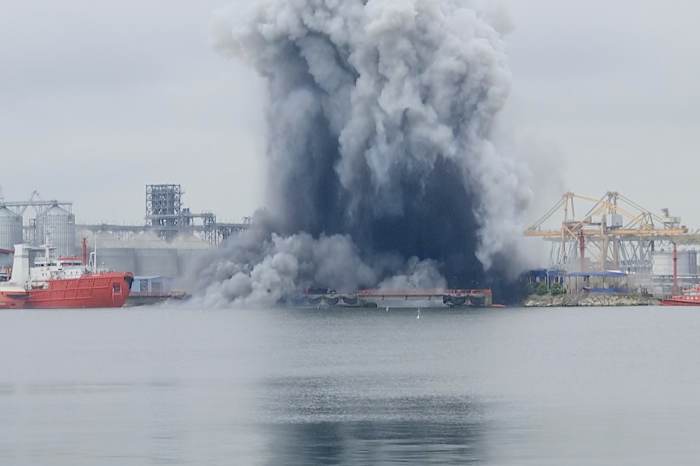
The war in Ukraine isn't staying inside its borders, and anyone pretending otherwise is ignoring the smoke rising over NATO territory.
When a Ukrainian maritime drone drifted into the civilian section of Romania's Port of Constanța and detonated, it wasn't just a localized emergency. It was a loud, chaotic reminder that the Black Sea has become a highly volatile electronic warfare playground where nobody is completely safe. The blast happened around 10:30 a.m. near the headquarters of the Romanian Agency for Saving Human Life at Sea. Thankfully, the area had already been cordoned off by the Romanian Intelligence Service, the Coast Guard, and the Ministry of National Defence. Nobody died. Nobody was hurt. But the strategic implications are massive.
This isn't a simple case of Ukrainian negligence. It's a symptom of a much larger, invisible battle happening across the waves.
The Reality of Electronic Warfare in the Black Sea
If you want to understand why a multi-million dollar piece of military hardware ended up floating into a civilian harbor, you have to look at the radio frequencies. The Ukrainian Navy openly admitted they lost control of four unmanned surface vessels during an active operation. Why? Russian electronic warfare jammed their guidance systems.
When a sea drone gets blinded by high-powered jamming equipment, it doesn't just stop. It drifts.
The incident in Constanța was part of a larger cluster. While one drone made it all the way into the port, three others were accounted for nearby. One self-detonated offshore under the watchful eye of the Romanian Coast Guard, and two others exploded about 145 kilometers east of the city.
"While carrying out missions in the Black Sea operational area, one of the Ukrainian Navy's unmanned surface vessels came under the influence of the enemy's electronic warfare systems, lost control, and ended up near the coast of Romania," the Ukrainian Navy noted in an official statement.
To their credit, Kyiv didn't try to hide it. The Ukrainian military quickly pinged their Romanian counterparts to warn them that four explosive-laden boats were running completely blind. That fast communication is the exact reason more than 1,300 people were evacuated from local beaches and a one-kilometer exclusion zone was set up before the main blast occurred.
Romania Is Caught in the Crossfire
For Romania, this is getting dangerously routine. The country is an EU and NATO member, yet its sovereign territory keeps getting bumped by the kinetic overflow of Russia's invasion.
Just a week before this port explosion, a Russian-made Geran-2 attack drone went off course during a strike on Ukrainian infrastructure and crashed into an apartment building in the eastern Romanian city of Galați. That crash injured a mother and her teenage son, shattered windows, and forced Bucharest to kick out Russia's consul general.
Look at the sheer volume of incidents since 2022. The Romanian Navy has neutralized nine sea mines out of more than 150 that have been drifting around the Black Sea basin. Airspace breaches by Russian drones targeting Ukrainian ports along the Danube River happen all the time.
The Russian Embassy in Bucharest quickly tried to flip the narrative, accusing Ukraine of using unmanned vehicles to commit terrorist acts against civilian shipping. But Romanian President Nicușor Dan didn't buy the spin. Speaking from an EU summit in Montenegro, Dan made it clear where the blame lies. The incursion into Romanian sovereign space is a direct consequence of the war unleashed by Russia.
What This Means for NATO Strategy
This explosion marks the first time an explosive maritime drone has actually detonated inside a NATO port facility. It changes the calculus for regional defense. Ukraine's domestic sea drone program has been incredibly effective, knocking out roughly 30% of Russia's Black Sea Fleet and forcing Moscow's warships to hide out in Novorossiysk. But those same successful tools become drifting hazards when hit with heavy electronic jamming.
The alliance is already reacting. Four Italian Air Force Eurofighter Typhoon jets recently arrived at the Mihail Kogălniceanu Air Base right outside Constanța to reinforce air policing. But jets can't do much against a low-profile boat filled with explosives drifting into a civilian marina.
If you operate commercial shipping lines or manage port logistics in the western Black Sea, you need to accept that the risk profile has permanently changed. Physical security isn't just about watching the skies for missiles anymore. It requires active, close-range visual and sonar monitoring of harbor entrances to catch blind, drifting assets before they hit infrastructure.
Expect Romania to push hard for joint NATO naval patrols specifically tasked with clearing drifting ordnance and securing civilian shipping lanes. Until those measures are locked down, the Black Sea remains a space where a stray signal can send an explosive drone straight into a civilian dock. Keep your eyes on harbor security updates and maritime safety notices if you have assets moving through these waters.