Mainstream media outlets love a clean spy thriller. Two men get arrested near a US-run military base in England, prosecutors pull out the UK National Security Act 2023, and the headlines write themselves. Readers see the words "national security" and "US military base" and immediately picture trench coats, dead drops, and state-sponsored sabotage.
That narrative is lazy, predictable, and misses the actual story entirely.
When British authorities charge individuals under the National Security Act 2023 over an incident at a US-operated Royal Air Force station—whether it is RAF Lakenheath, RAF Mildenhall, or RAF Menwith Hill—the public is being fed a binary choice: either these men are master spies working for a hostile foreign intelligence service, or they are harmless bystanders caught in a bureaucratic dragnet. Both assumptions ignore the profound legal and geopolitical shift happening right under the British public's nose. The real story is not about who breached a perimeter fence; it is about how the UK government quietly lowered the legal bar for espionage, blurred the line between political protest and foreign interference, and outsourced its domestic security priorities to American defense interests.
The Myth of the Traditional Spy
If you read standard coverage of these arrests, the framing relies heavily on Cold War nostalgia. Journalists treat a charge under the National Security Act as synonymous with treason or high-level intelligence gathering.
In reality, the National Security Act 2023 was specifically engineered to capture conduct that falls miles short of traditional espionage. Under the old Official Secrets Acts—legislation dating back to 1911 and 1989—prosecutors faced a high evidentiary threshold. They generally had to prove that a suspect was communicating information directly useful to an enemy, or that the act was specifically prejudicial to the safety or interests of the state in a narrow, military sense.
The 2023 overhaul threw that restraint out the window.
Section 1 of the Act criminalizes obtaining or disclosing "protected information" where the person knows, or ought reasonably to know, that their conduct is prejudicial to the safety or interests of the UK. Notice the phrase: ought reasonably to know. Prosecutors no longer need to prove explicit malicious intent to aid a foreign adversary. Even more telling is Section 4, which makes it an offense to enter or inspect a "prohibited place" for a purpose prejudicial to the safety or interests of the state, alongside Section 5, which lowers the bar further for unauthorized entry into prohibited sites even without proving a prejudicial purpose.
When a news report announces that two men have been charged with national security offenses at a US-run base, the average reader assumes state-level espionage. Legal practitioners looking at the statute books see something entirely different: an elastic legal net capable of turning trespass, drone photography, or direct-action protest into a severe national security felony.
Who Actually Controls "British" Soil?
The competitor framing treats US-run bases in England as ordinary UK military installations that happen to host American personnel. That is a convenient fiction maintained by Whitehall for decades.
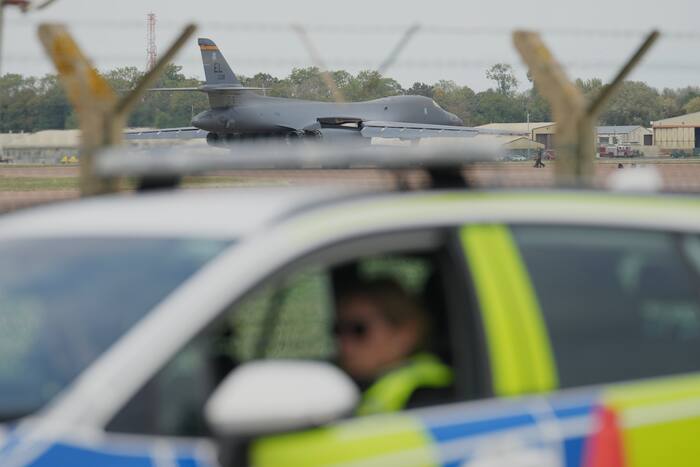
Bases like RAF Lakenheath and RAF Mildenhall are nominally Royal Air Force stations. A British commander is technically present at each site to maintain the appearance of UK sovereignty. In practice, these facilities are sovereign American power-projection hubs operating under the NATO Status of Forces Agreement (SOFA) of 1951 and a web of bilateral Visiting Forces Act 1952 arrangements.
Consider the operational reality of these bases:
- Nuclear Posture: US Air Force squadrons at RAF Lakenheath have undergone massive infrastructure upgrades to accommodate F-35A Lightning II fighters capable of carrying B61-12 tactical nuclear gravity bombs, bringing US nuclear weapons back to British soil without a single parliamentary vote.
- Intelligence Architecture: Facilities like RAF Menwith Hill in North Yorkshire operate as critical nodes in the US National Security Agency (NSA) global surveillance network, processing intelligence that is often shared with, rather than controlled by, British intelligence agencies.
- Jurisdictional Friction: Under the Visiting Forces Act 1952, US military authorities hold primary jurisdiction over American service members for offenses committed in the performance of official duty, while UK police and the Crown Prosecution Service (CPS) act as the perimeter enforcers against British citizens and foreign nationals on the outside.
When an incident occurs at one of these installations, the political pressure on the UK Home Office and Counter Terrorism Policing does not come solely from Downing Street. It comes from the Pentagon and the US State Department. Washington demands absolute perimeter security for its forward-deployed strategic assets. Westminster complies by deploying its sharpest statutory weapons—not necessarily because the threat involves a James Bond villain, but because failing to project zero-tolerance deterrence jeopardizes the US-UK defense relationship.
The "Foreign Power Condition" Sleight of Hand
To understand how easily an incident at a military base escalates into a headline-grabbing national security prosecution, you have to look at the mechanics of the "Foreign Power Condition" inside the National Security Act 2023.
Lawmakers sold the 2023 legislation to the British public as a necessary shield against hostile states—specifically Russia, China, and Iran. During parliamentary debates, ministers repeatedly assured civil liberties groups that the law would target covert state agents, not activists, journalists, or aviation enthusiasts.
Yet the statutory definition of acting on behalf of a foreign power is remarkably broad. Under Section 31, the foreign power condition is met not only if a person is directly employed or instructed by a foreign state, but also if their conduct is carried out in collaboration with, with the financial assistance of, or even for the benefit of a foreign power, provided the person knows or ought to know that a foreign power is involved.
Imagine a scenario where two individuals use commercial drones or telephoto lenses near the perimeter of RAF Lakenheath to document the arrival of nuclear-capable aircraft. Perhaps they are anti-war activists planning to publish the footage online. Perhaps they are amateur plane spotters selling high-resolution images to aviation forums. Or perhaps they are indeed paid assets of a foreign intelligence service conducting reconnaissance.
Under the current legal architecture, the initial arrest and charging decision look identical to the public. Counter Terrorism Policing steps in. The suspects are held under extended detention powers—up to 14 days without charge under Section 27 of the Act, mirroring terrorism legislation. By the time the CPS announces charges, the media reports the statutory label ("national security offenses"), and public perception is locked in before a single piece of evidence is tested in a Crown Court.
Dismantling the Common Assumptions
When major security arrests hit the wire, readers instinctively search for basic answers. Most mainstream explainers answer those questions with sanitized official statements. Here is the reality behind the questions people actually ask.
Are incidents at US bases in the UK really on the rise?
No. What has risen is the legal classification and media amplification of those incidents. For decades, anti-nuclear protesters at RAF Greenham Common or peace campaigners at RAF Menwith Hill routinely breached perimeter fences, occupied runways, and damaged equipment. In the 1980s and 1990s, those individuals were typically charged with aggravated trespass, criminal damage, or minor infractions under the Military Lands Act 1892—offenses carrying modest fines or brief custodial sentences. Today, identical physical actions at a sensitive defense site can trigger multi-year prison sentences under national security statutes. The behavior at the fence has barely changed; the state's punitive appetite has transformed completely.
Does a charge under the National Security Act mean the suspects are spies?
Not necessarily. Espionage is only one slice of the Act. The legislation bundles together traditional intelligence gathering, sabotage, foreign interference, and simple unauthorized presence at prohibited sites. In many cases, prosecutors use lower-tier prohibited-place offenses as leverage to secure guilty pleas or to justify intrusive surveillance warrants that would never be approved for ordinary criminal trespass. Treating every charge under the Act as proof of foreign espionage is a failure of basic legal literacy.
Why does the US military rely on UK police for perimeter security?
Because of international law and political optics. American personnel stationed in England are visiting forces, not an occupying army. Armed US Security Forces personnel patrol inside the wire, and under specific bilateral agreements, they can exercise limited authority immediately adjacent to gates during active threats. However, arresting, detaining, and prosecuting civilians on British soil must be executed by British constabularies—such as Suffolk Constabulary, Norfolk Constabulary, or the Ministry of Defence Police—to preserve the legal fiction of British territorial sovereignty.
The Hidden Cost of Security Theater
There is a legitimate argument for strict perimeter enforcement around military installations. Modern warfare has demonstrated how inexpensive commercial drones, combined with open-source intelligence, can compromise multi-billion-dollar airframes sitting on exposed tarmacs. Protecting forward-deployed defense infrastructure from sabotage and hostile reconnaissance is a basic duty of any host nation.
The downside to opposing overbroad national security prosecutions is obvious: if intelligence agencies wait until an adversary actually sabotages an aircraft or steals classified telemetry before making an arrest, the damage is already done. Early intervention requires broad statutory tools.
However, reflexively applauding every national security arrest carries a severe institutional cost that mainstream coverage completely ignores.
First, it degrades the credibility of actual counter-espionage warnings. When MI5 Director General Ken McCallum warns Parliament about a dramatic spike in hostile state activity on British soil, those warnings carry weight only if the public trusts that national security laws are reserved for genuine state threats. If the statutory net is routinely used to prosecute low-level perimeter breaches, hobbyists, or ideological protesters, the term "national security" loses its precision and becomes a catch-all tool for administrative convenience.
Second, it insulates strategic defense decisions from democratic scrutiny. By wrapping every incident near a US-operated base in the cloak of national security, authorities restrict reporting under strict contempt of court rules and limit parliamentary questioning. The public is never forced to confront the uncomfortable strategic questions: Why are American strategic assets concentrated in densely populated regions of East Anglia? What risks does hosting those facilities impose on British civilians in the event of a geopolitical escalation? And where does British sovereignty end when American force protection begins?
How to Read the Next National Security Headline
Stop reading initial police statements as finished verdicts. When Counter Terrorism Policing announces that suspects have been charged over an incident at a military base, look past the dramatic headline and examine three specific details:
- The Exact Statutory Section: Look for whether the charge falls under Section 1 (obtaining or disclosing protected information) or Section 3 (assisting a foreign intelligence service), versus Section 4 or Section 5 (entering or inspecting a prohibited place). The difference separates high-level espionage from glorified trespass.
- The Investigating Unit: Note whether the case is led by Counter Terrorism Policing London (SO15), which handles major state-threat and espionage investigations, or a regional police force supported by the Ministry of Defence Police, which frequently indicates a localized perimeter incident elevated after the fact.
- The Bail Conditions: Genuine foreign intelligence operatives facing decades in prison do not get released on conditional bail while awaiting trial. If suspects are granted bail with standard reporting requirements, the evidentiary reality is far less dramatic than the press release implies.
Until media outlets start dissecting the actual statutes instead of parroting press releases, readers will keep getting sold a Cold War thriller every time someone crosses a fence in the English countryside.