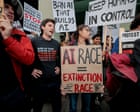
The rain in San Francisco does not fall so much as it hangs, a cold, gray mist that settles into the seams of your jacket and turns cardboard signs to pulp within the hour.
On a Tuesday morning in late 2026, a twenty-six-year-old junior copywriter—let’s call her Maya, a composite of the dozens of displaced creatives who showed up—stood outside a glass-and-steel building in the South of Market district. She was holding a piece of shipping box reinforced with silver duct tape. Written in thick black marker were four words: My brain wasn’t free.
Three thousand miles east, in Lower Manhattan, the opening bell had just rung. Inside the New York Stock Exchange, confetti was not falling, because institutional wealth prefers a quieter kind of celebration, though the numbers flashing across the electronic ticker boards carried the unmistakable roar of a coronation. Anthropic, the artificial intelligence safety and research company founded just five years earlier by a handful of idealistic defectors, had just crossed a two-trillion-dollar valuation on its public market debut.
Two trillion.
Pause on that number. Let it sit in your chest for a second. It is roughly the entire gross domestic product of Italy. It is more than the combined market value of every major airline, automaker, and legacy newspaper on the American continent. And it materialized on a trading floor while Maya’s sneakers soaked through on a wet sidewalk in California, and while another crowd gathered behind steel barricades outside the exchange in New York, chanting into the crisp autumn air.
If you read the standard financial dispatches from that day, the story looks neat, predictable, almost boring. Tech company goes public at a historic valuation; activist groups stage coordinated protests on both coasts citing labor displacement, copyright infringement, and existential risk. Stocks go up. Megaphones buzz. Police issue a dispersal order by four in the afternoon.
But those dry summaries miss the actual earthquake. They treat the street protests and the stock ticker as two separate news items happening in parallel, when in reality, they are the exact same story told from opposite ends of a widening chasm.
The Architecture of a Trillion-Dollar Ghost
To understand why people were willing to stand in the freezing rain to scream at a logo, you first have to understand what Wall Street was actually buying that morning.
When Standard Oil dominated the early twentieth century, you could see the empire. You could smell the crude, trace the steel pipelines across states, count the barrels rolling off the docks. When Apple crossed two trillion dollars a few years ago, you could hold the product in your palm, feel the machined aluminum, tap the glass.
What does two trillion dollars of Anthropic look like?
It looks like a blinking cursor in a white text box. It looks like miles of windowless data centers humming in the deserts of Nevada and the plains of Iowa, drinking river water to cool racks of silicon chips that run twenty-four hours a day. It is an invisible architecture built out of probability, statistics, and—this is the part that brought Maya to the sidewalk—the digitized residue of everything human beings have ever written, drawn, coded, or whispered into the public internet.
Think of it as the largest library in the history of our species, except the librarians never asked the authors for permission to take the books, ground the pages into a fine, statistical dust, and now charge the authors twenty dollars a month to buy back sentences made from their own pulp.
That is a metaphor, of course, though ask any illustrator, novelist, or software engineer watching their freelance rates collapse by sixty percent over the last twenty-four months, and they will tell you it feels uncomfortably literal.
I remember the first time I used an early version of these models a few years ago, sitting at my kitchen table at two in the morning. I asked it to draft a complex legal clause and then rewrite it in the cadence of a nineteenth-century sea captain. It took four seconds. I laughed out loud. It felt like magic—a clever parlor trick, a tireless intern trapped inside my laptop.
Nobody laughs like that anymore. The novelty curdled into something heavier the moment the parlor trick learned how to pass the bar exam, diagnose rare pathologies, write production-grade code, and draft marketing campaigns before a human creative director could finish their morning espresso.
What the Ticker Tape Cannot Measure
Outside the New York Stock Exchange, the crowd was a strange, volatile coalition that would have been unthinkable five years ago.
There were unionized screenwriters standing shoulder-to-shoulder with open-source software developers. Beside them stood climate activists holding banners tracking the gigawatt hours required to train a single frontier model, and twenty feet away stood a smaller, quieter contingent of AI safety researchers—people who actually understand the math inside the black box—holding signs warning against unregulated scaling.
Listen to the chants, and you hear the confusion of a society trying to name a threat it hasn't quite finished building yet.
“Whose data? Our data!”
“Pause the compute!”
“People over parameters!”
Wall Street analysts watching from forty stories up dismissed the gathering as Luddite theater. In their morning notes to institutional clients, the math was crystal clear and utterly seductive. Enterprise adoption of Anthropic’s Claude models had surged across Fortune 500 balance sheets. Banks were replacing entire tiers of junior analysts; insurance firms were automating claims processing; pharmaceutical giants were compressing years of molecular screening into weeks.
From a spreadsheet’s perspective, the company wasn’t just selling software. It was selling labor itself, stripped of health insurance, sick days, sleep, and negotiation. A two-trillion-dollar valuation wasn’t exuberance. To the men and women ringing the bell, it was simply the discounted present value of future human payrolls transferred cleanly onto corporate profit margins.
Here is the uncomfortable truth that makes this whole spectacle so hard to untangle: both sides are right.
The investors are right that this technology represents the most potent productivity engine since the electrical grid. When a rural clinic can access diagnostic reasoning that rivals a specialist at Johns Hopkins, or a solo entrepreneur in Manila can build and ship software that once required a thirty-person engineering team, real value is being created. Denying that is sticking your head in the sand.
Yet the protesters shivering behind the NYPD barricades are right about something deeper, something that never shows up in a quarterly earnings call. They are grieving the sudden devaluation of human effort.
For centuries, the implicit social contract of modern capitalism worked like this: if you spent twenty years mastering a craft—learning to write clean code, paint light on canvas, synthesize legal precedent, or translate languages—your skill had scarcity. Scarcity gave you leverage. Leverage bought you a house, put your kids through school, and gave your Tuesday mornings a sense of purpose.
Overnight, that scarcity evaporated.
The Paradox of the Safety Company
There is a particular, bitter irony in the fact that Anthropic became the lightning rod for this public fury.
Unlike some of its more swashbuckling competitors in Silicon Valley, Anthropic was born out of a conscience. Its founders left OpenAI in 2021 precisely because they worried the race toward artificial general intelligence was moving too fast, with too little regard for safety, alignment, and societal fallout. They structured the company as a Public Benefit Corporation. They published dense, earnest papers on "Constitutional AI," trying to teach machines to be helpful, honest, and harmless. They positioned themselves as the adults in the room.
So how does the adult in the room end up as the two-trillion-dollar villain on a wet cardboard sign?
Because gravity doesn't care about your mission statement.
Building frontier AI models is not like starting a software company in a garage. It is an arms race of capital. Training the next generation of models requires clusters of tens of thousands of specialized chips, custom-built power substations, and billions of dollars in upfront liquidity before a single dollar of revenue comes back. You cannot fund a ten-billion-dollar training run with good intentions and academic grants. You have to go to the titans of cloud computing, the sovereign wealth funds, and eventually, the public markets.
And the public markets do not buy patience.
Once you step onto that floor and accept a two-trillion-dollar valuation, your Constitution—no matter how noble its principles—has a silent co-author: the quarterly earnings expectation. Every researcher inside those San Francisco offices who wants to slow down a deployment to test for subtle psychological harms or labor shocks now has to argue against a stock price that assumes relentless, exponential growth.
Consider what happens next. When a company is worth two trillion dollars, it is no longer just a tech firm. It is systemic infrastructure. Pension funds, retirement accounts, and university endowments are suddenly tethered to its stock performance. If Anthropic slows down, your teacher’s pension dips. If Anthropic accelerates, your neighbor’s copywriting job disappears.
We have wired our financial survival to the very engine displacing our labor. That isn't a bug in the system. That is the trap.
The Invisible Stakes
I spent three hours talking to people on the fringes of the San Francisco rally before the rain finally drove everyone toward the Montgomery BART station. Most of them weren't radicals. They didn't want to smash servers with hammers.
One man, a forty-two-year-old localization specialist who had spent fifteen years translating video games and technical manuals from Japanese to English, pulled out his phone to show me his bank balance and his latest client email. The email was polite, automated, and final: the studio had moved its entire translation pipeline to an enterprise API, keeping only two editors on contract to clean up the machine's occasional idioms. His income had dropped by seventy percent in eight months.
"I'm not mad at the math," he told me, wiping water off his glasses. "I'm mad that nobody asked us if this was the trade we wanted to make. Three guys in a boardroom decided my career was an inefficiency to be optimized away, and now they’re billionaires."
Listen closely to that sentence. Nobody asked us.
That is the invisible stake running beneath the surface of the 2026 tech boom. Beneath the arguments over copyright law, energy grids, and stock valuations lies a raw, democratic deficit. Decisions that will permanently reshape how human beings earn a living, how children learn to think, how truth is verified, and how power is concentrated are being made by a tiny, insular priesthood of engineers and venture capitalists, ratified by institutional investors, and handed down to the rest of humanity as an inevitability.
When people feel powerless in the face of a force reshaping their lives, they don't write white papers. They make signs out of shipping boxes and stand in the rain.
By five o'clock in New York, the closing bell rang. Anthropic finished its first day of trading up fourteen percent, adding another two hundred and eighty billion dollars to its paper worth in six and a half hours—roughly ten million dollars for every protester standing outside the building.
In San Francisco, the mist finally turned into a steady downpour. The barricades came down. The crowds dispersed into the subway tunnels, their damp cardboard signs folded and stuffed into trash cans along Market Street, while ten floors above them, behind tinted glass, the servers kept humming in the dark.