Silence.
That is what greets you when you sit at the console of the Deep Space Network in Goldstone, California, waiting for a machine built during the Carter administration to answer a question you asked yesterday.
In November 2026, NASA's Voyager 1 crossed a threshold that makes the human mind ache to comprehend. Nearly half a century after lifting off from Cape Canaveral in September 1977, the aging spacecraft reached a distance of one light-day from Earth. Roughly 16 billion miles. Twenty-five point nine billion kilometers.
News tickers flashed the milestone in sterile bursts of telemetry. A headline here. A thirty-second clip there. Yet the numbers themselves feel curiously numb, like reading the temperature of a star on a spreadsheet while standing in a warm kitchen. To feel what one light-day actually means, you have to stop looking at the odometer and start watching the clock.
The Architecture of Patience
Consider a hypothetical flight controller named Elena, sitting in a dimly lit room at NASA's Jet Propulsion Laboratory in Pasadena. She was not yet born when Voyager 1 left the launchpad. Neither were most of the engineers keeping the spacecraft alive today.
On a Tuesday morning, Elena spots a subtle wobble in the spacecraft's attitude control system—a whisper of trouble across the interstellar dark. She drafts a command. A string of binary code, clean and surgical, designed to nudge a thruster that has been firing since disco ruled the radio. She hits send.
The signal leaves a massive dish antenna in the Mojave Desert, traveling at 186,282 miles per second. It is the fastest anything in this universe is permitted to move. There are no shortcuts. No warp drives. No cosmic backchannels.
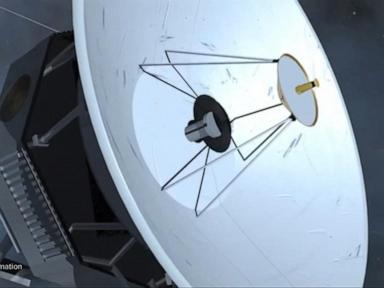
Elena goes home. She sits in Los Angeles traffic. She eats dinner, brushes her teeth, sets her alarm, and sleeps through the night. When she returns to her desk the next morning, the radio waves she sent have only just arrived at Voyager 1's twelve-foot dish antenna. The spacecraft receives the instruction, executes the tiny burst of hydrazine, and beams back a confirmation.
Then, Elena waits again.
Another commute. Another dinner. Another night of sleep. Forty-eight hours after she pressed a button on her keyboard, a faint, 23-watt signal—carrying less power than the bulb inside your refrigerator—washes over the California desert.
One light-day does not sound like much until you realize it turns every single conversation with our furthest emissary into a two-day cliffhanger.
Built From Scrap and Stubbornness
We like to imagine space exploration as a triumph of sleek, futuristic engineering. We picture chrome hulls and artificial intelligence humming behind glass.
Voyager 1 is nothing like that. It is an artifact of slide rules, eight-track tape recorders, and the sheer, terrifying audacity of 1970s optimism.
Its onboard computers carry roughly 69 kilobytes of memory. A single high-resolution photograph on the phone sitting in your pocket contains thousands of times more data than the entire digital brain guiding Voyager through interstellar space. Its wiring is wrapped in gold-colored Kapton foil to shield it from radiation, looking less like a starship and more like an intricate origami sculpture folded by frantic geniuses working on a tight deadline.
And it was never supposed to last this long.
The original mission was a grand tour of the outer planets—a four-year sprint past Jupiter and Saturn to capture close-up portraits of worlds that had previously been blurry smudges through terrestrial telescopes. When Voyager 1 whipped past Saturn's giant moon Titan in November 1980, its primary job was officially done. Everything since then has been overtime. Forty-six years of borrowed time.
I still remember the first time I saw the Pale Blue Dot photograph—the grainy, sun-streaked image Voyager 1 snapped from 3.7 billion miles away in February 1990, just before engineers switched off its cameras forever to save power. As a kid staring at that picture in a library book, I felt an unexpected wave of vertigo. Earth was not a sprawling continent of oceans and mountain ranges. It was a speck of dust suspended in a sunbeam, smaller than a single pixel.
That image changed how an entire generation understood geography. Reaching one light-day changes how we understand time.
A Ghost Ship on a Fading Battery
To appreciate the sheer absurdity of Voyager 1 still speaking to us in 2026, you have to understand how badly it wants to die.
Deep beyond the heliopause—the magnetic bubble blown by our Sun that shields the planets from raw cosmic radiation—there is no sunlight to harvest. Solar panels would be useless dead weight. Instead, Voyager runs on three radioisotope thermoelectric generators, canisters packed with plutonium-238 whose natural radioactive decay generates heat that thermocouples convert into electricity.
Every year, that plutonium loses a little more of its punch. The spacecraft loses roughly four watts of power annually.
Imagine trying to keep a freezing house warm by burning the furniture one chair at a time. That is the daily reality for the Voyager flight team. Over the decades, they have systematically shut down heaters, switched off instruments, and let parts of the spacecraft plunge to temperatures well below minus 100 degrees Fahrenheit—far colder than the hardware was ever tested to survive.
They are flying a ghost ship through a pitch-black ocean, rewriting software patches in archaic assembly language for a computer architecture that hasn't been manufactured since the Carter administration.
In late 2023, that fragility nearly ended everything. A single corrupted memory chip in the flight data subsystem scrambled Voyager's telemetry, turning its crisp scientific reports into an unreadable stream of repeating ones and zeros. For months, engineers stared at digital gibberish. You cannot send a mechanic sixteen billion miles into the dark. You cannot hit a physical reset button.
Working with a round-trip communication lag that stretched past forty-five hours, the team carefully dissected the memory dump, located the dead hardware, and sliced the critical code into smaller pieces—tucking them into scattered corners of remaining healthy memory like refugees hiding in an attic. By the spring of 2024, Voyager 1 was speaking clearly again.
It was one of the greatest feats of remote surgery in human history. And it happened across a gulf of space that grows wider by 38,000 miles every single hour.
The Invisible Stakes of a Dying Signal
Why spend millions of dollars and thousands of engineering hours nursing a half-century-old probe through its twilight years?
Critics occasionally ask what practical value comes from measuring the density of plasma sixteen billion miles from home. The question misses the point entirely, though the scientific return is real enough. Voyager 1 is our only pair of eyes outside the Sun's protective bubble. Everything we know about the raw interstellar medium—the soup of charged particles, magnetic fields, and cosmic rays drifting between the stars—comes from the trickle of bits arriving from Voyager 1 and its twin, Voyager 2.
Without Voyager 1, we would be guessing at how stellar winds collide with the galaxy. We would be blind to the true boundary of our solar neighborhood.
Yet the deeper stakes are not found in plasma physics. They live inside our own heads.
Human beings are terrible at thinking beyond a single election cycle, a quarterly earnings report, or a mortgage term. We build things to break so we can sell the replacement next autumn. We measure progress in software updates that render yesterday's hardware obsolete.
Voyager 1 is the exact opposite of everything our modern world teaches us to value. It is an intergenerational cathedral.
Think about the chain of human hands required to keep that faint radio signal alive. The men and women who designed Voyager's circuitry in the early 1970s are now in their eighties and nineties, or gone altogether. They handed the keys to a second generation of engineers who guided the probe past the outer giants and into the quiet dark. Those engineers, in turn, passed the manuals—some printed on fading dot-matrix paper—to young programmers who learned to code on smartphones.
Three generations of human beings have kept a promise to a machine they will never touch again.
What Happens When the Music Stops
We know how this story ends. There is no ambiguity in the physics of radioactive decay.
Sometime in the 2030s, the plutonium inside Voyager 1's generators will dip below the threshold needed to power its transmitter. One day, the Deep Space Network antennas in California, Spain, and Australia will turn toward the constellation Ophiuchus, listen for the familiar carrier wave, and hear only the natural hiss of the cosmos.
No explosion. No dramatic crash. Just a quiet, permanent disconnect.
Yet the spacecraft itself will not stop. Coasting through the frictionless vacuum of interstellar space at roughly 38,000 miles per hour, Voyager 1 will outlive the pyramids. It will outlive our languages, our borders, and quite possibly our species.
In roughly 40,000 years, it will drift within 1.6 light-years of a red dwarf star named Gliese 445. Millions of years after that, it will still be orbiting the center of the Milky Way, carrying its twelve-inch gold-plated copper phonograph record—the Golden Record—tucked against its side.
On that disc are the sounds of surf breaking on a shore, a mother's first words to her newborn child, Chuck Berry's "Johnny B. Goode," and the recorded greetings of Earth's people in fifty-five languages. Etched into the aluminum cover are instructions for playing the record and a pulsar map pointing back toward a small yellow star where curious creatures once looked up at the night sky and wondered what lay beyond the horizon.
Reaching one light-day is not a finish line. It is barely the end of the driveway. The nearest star system to our own, Alpha Centauri, sits more than four light-years away—over fifteen hundred times further than Voyager 1 has traveled in forty-nine years. At its current speed, the spacecraft would need seventy-five thousand years to cross that gap.
Space is so vast that our greatest triumph of distance barely registers as a rounding error on a galactic map.
That realization could make you feel small. It could make our triumphs seem trivial against the crushing weight of cosmic scale.
Or you can look at the clock in Pasadena, watch a twenty-four-hour timer tick down as a whisper of radio waves crosses sixteen billion miles of absolute zero, and marvel that anything born on this tiny rock ever learned to throw its voice that far into the dark.