Nature doesn't care about our calendars anymore. If you've been watching the skies over Pakistan and India lately, you know exactly what I mean. We're seeing a massive shift in how weather patterns behave across South Asia, and it's catching everyone from farmers to city planners off guard. Massive thunderstorms and heavy rain just tore through parts of Sindh, Punjab, and Balochistan in Pakistan, while Rajasthan and Gujarat in India dealt with similar chaos. This isn't just a bit of "weird weather" to chat about at lunch. It's a structural change in the region's climate.
The timing of these storms is the biggest red flag. We expect the monsoon much later. We expect dry heat during this window. Instead, people are waking up to lightning strikes, flash floods, and hailstones the size of marbles. It's messy. It’s dangerous. And honestly, the old ways of predicting these shifts aren't cutting it.
Why the Western Disturbance is acting out
The culprit behind this recent bout of unseasonal rain is something called a Western Disturbance. Usually, these are low-pressure systems that start over the Mediterranean Sea, travel across the Middle East, and dump moisture over the Himalayas. They’re supposed to provide the winter rain that keeps the wheat crops alive. By the time we hit the warmer months, they usually taper off or move further north.
That's not happening this year. Instead of fading away, these systems are sticking around and packing more punch because they're feeding off a warmer Arabian Sea. When cold air from the north meets that extra-moist, hot air from the south, you get an atmospheric explosion. That’s why the storms feel more violent. It isn't just rain; it's a high-energy event that the infrastructure in cities like Karachi or Jaipur just isn't built to handle.
Data from the Pakistan Meteorological Department (PMD) and the India Meteorological Department (IMD) shows that rainfall totals in these specific "off-season" events are sometimes hitting 200% or 300% above the monthly average in just forty-eight hours. You can't just drain that away. The ground is often too baked hard from the heat to absorb it, leading to the immediate runoff and flash flooding we've seen in the streets.
The devastating blow to regional agriculture
If you want to see the real tragedy of these unseasonal storms, look at the fields. Farmers in Pakistan’s Sindh province and India’s Punjab region are in a constant state of anxiety. This is the time when crops like wheat and mustard are either being harvested or are at a critical stage of maturity.
When a heavy storm hits right before harvest, it flattens the stalks. This is called "lodging." Once the wheat is on the ground, it’s nearly impossible to harvest mechanically, and the moisture makes the grain rot or sprout prematurely. This isn't just a loss of profit for the farmer. It’s a blow to national food security.
- Crop damage: Thousands of hectares of wheat, cumin, and mango orchards have been battered.
- Economic ripples: When supply drops, prices in the local mandis (markets) spike. Your grocery bill is directly tied to these storms.
- Livestock risks: Lightning strikes during these unseasonal bouts have killed hundreds of cattle across the border regions, which are a primary source of wealth for rural families.
I’ve talked to people who lost their entire year's income in a single afternoon of hail. They don't have insurance. They don't have a backup plan. The "unseasonal" part of the storm is what makes it so lethal—nobody was ready to protect the yields.
Urban chaos and the drainage failure
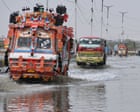
Our cities are death traps when these storms hit. You’ve seen the videos. Cars submerged in Lahore, traffic at a standstill in Ahmedabad, and power grids failing because a few trees fell over. The reality is that South Asian urban planning is still stuck in the 20th century. We build over natural drainage veins and then act surprised when the water has nowhere to go but into our living rooms.
The intensity of these storms is a "force multiplier." If you have a city with a drainage system designed for 20mm of rain and you dump 80mm in three hours, the system fails. It's math. But we also have the issue of plastic waste clogging every available outlet. These unseasonal storms turn streets into rivers of trash.
Public safety is another massive concern. Wind speeds during these recent events have topped 80 kilometers per hour. That’s enough to rip down those giant, poorly secured billboards you see everywhere. In several districts, the primary cause of death hasn't been drowning, but rather structural collapses or electrocution from downed power lines. It’s a grim reminder that our "modern" cities are incredibly fragile.
The Arabian Sea is the engine room
We have to talk about the water. The Arabian Sea is warming faster than almost any other part of the global ocean. This heat acts like fuel for any storm passing by. It’s why we’re seeing more cyclones and why these Western Disturbances are becoming so much more erratic.
In the past, the sea was cool enough to keep these systems in check. Now, it’s a boiling pot. This extra heat means more evaporation, which means more water in the clouds, which means more intense downpours. Scientists at the Indian Institute of Tropical Meteorology have been screaming about this for years. They’ve pointed out that the frequency of extreme weather events in the region is rising, even if the total amount of annual rain stays roughly the same. We’re getting all our rain at once, in violent bursts, instead of spread out over a healthy season.
How to actually prepare for a shifting climate
Waiting for the government to fix the drainage isn't a strategy. If you live in these affected zones, you need to change how you approach the "transition" months between winter and summer. The old rules are dead.
First, stop trusting the calendar. If the forecast mentions a Western Disturbance, take it seriously even if it’s "not the season" for rain. Secure your roof, clear your immediate gutters of plastic, and make sure you have a backup power source that isn't dependent on the main grid.
For those in agriculture, the shift toward climate-resilient seeds is no longer optional. Some varieties of wheat are shorter and have thicker stalks, making them less likely to fall over in high winds. It’s also time to look at better weather-indexed insurance. If the weather is going to be this unpredictable, the only way to survive financially is to hedge against the risk.
Governments need to stop treating these as "emergency" events and start treating them as the new baseline. This means banning construction on floodplains and actually enforcing it. It means upgrading the grid to withstand high-velocity winds. The storms aren't going back to their old schedule. We have to be the ones who adapt.
Check your local weather apps daily and look specifically for "convective activity" alerts. These are the indicators that a simple cloudy day could turn into a destructive storm in less than an hour. Keep your devices charged and your emergency kits ready during these bridge months. The weather has changed, and it’s time we caught up.