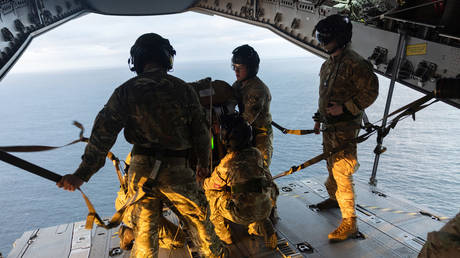
The British Army just pulled off a high-stakes medical evacuation that looks more like a Hollywood thriller than a standard training exercise. When a suspected hantavirus case appeared on a remote island, the military didn't send a boat. They dropped medics out of a plane. Most people don't realize how rarely these specialized units are deployed for civilian medical emergencies, but this specific mission highlights exactly why the UK maintains these elite capabilities.
Hantavirus isn't something you want to mess with in a remote setting. It's a respiratory disease often carried by rodents. If it turns into Hantavirus Pulmonary Syndrome (HPS), the mortality rate can climb toward 38%. When you're stuck on an island with limited medical infrastructure, waiting for a ferry isn't an option. You need boots on the ground. You need them now.
Why the British Army chose parachutes over helicopters
Most folks ask why they didn't just fly a Merlin or a Wildcat helicopter to the site. Helicopters are great, but they've got limits. Range is the big one. If an island is far enough offshore or the weather is acting up, a rotary-wing aircraft might not have the legs to get there and back safely without refueling.
Fixed-wing transport planes can fly faster and further. By dropping medics from a C-130 or similar craft, the British Army ensures that life-saving care arrives hours before a ship could dock. These medics aren't just your average first-aid responders. They're part of 16 Air Assault Brigade, trained to stabilize patients in "austere environments." That's military-speak for "places that have absolutely nothing you need to survive."
I've seen these units train. They carry everything on their backs—ventilators, monitors, and drugs that usually stay locked in a hospital ward. They're essentially a walking Intensive Care Unit. In this case, the mission wasn't just about the jump. It was about the specialized knowledge required to handle a biosafety risk like hantavirus.
Understanding the hantavirus threat in the wild
Hantavirus is scary because it's sneaky. You don't get it from a person coughing on you. You get it from breathing in dust contaminated by rodent droppings or urine. On a remote island, where mouse and rat populations can explode without natural predators, the risk is higher than you’d think.
Early symptoms feel like the flu. Fever, aches, fatigue. You might think you've just got a bad cold. But then your lungs start filling with fluid. That's the HPS phase. Once that starts, the clock is ticking. The British Army medics had to arrive prepared for the worst-case scenario. They weren't just there to check a pulse. They were there to keep someone breathing until a full-scale extraction could happen.
The military's involvement suggests the civilian authorities reached the end of their rope. In the UK, this usually happens through a Military Aid to the Civil Authorities (MACA) request. It's not a decision made lightly. It means the situation is grave enough that only the military's specific "vertical insertion" skills can solve the problem.
The logistics of a remote island drop
Dropping people onto an island isn't like hitting a target in a field. You've got crosswinds, rocky terrain, and the very real possibility of landing in the drink.
The team would've analyzed the Drop Zone (DZ) with incredible precision. They use specialized chutes that allow for high levels of maneuverability. This isn't the old-school "round" parachute where you're at the mercy of the wind. These guys use "squares" or RAM-air chutes. They can steer. They can land on a dime, even if that dime is a narrow strip of beach between a cliff and the Atlantic.
What the medics bring to the fight
- Portable Oxygen: Essential for HPS cases.
- PPE: They have to protect themselves from the virus while treating the patient.
- Satellite Comms: To coordinate with the mainland for the eventual extraction.
The video footage of the jump shows the sheer isolation of the area. It's beautiful, sure. But it's also a death trap if your lungs are failing.
Reality check on hantavirus risks for the public
Don't start panicking about every mouse in your shed. While hantavirus is serious, it's relatively rare in the UK. We usually see "Hantaan" or "Dobrava" strains in Europe, which often cause Hemorrhagic Fever with Renal Syndrome (HFRS). It's still nasty, but it's different from the North American strains that primarily attack the lungs.
The island mission was likely a "better safe than sorry" play. When a virus with a high kill rate is suspected, the response has to be massive. If it turns out to be something else, great. If it is hantavirus, you've already got the experts on-site.
What happens after the medics land
Once the team hits the ground, the "golden hour" begins. They have to find the patient, set up a sterile environment, and start an assessment. They're likely using portable diagnostic kits that can rule out other issues like sepsis or standard pneumonia.
The jump was just the beginning. The hard part is the "stay-behind" phase. These medics might be on that island for 24 to 48 hours if the weather prevents a boat or helicopter from getting in for the final lift. They have to live out of their bags, manage the patient, and stay vigilant against the same rodents that caused the problem in the first place.
How to stay safe in remote areas
If you're heading to remote islands or old cabins, don't be a hero with a broom. If you see rodent droppings, don't sweep them up. You'll just kick the virus into the air where you can breathe it.
Wet the area down with bleach and water first. Wear a mask. It sounds like overkill until you're the one watching a C-130 circle overhead. The British Army proved they can reach anyone, anywhere. But you'd probably prefer not to meet them because you inhaled a bit of dusty mouse poop.
Keep your food in sealed containers and don't sleep directly on the floor of old structures. These are simple steps, but they're the difference between a great trip and a military medical evacuation. If you start feeling sick after being in a rodent-heavy area, tell the doctor exactly where you've been. Speed is everything.