Most people assume a federal lawsuit automatically freezes a massive construction project in its tracks. It doesn't.
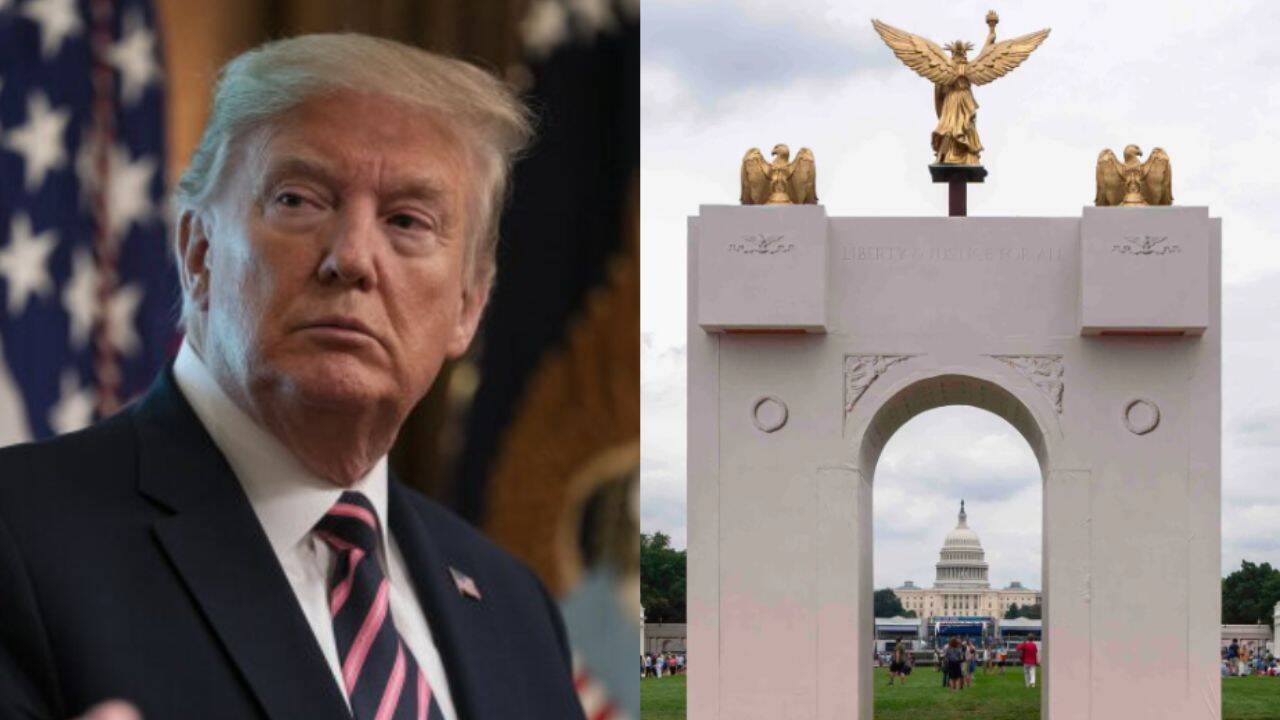
Unless a judge explicitly grants a temporary restraining order or a preliminary injunction, dirt keeps moving, permits keep processing, and steel gets ordered. That is the exact reality surrounding the proposed 250-foot memorial arch tied to Donald Trump's America 250 initiatives, which has been slated for potential groundbreaking around November 5 even while litigation sits unresolved on a federal docket.
If you've been following the headlines, you've probably seen plenty of outrage from both sides. Supporters view the towering monument as a bold tribute to the nation's 250th anniversary. Critics call it an eyesore, an executive overreach, or an environmental headache. Almost nobody is talking about the actual procedural mechanics that allow a project of this scale to reach a November 5 construction start date while lawyers are still arguing in court.
I've spent years tracking federal infrastructure disputes and National Park Service (NPS) permitting battles in Washington, D.C. When you strip away the partisan noise, this fight comes down to three things: statutory authority under the Commemorative Works Act, how federal agencies sequence environmental reviews, and the brutal math of civil litigation timelines.
How a 250-Foot Monument Moves Forward During an Active Lawsuit
Filing a complaint in federal court is easy. Stopping a bulldozer is hard.
When preservation groups or environmental coalitions sue to block a federal monument, they almost always file under the Administrative Procedure Act (APA). Under the APA, plaintiffs argue that a federal agency—such as the Department of the Interior or the National Park Service—acted "arbitrarily and capriciously" or skipped mandatory review steps.
Here is what most news coverage misses about how these cases actually play out. Simply filing an APA lawsuit does not pause the agency's decision. The agency's approval remains legally valid and active unless the plaintiffs clear a very high legal bar to obtain injunctive relief.
To get a preliminary injunction before November 5, the challengers have to prove four specific things to a federal judge:
- They are likely to succeed on the merits of their underlying legal claim.
- They will suffer "irreparable harm" if construction begins before the case is decided.
- The balance of equities tips in their favor.
- An injunction is in the public interest.
That second prong—irreparable harm—is usually where plaintiffs win or lose early. If the November 5 start date only involves site surveying, soil boring, utility relocation, or staging fencing, government lawyers will argue that no permanent damage is occurring. Judges routinely refuse to halt early site prep when the irreversible pouring of concrete or destruction of historic sightlines is still months away.
The Commemorative Works Act and Why Height Matters
Washington, D.C. has some of the strictest architectural and commemorative rules on the planet. You can't just drop a 250-foot structure anywhere near the National Mall without running into a buzzsaw of federal commissions.
Under the Commemorative Works Act of 1986, Congress tightly regulates where monuments go, how they are funded, and who approves their design. Normally, establishing a major new commemorative work in the capital's core requires explicit congressional authorization, site selection approval from the National Capital Planning Commission (NCPC), and aesthetic sign-off from the U.S. Commission of Fine Arts (CFA).
To put 250 feet into perspective, consider the surrounding D.C. skyline. The Lincoln Memorial stands roughly 99 feet tall. The U.S. Capitol dome reaches about 288 feet. Even the Washington Monument—which towers above everything at 555 feet—is governed by strict visual buffer zones meant to keep the monumental core open and uncluttered. A 250-foot arch rivals the height of a 22-story commercial office building.
That sheer scale is why the legal challenges focus heavily on sightlines and historic preservation. Under Section 106 of the National Historic Preservation Act (NHPA), federal agencies must evaluate how any major undertaking affects nearby historic properties. Critics argue that pushing toward a November 5 mobilization compresses or bypasses the genuine consultation period required under Section 106. Project backers counter that the anniversary timeline demands decisive action and that statutory review boxes have already been checked through executive directives and existing statutory authorities.
Why November 5 Is Such a Loaded Target Date
Dates in Washington are rarely accidental. Targeting November 5 for the start of construction carries obvious political and symbolic weight, falling right after early November election cycles and positioning the build ahead of peak America 250 celebrations.
From a construction management standpoint, starting in early November also makes practical sense—and creates a strategic advantage in court.
In the Mid-Atlantic region, November marks the narrow window before deep winter frost sets in. Contractors rush to complete clearing, grading, and deep foundation caisson work before January and February freezes drive up costs and stall concrete pours. Once heavy machinery is mobilized and subcontracts are executed, the legal calculus shifts dramatically.
In federal court, "facts on the ground" matter. When millions of dollars in mobilization costs have already been spent, government attorneys argue that halting work wastes taxpayer or donor money and disrupts vetted schedules. Even if a judge eventually finds a procedural flaw in the environmental review, courts sometimes decline to vacate an approval if construction is already substantially underway, opting instead to order the agency to fix its paperwork while work continues.
What Critics Get Wrong About Monument Funding
One of the biggest misconceptions floating around social media is that taxpayers are automatically writing a blank check for every dollar of a 250-foot arch.
Historically, major commemorative projects in the capital rely heavily on private fundraising paired with federal land administration. Under standard Commemorative Works Act frameworks, sponsoring foundations must raise private capital not only for design and construction, but also an additional percentage—typically 10 percent of the construction cost—deposited into a federal maintenance account so taxpayers aren't stuck with the upkeep bill decades later.
Where federal money does enter the picture is infrastructure integration, security perimeters, NPS oversight, and site preparation if the project is folded into broader America 250 federal programming. Opponents in the pending lawsuit have scrutinized whether public funds or federal agency staff hours are being used prematurely before all statutory conditions are satisfied. Those financial accounting questions often give plaintiffs better traction in court than aesthetic complaints about whether a 250-foot arch looks good or bad. Judges don't rule on architectural taste. They rule on statutory compliance and appropriations law.
The Role of NEPA and Environmental Review Shortcuts
Alongside historic preservation rules, the National Environmental Policy Act (NEPA) is the sharpest weapon in any plaintiff's toolkit against a November 5 groundbreaking.
NEPA doesn't forbid the government from building massive structures. It simply forces agencies to look before they leap—analyzing traffic impacts, stormwater runoff, soil disturbance, tree canopy loss, and local congestion before approving a project.
When an administration wants to move fast on a signature build, agencies often rely on an Environmental Assessment (EA) resulting in a "Finding of No Significant Impact" (FONSI), rather than spending two to three years drafting a full Environmental Impact Statement (EIS). Or, where applicable, they look for categorical exclusions for specific early-stage site activities.
That speed creates vulnerability. In federal court, plaintiffs attack a FONSI by pointing to the unprecedented height of the 250-foot arch and arguing that a structure of that magnitude inherently creates significant visual, traffic, and environmental impacts that require a full EIS. If the judge agrees that the agency took a shortcut on NEPA, that is the one scenario where a last-minute injunction could actually stop work right around November 5.
How You Can Track the Case and Permits Yourself
You don't have to rely on partisan pundits or vague headlines to see whether construction actually starts on schedule or gets blocked by a court order. Federal permitting and court dockets leave a clear public paper trail if you know where to look.
First, check the public meeting agendas and project files of the National Capital Planning Commission (ncpc.gov) and the U.S. Commission of Fine Arts (cfa.gov). Both agencies publish staff reports, architectural renderings, height analyses, and formal approval letters online before any permanent vertical construction can legally proceed on federal land in the capital region. If a project hasn't cleared final site and building plans on those dockets, any November 5 activity is strictly limited to preliminary site prep.
Second, look up the underlying civil docket through PACER (Public Access to Court Electronic Records) or free court-tracking mirrors like CourtListener. Search the docket for the phrase "Motion for Preliminary Injunction" or "Temporary Restraining Order." Until you see a signed order from a federal district judge granting one of those two motions, the legal challenge remains a background battle—and the November 5 construction timeline stays alive.