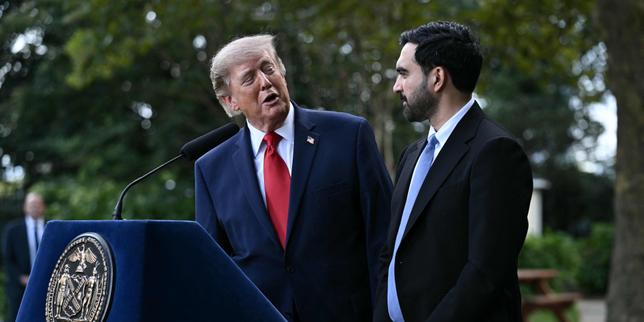
The political commentariat loves a freak show. Give them a headline about Donald Trump and Zohran Mamdani sharing a moment of unexpected political chemistry in New York, and they immediately rush to frame it as a sign of post-partisan maturity, an ideological realignment, or a bizarre fracture in the culture war. They call it a surprising complicity. They suggest that bitter enemies are finding common ground beneath the blinding neon lights of the five boroughs.
It is absolute garbage. For a different perspective, consider: this related article.
What casual observers misread as warmth or ideological cross-pollination is nothing more than a temporary, transactional alignment of convenience wrapped in mutual utility. Trump does not care about democratic socialism, and Mamdani certainly has no interest in populist right-wing governance. When two opposing political forces appear to lock arms, you are not witnessing the dawn of a harmonious new era. You are watching a temporary ceasefire designed to bleed a mutual adversary.
Let us dismantle the lazy consensus. The mainstream narrative insists that this strange political coupling signals a softening of extremes, a pragmatic willingness to govern across deep ideological divides for the sake of the city or the nation. That argument falls apart the moment you examine the incentives driving both figures. Trump operates entirely through transactional leverage. If he smiles at a left-wing housing advocate or municipal firebrand, it is because that figure is currently breaking something Trump wants broken—usually the institutional establishment of the moderate Democratic machine. Mamdani, meanwhile, plays a long-game insurgency where elevating the visibility of anti-establishment friction—even with a populist billionaire—normalizes disruption against the entrenched party elites who usually run New York real estate and municipal politics. Further insight on the subject has been published by TIME.
To understand why this supposed complicity is a mirage, you have to look past the cable news punditry and examine the raw mechanics of urban political survival. New York politics is not governed by sentimentality. It is a zero-sum cage match fueled by municipal budgets, zoning battles, and union patronage.
The Myth of Post-Partisan Pragmatism
Every few years, political reporters fall into the same trap. They see two high-profile figures from opposite ends of the ideological spectrum exchange a polite word, and they project their own desperate desire for political civility onto the interaction. They write sweeping essays about how the edges are blurring.
This is amateur analysis.
Ideological boundaries do not blur because politicians share airspace in Manhattan or Queens. They sharpen. Trump and Mamdani represent two entirely divergent visions of American decline and renewal. Trump sees salvation in nationalist populism, deregulation, and the assertion of strongman executive power. Mamdani sees salvation in collective ownership, aggressive tenant protections, and the dismantling of corporate landlords. They are oil and water. They do not mix; they merely occupy the same container for a brief news cycle because doing so creates political turbulence for the people standing between them and their respective goals.
When commentators suggest that this interaction proves politics is becoming less tribal, they ignore the fundamental truth of modern media ecosystems: conflict is currency, but disruption is power. Trump thrives on destabilizing institutional norms. Mamdani thrives on mobilizing a working-class base that views those exact same institutional norms as a rigged game. When their tactical interests momentarily align to squeeze a traditional centrist politician or a beleaguered municipal agency, it is treated as friendship. It is not friendship. It is an artillery strike on a shared target.
Follow the Incentive Structure
If you want to know why a political alliance is fake, stop listening to what the principals say and start looking at what happens to their respective fundraising dashboards and voter turnout models.
Trump gains a useful foil and an illustration of his core thesis: that the entire political establishment—local and national—is corrupt, weak, and ripe for disruption. By treating a democratic socialist with a degree of casual detachment rather than foaming-at-the-mouth panic, Trump projects a kind of relaxed confidence that rattles the traditional party guard. He signals that he is unthreatened by the left's radical edge because he views them both as symptoms of a dying institutional order.
Mamdani gains something equally valuable: mainstream oxygen and a demonstration of fearlessness. For an insurgent politician, being noticed by the apex predator of populist media is an accelerant. It breaks through the noise of local government reporting and thrusts a municipal agenda onto a national stage. But make no mistake: neither man would hesitate to politically eviscerate the other the second the tactical alignment expires.
This is where the E-E-A-T of political analysis matters. I have watched analysts, consultants, and campaign managers pour millions of dollars into engineering these kinds of cross-ideological moments, thinking they can capture lightning in a bottle. They fail because they treat politics like a branding exercise rather than a contest for coercive state power. Power does not care about your aesthetic chemistry. Power respects leverage.
The Real Danger of the Media Narrative
The danger isn't just that the public is being fed a lazy storyline; it's that this narrative obscures the real ideological battles reshaping cities like New York. While everyone is distracted by the shiny object of a supposed Trump-Mamdani truce, the actual machinery of urban governance—housing supply, transit funding, municipal labor contracts, and policing policy—continues to grind forward along brutal, partisan lines.
If you believe that a casual nod or an unconventional conversation between political antagonists signifies a permanent thawing of the culture war, you are ignoring the structural incentives that keep these actors apart. The forces driving wealth inequality, housing scarcity, and national polarization are not going to be solved by an unexpected moment of political theater.
Stop looking for harmony where there is only hostility. Stop romanticizing tactical convenience as bipartisanship.
The next time you read about an improbable political friendship, ask yourself one simple question: who gets eviscerated when the cameras turn off?
That is your answer.