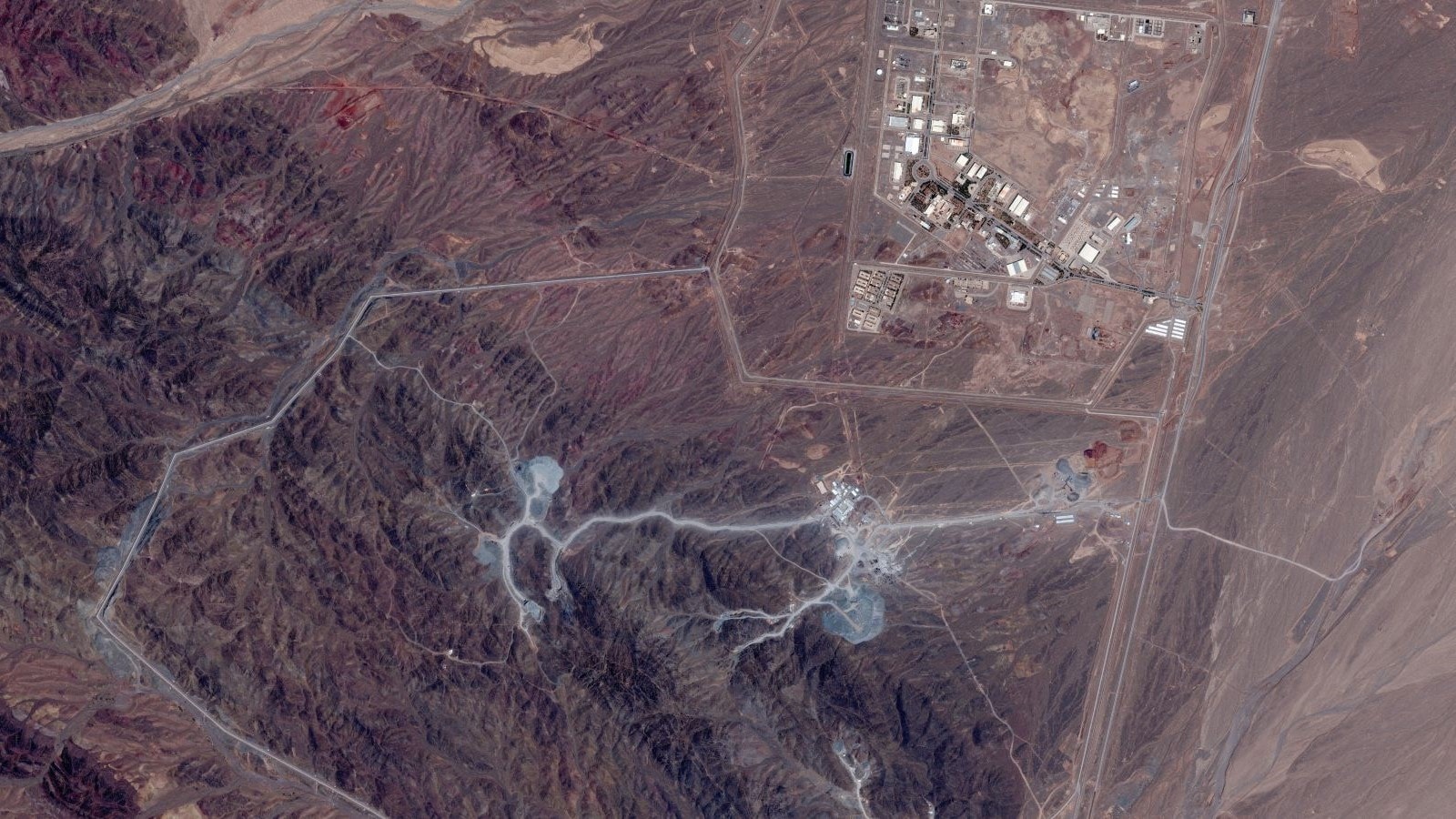
Donald Trump says he wants to hit it with a "nice big fat shot right in the front door." He's talking about Pickaxe Mountain, a secretive Iranian underground facility that has suddenly landed squarely in the crosshairs of American foreign policy.
But here is the reality check most commentators are missing. You can't just blow up a fortress buried up to 600 meters under solid granite. While political rhetoric makes it sound like a simple game of targeted airstrikes, the physics of military hardware say otherwise. You might also find this similar story insightful: The Great Illusion of the India Europe Strategic Alliance.
The sudden focus on this hidden site comes as the fragile April ceasefire between Washington and Tehran collapses. With military tensions hitting a boiling point and maritime traffic in the Strait of Hormuz choking under fresh blockades, Pickaxe Mountain is no longer a footnote in intelligence briefs. It is the epicenter of a looming confrontation.
What is Pickaxe Mountain anyway
Known locally in Farsi as Kūh-e Kolang Gaz Lā, Pickaxe Mountain is an ultra-hardened underground complex situated in Iran's Isfahan Province. It sits just a mile or so south of the main Natanz uranium enrichment hub, a site that has been the focal point of Iran’s nuclear ambitions for over two decades. As extensively documented in detailed reports by The Guardian, the implications are worth noting.
Iran started digging into the mountain back in late 2020. Satellite imagery captured massive excavation efforts, heavy engineering machinery, and the slow development of heavily reinforced tunnel portals. For years, Tehran has maintained a public stance that the location is merely a centrifuge assembly plant.
Western intelligence agencies don't buy that story for a second. Analysts suspect the sprawling underground galleries are designed to house an undeclared uranium enrichment plant or a secure vault for near-weapons-grade uranium stockpiles.
The big issue? Nobody from the outside has ever actually seen the inside.
Tehran has continually barred the International Atomic Energy Agency (IAEA) from accessing the site. Because Iran hasn't officially declared it as an active enrichment facility, UN inspectors have zero footprint there. We are looking at a completely dark zone, monitored entirely through the lenses of passing spy satellites.
Why the site survived previous bombing campaigns
If you listen to the administration's speeches, you might wonder why this place is still standing. Trump previously boasted that the air campaigns of 2025 had utterly "obliterated" Iran’s nuclear footprint.
Except they didn't. Pickaxe Mountain went completely untouched during Operation Midnight Hammer in June 2025 and escaped damage again during Operation Epic Fury earlier this year.
There are two major reasons this fortress survived the initial waves of B-2 stealth bombers and Tomahawk missiles:
- It wasn't operational yet: During the 2025 strikes, intelligence assessments indicated the complex wasn't fully functional. Military planners focused their heavy ordnance on active enrichment facilities like Fordow and Natanz instead.
- The granite shield: Fordow is buried roughly 90 meters deep. Pickaxe Mountain laughs at those numbers. Estimates suggest its deepest chambers sit anywhere from 100 to 600 meters down, protected by a massive ceiling of solid granite.
Granite has a massive compressive strength compared to the softer limestone and dolostone structures shielding other Iranian installations. It absorbs, dampens, and disperses kinetic shock waves with terrifying efficiency.
The physics of bunker busting vs solid rock
Let's look at the math facing military planners. The apex predator of the American conventional arsenal is the GBU-57 Massive Ordnance Penetrator (MOP). It's a 30,000-pound monster designed specifically to punch through reinforced concrete and earth before exploding.
But even the GBU-57 has hard physical limits. Experts note that its maximum penetration depth tops out around 200 feet (about 60 meters) of standard earth and rock, or roughly 20 feet of heavily reinforced concrete.
Do the quick conversion. Sixty meters of penetration capacity doesn't do much against a facility buried under hundreds of meters of premium granite. Iranian parliamentary adviser Mehdi Mohammadi even went on the record calling the complex completely "untargetable," claiming US military documents back up that assertion.
Does that mean Pickaxe Mountain is completely immune? Not exactly.
You don't need to crack open an underground chamber like an egg to take it out of commission. A military strike doesn't have to vaporize the centrifuges; it just needs to make the facility unusable.
A concentrated air campaign could easily target the open tunnel portals, crater the access roads, collapse the ventilation shafts, and cut off external power connections. If you seal the doors and choke out the air supply, a high-tech underground bunker effectively becomes a very expensive, deeply buried tomb.
The immediate diplomatic and military fallout
The real danger here isn't just a technical question of bombs versus rock. It's what happens the moment those weapons are released.
The Foundation for Defense of Democracies recently pointed out that satellite data from late June shows accelerating vehicle activity around the western tunnel portals. Iran is rushing to harden the entrances and finish internal construction, clearly signaling they are violating the nuclear status quo outlined in the June 17 Memorandum of Understanding.
If the US chooses to strike Pickaxe Mountain's "front door," any hope of a diplomatic resolution evaporates instantly. Tehran has already shown its hand by choking maritime corridors, and a direct hit on their most prized military engineering project would likely trigger an uncontained regional escalation.
Worse yet, a partial strike leaves us completely blind. If American forces crater the entrances without actually destroying the materials inside, verifying what survived becomes impossible. Iran could easily use the chaos to continue refining its estimated 440 kilograms of near-weapons-grade uranium entirely out of view of global intelligence.
Keep a close eye on satellite imagery updates and regional troop movements over the coming weeks. The technical reality says Pickaxe Mountain can't be easily erased from the map, but the political reality suggests someone might try anyway. Anyone tracking global energy markets or Middle Eastern defense strategies needs to treat this hidden ridge as the ultimate geopolitical tripwire.
:max_bytes(150000):strip_icc():focal(749x0:751x2)/auschwitz-2-691cb034ee9e43cfa45a0969012c6337.jpg)