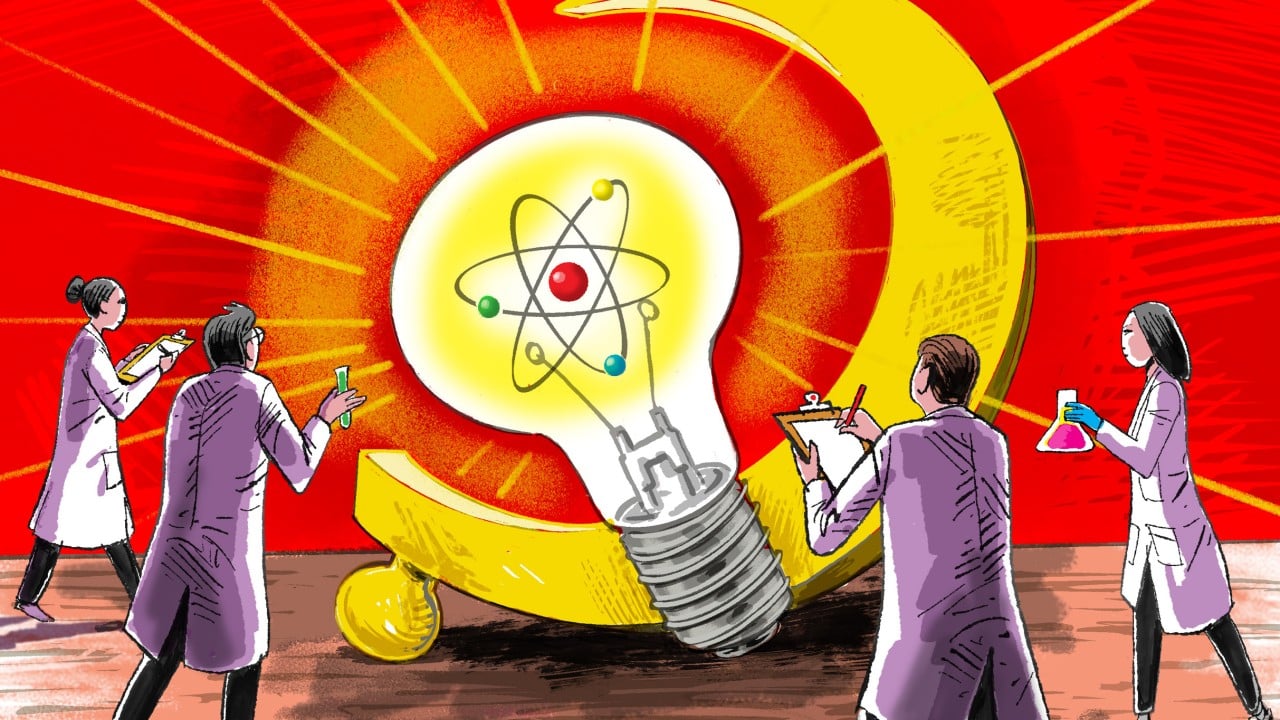
China is shifting its entire economic engine from mass manufacturing to fundamental frontier science because Beijing realizes its current tech dominance is built on sand. For decades, the nation excelled at scaling up existing technologies, refining solar panels, dominating electric vehicle supply chains, and assembling consumer electronics. However, true geopolitical resilience requires owning the underlying scientific discoveries, not just the factories. This strategy demands a total overhaul of how the country funds research, treats intellectual property, and manages its academic institutions. The transition is already underway, but the cost of failure is astronomical.
The Vulnerability of the Factory Floor
Western analysts frequently misjudge China's technological trajectory by focusing on consumer apps or factory output. This focus misses the point entirely. While apps like TikTok capture global attention, Chinese policymakers view them as superficial layer achievements. They know that as long as the underlying operating systems, semiconductor architecture, and core scientific instruments remain imported, the entire apparatus is vulnerable to external choking points.
The strategy relies on achieving self-sufficiency in foundational disciplines. We are talking about quantum computing, synthetic biology, materials science, and deep-sea exploration. These fields do not yield immediate quarterly profits. They require decades of patience and capital that would make traditional venture capitalists turn pale.
Consider the semiconductor bottleneck. When restrictions cut off access to advanced lithography machines, the limitation was not a lack of engineering will. It was a lack of foundational physics and precision optics mastery. Beijing’s response was not merely to build more fabrication plants, but to dump billions into national laboratories tasked with reinventing the physics of light manipulation. This is a structural pivot from applied engineering to pure, raw science.
The Blueprint of the National Laboratory System
To understand this transformation, look at how the central government is reorganizing its scientific apparatus. The old model relied heavily on the Chinese Academy of Sciences and a fragmented network of universities competing for the same pool of state funds. This created duplication, bureaucratic infighting, and a culture focused on safe, incremental papers rather than high-risk breakthroughs.
The new model centers on a highly centralized national laboratory system.
Old Model: Fragmented Universities -> Safe Research -> Incremental Papers
New Model: Centralized National Labs -> High-Risk Capital -> Deep Tech Monopoly
These mega-facilities are designed to bypass university bureaucracy. They are given massive budgets, direct lines to the state council, and a mandate to pursue "hard tech."
- Quantum Information Science: Facilities in Hefei are not just building quantum cryptography networks; they are attempting to define the international standards for quantum computing hardware.
- Deep Earth and Deep Sea Exploration: Research vessels and boring equipment are pushing physical boundaries to secure rare earth elements and map out resource dependencies before the decade ends.
- Synthetic Biology: Hubs in Shenzhen are engineering microbes to replace petrochemicals in manufacturing, aiming to decouple the industrial base from foreign oil.
This approach treats scientific discovery like a military campaign. Personnel are deployed to specific bottlenecks. Funding is guaranteed for a decade rather than reviewed annually. It is an industrial policy applied to the laws of nature.
The Cultural Crisis in Chinese Academia
Money cannot solve every problem. The biggest obstacle to China's scientific ambitions is its own deeply entrenched academic culture. For a generation, Chinese scientists were evaluated on a metric known as the "SCI count"—the number of papers published in Science Citation Index journals.
This system incentivized gaming the metrics. Researchers focused on safe, derivative studies that were guaranteed to pass peer review rather than tackling high-risk, high-reward questions that might end in failure.
Metric Driven: High Publication Volume + Low Scientific Risk = Bureaucratic Success
Frontier Driven: Low Publication Volume + High Failure Rate = Geopolitical Breakthrough
The state has explicitly ordered the dismantling of this "paper mill" culture. Evaluation criteria are shifting toward practical problem-solving and true originality. But changing the mindset of hundreds of thousands of academics who grew up in a rigid, hierarchical system is proving remarkably difficult. Younger researchers still complain that senior professors, who built their careers on the old system, continue to block unconventional ideas.
Furthermore, true frontier science thrives on open exchange, dissent, and global collaboration. The current political climate creates an environment of intense caution. When scientists fear that a misstep or an unauthorized international connection could end their career, they default to conformity. Conformity is the death of scientific innovation.
The IP Theft Pivot
For years, the Western narrative around Chinese tech was simple: copy, paste, scale. While that was true during the internet boom of the 2010s, it is a dangerous misreading of the current environment. Today, the focus has shifted toward building a domestic intellectual property regime that is ruthlessly enforced.
China established specialized intellectual property courts that handle patent disputes with surprising speed and efficiency. The goal is not just to protect foreign companies—though foreign firms win a high percentage of cases there—but to protect domestic innovators from being undercut by local copycats. If a domestic startup spends five years developing a new solid-state battery material, they need to know a rival factory down the road cannot simply steal the formula with impunity.
This domestic IP enforcement is the scaffolding for frontier science. Without it, private capital will never flow into deep tech. The state knows it cannot fund everything; it needs the private sector to take the scientific breakthroughs from the national labs and commercialize them.
The Talent Reverse Brain Drain
Historically, China's best and brightest left for doctoral programs in the United States or Europe and stayed there. That pipeline is reversing. A mix of aggressive domestic recruiting programs and an increasingly hostile political environment in Western democracies is driving top-tier scientific talent back home.
These are not just entry-level postdocs. These are tenured professors, lab directors, and principal investigators who are bringing entire research agendas with them.
What the Returnees Bring Home
- Established Networks: Connections to global labs that keep Chinese research integrated with international benchmarks.
- Methodological Rigor: Experience in running peer-review processes and managing multi-disciplinary teams without bureaucratic interference.
- Advanced Equipment Know-How: Deep familiarity with the exact specifications of the scientific instruments needed to run frontier experiments.
The state provides these returning scientists with immediate access to massive funding, state-of-the-art facilities, and housing subsidies that Western universities simply cannot match. A mid-career physicist in the West might spend 40% of their time writing grant proposals just to keep their lab running. In Hefei or Suzhou, they are handed a fully equipped lab and told to build.
The Venture Capital Alignment Problem
In the West, venture capital chases software, consumer platforms, and artificial intelligence wrappers that promise quick returns. China’s venture capital ecosystem has been forcibly realigned by state decree. The era of funding consumer delivery apps or fintech platforms is over.
Today, if a Chinese venture fund wants to survive, it must align its portfolio with the state's five-year plans. This means capital is flowing into industrial software, advanced materials, and biotech.
This creates a unique distortion. You have massive amounts of private money chasing very early-stage, highly speculative scientific projects. The risk of asset bubbles is extreme. Dozens of under-qualified companies are slapped with the "deep tech" label just to secure funding.
Yet, even if 90% of these state-steered startups fail, the remaining 10% will possess the capabilities to dominate their specific niches globally. The sheer volume of capital ensures that some breakthroughs will cross the chasm from lab to market.
The Instruments of Science
You cannot do frontier science without the tools of science. One of the most overlooked vulnerabilities in this entire strategy is the reliance on Western scientific instruments. Cryo-electron microscopes, mass spectrometers, nuclear magnetic resonance machines—the vast majority of these precision tools are manufactured in the United States, Germany, or Japan.
If the West decides to restrict the export of these diagnostic and analytical tools, China’s frontier science push could grind to a halt. Recognizing this, a quiet but intense push is underway to build a domestic scientific instrument industry.
This is arguably harder than building semiconductors. It requires a highly specialized, low-volume supply chain where precision is measured in picometers. The state is currently subsidizing domestic universities to buy Chinese-made instruments, even if they are inferior to Western alternatives, simply to give these domestic manufacturers the revenue they need to iterate and improve.
The Paradox of Top-Down Discovery
The fundamental question hangings over this entire experiment is whether true frontier science can be commanded from the top down. Historically, major scientific breakthroughs—the discovery of penicillin, the development of the transistor, the creation of the internet—came from serendipity, decentralized funding, and spaces where eccentric individuals were allowed to fail repeatedly without bureaucratic oversight.
China is betting that the nature of modern science has changed. They argue that frontier science is no longer about the lone genius in a lab, but about massive data aggregation, supercomputing power, and coordinated engineering at scale. They are treating the next scientific revolution not as an intellectual pursuit, but as a massive infrastructure project.
If this assumption is correct, the sheer scale of China's centralized investment will inevitably make it the epicenter of global scientific discovery. If the assumption is wrong, they will have spent trillions of dollars building highly sophisticated laboratories populated by cautious bureaucrats who can replicate existing science with extreme precision but lack the creative spark to discover anything genuinely new.
The outcome will decide the global balance of power for the rest of the century. The race is no longer about who can build the fastest smartphone or the biggest e-commerce platform. It is about who can rewrite the rules of physics, chemistry, and biology from the ground up.



.png?width=1200&auto=webp&trim=0%2C0%2C0%2C0)