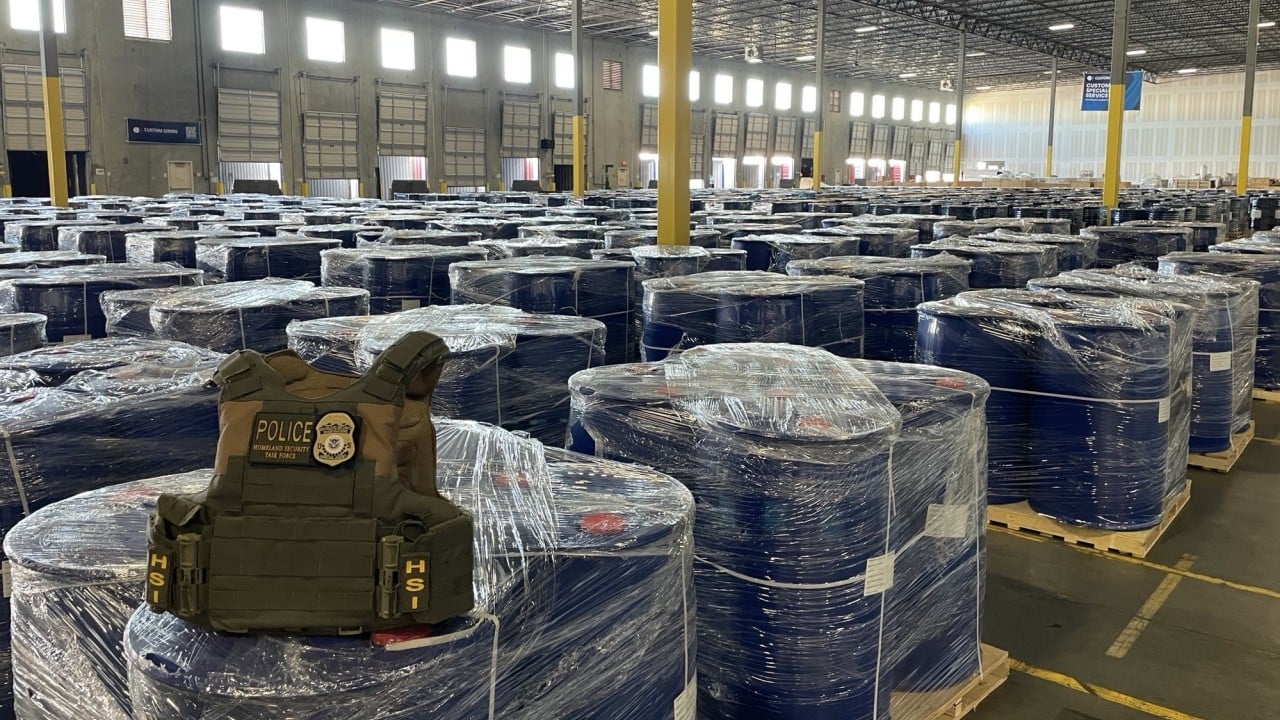
The geopolitical friction between Washington, Beijing, and Mexico City over synthetic drug production and bilateral trade agreements is a structural collision between two competing economic architectures. Standard news coverage frames this dynamic as a simple diplomatic spat—the United States Embassy in Mexico criticizing Chinese chemical exports at the exact moment Mexican officials finalize commercial agreements with Beijing. This framing misses the underlying operational reality. The core issue is not diplomatic rhetoric; it is the entanglement of legitimate dual-use chemical supply chains with illicit cartel manufacturing networks, occurring simultaneously alongside Mexico’s strategic hedging in global trade.
To understand why diplomatic pressure from Washington fails to halt commercial integration between Mexico and China, analysts must separate the public messaging from the physical and financial mechanics driving both trends. The situation operates across three distinct dimensions: the industrial economics of precursor chemicals, the strategic calculus of Mexican trade diversification, and the asymmetric enforcement capabilities of the three states involved.
The Economics of Dual-Use Precursor Supply Chains
Illicit synthetic drug production—specifically methamphetamine and fentanyl—does not rely on agricultural cultivation, which requires vast land footprints, predictable weather, and seasonal labor. Instead, synthetic production operates like a specialized chemical manufacturing sector. The primary bottleneck in this sector is access to precursor chemicals and essential reagents.
China maintains the largest chemical manufacturing base globally. The industry comprises tens of thousands of registered chemical enterprises, many operating in coastal provinces with direct access to deep-water container ports. This industrial scale creates three operational realities that complicate interdiction:
- The Dual-Use Dilemma: Most precursors required for methamphetamine synthesis—such as phenylacetic acid derivatives, methylamine, or nitroethane—have legitimate, high-volume industrial applications in pharmaceuticals, plastics, agrochemicals, and fragrances. Banning these substances outright would cripple legitimate global manufacturing.
- Molecular Workarounds: When international regulatory bodies schedule a specific precursor, illicit chemists rapidly pivot to "pre-precursors" or unscheduled chemical analogues. Because Chinese chemical firms synthesize custom molecules on demand for global pharmaceutical research, cartel procurement networks exploit this same infrastructure to order bespoke, unscheduled compounds that require only one additional reaction step to yield a controlled precursor.
- Containerization and Mislabeling: Global maritime trade relies on high-throughput logistics where physical inspection rates at ports rarely exceed a single-digit percentage of total container volume. Chemical shipments originating from East Asia and arriving at Mexican Pacific ports—principally Manzanillo and Lázaro Cárdenas—are routinely mislabeled as benign industrial inputs, cleaning agents, or textile dyes.
The U.S. Embassy’s public criticism of Beijing targets this exact supply chain vulnerability. Washington’s operational thesis is that Beijing possesses the domestic surveillance and regulatory apparatus to monitor chemical producers, enforce Know-Your-Customer protocols on international buyers, and restrict the export of known pre-precursors. From the American perspective, the continued flow of these materials represents a policy choice by Beijing rather than a simple regulatory blind spot.
The Mechanics of Beijing’s Counter-Narrative
Beijing’s standard diplomatic response to U.S. accusations rests on strict legalism and burden-shifting. Chinese officials consistently argue that once a chemical leaves a Chinese port under a legitimate commercial manifest, responsibility for diversion into illicit channels lies with the importing nation’s customs authorities and the consuming nation’s domestic demand reduction policies.
This position exploits a fundamental asymmetry in international narcotics control. Under existing United Nations conventions, exporting states are obligated to track scheduled substances, not every unscheduled industrial chemical that could theoretically be converted into a precursor. By adhering strictly to the letter of international scheduling lists while resisting broader unilateral American designations, Beijing shields its domestic chemical industry from compliance costs while framing U.S. criticism as geopolitical containment.
Furthermore, narcotics cooperation functions as a diplomatic lever in the broader U.S.-China relationship. When bilateral tensions escalate over semiconductor export controls, maritime disputes in the South China Sea, or tariffs, Beijing historically deprioritizes joint counternarcotics working groups. Law enforcement intelligence sharing becomes contingent on broader geopolitical concessions.
Mexico’s Strategic Hedging and Trade Diversification
While the U.S. Embassy escalates public pressure on China, the Mexican government continues to sign investment and trade agreements with Beijing. To an observer focused solely on security cooperation, this appears contradictory. Viewed through the lens of macroeconomic strategy, however, Mexico’s actions follow a predictable logic of risk mitigation.
Mexico’s economy is heavily integrated with the United States through the United States-Mexico-Canada Agreement (USMCA). Over eighty percent of Mexican exports go to the U.S. market. While this proximity drives manufacturing growth—particularly through nearshoring trends—it also creates extreme structural vulnerability to U.S. domestic politics, tariff threats, and unilateral policy shifts.
Signing deals with Beijing serves three specific strategic functions for Mexico City:
- Capital Injection for Infrastructure: Mexico faces severe infrastructure deficits in energy generation, water distribution, and rail transport—all of which are necessary to sustain nearshoring manufacturing capacity. Chinese state-owned enterprises and private conglomerates offer rapid financing and construction capabilities for industrial parks, automotive supply chains, and port modernization without the stringent governance conditions often attached to Western institutional capital.
- Counter-Leverage Against Washington: By demonstrating viable commercial alternatives with China, Mexico increases its bargaining power in bilateral negotiations with the United States over migration, water rights, and trade disputes. It signals to Washington that Mexican alignment is not automatic and requires continuous economic accommodation.
- Supply Chain Localization: Many Chinese manufacturers are establishing operations directly inside Mexico to bypass U.S. tariffs on Chinese goods while maintaining access to the North American market under USMCA rules of origin. Mexican officials view these investments as job creators and tax revenue generators, prioritizing immediate economic development over Washington’s long-term strategic concerns regarding Chinese industrial penetration.
The Structural Collision at Pacific Ports
The physical intersection of these two dynamics—U.S. security demands and Mexican economic outreach—occurs at Mexico’s Pacific maritime infrastructure. Ports like Manzanillo and Lázaro Cárdenas are simultaneously the primary gateways for legitimate Asian industrial imports and the primary entry points for illicit methamphetamine precursors.
Criminal organizations, particularly the Sinaloa Cartel and the Jalisco New Generation Cartel (CJNG), operate as transnational logistics conglomerates. They do not merely smuggle drugs; they manage complex maritime procurement networks, bribe port officials, infiltrate customs brokerage firms, and launder proceeds through Chinese underground banking networks.
The financial mechanism linking these cartels to Chinese chemical suppliers relies on mirror-image value transfers rather than traditional wire transfers, which are easily tracked by U.S. financial intelligence. In this system:
- Cartel operatives in the United States deliver bulk U.S. dollar cash proceeds to Chinese money brokers operating domestically.
- These brokers sell the U.S. dollars to wealthy Chinese nationals seeking to bypass Beijing’s strict capital controls, which limit individual foreign currency exports to $50,000 annually.
- The Chinese nationals transfer an equivalent value in Renminbi (RMB) inside China directly to the bank accounts of the chemical manufacturers supplying the cartels in Mexico.
- The chemical companies ship the precursors to Mexican ports, completing the transaction without illicit funds ever crossing an international banking border.
This closed-loop financial architecture insulates both the cartels and the chemical suppliers from traditional anti-money laundering enforcement. It also demonstrates why diplomatic statements from the U.S. Embassy, standing alone, rarely disrupt operational flows.
Limitations of Unilateral Diplomatic Pressure
Publicly criticizing China in Mexico City exposes the inherent limits of coercive diplomacy when economic incentives point in the opposite direction. The U.S. strategy faces three structural constraints:
- Sovereignty Sensitivities: Mexican political culture places a high premium on non-intervention and national sovereignty. When U.S. diplomats publicly dictate which foreign partners Mexico should engage with, it frequently triggers domestic political backlash, forcing Mexican leaders to defend their bilateral agreements with Beijing to avoid appearing subordinate to Washington.
- Asymmetric Enforcement Costs: Washington asks Mexico to aggressively inspect incoming Chinese cargo and restrict Chinese investment in sensitive sectors. However, halting container traffic at Manzanillo slows down legitimate automotive and electronics supply chains bound for U.S. factories. Neither Mexico City nor U.S. corporate interests are willing to absorb the economic shock of prolonged port paralysis.
- The Regulatory Lag: International scheduling of precursor chemicals takes years to finalize through United Nations commissions. By the time a specific compound is banned, cartel chemists have already migrated to an unscheduled alternative. Diplomatic pressure aimed at enforcing existing lists always lags behind real-world chemical innovation.
Tactical Realignment for Supply Chain and Risk Management
Because public diplomatic friction will persist alongside deepening Sino-Mexican commercial ties, organizations operating in North American logistics, manufacturing, and compliance must adjust their operational frameworks. Relying on state-level diplomatic alignments to guarantee supply chain stability is no longer viable.
First, corporate compliance teams importing chemical inputs or industrial components through Mexican Pacific ports must implement granular vendor verification beyond standard customs documentation. Supply chains touching dual-use chemicals face heightened risk of sudden container seizures, secondary sanctions, or U.S. customs holds under the Uyghur Forced Labor Prevention Act and counternarcotics designations. Firms must audit tier-two and tier-three suppliers in East Asia to ensure their chemical vendors are not simultaneously servicing illicit procurement networks.
Second, manufacturers utilizing Mexico as a nearshoring hub must prepare for stricter enforcement of USMCA rules of origin. As Washington scrutinizes Chinese capital inflows into Mexican industrial parks, U.S. trade authorities will increasingly target components suspected of being minimally processed Chinese goods routed through Mexico to evade tariffs. Companies must maintain auditable, end-to-end provenance data demonstrating substantial transformation within North America.
Third, bilateral security cooperation will continue to decouple from trade negotiations. The U.S. government will increasingly bypass slow diplomatic channels in favor of targeted unilateral actions: Treasury Department sanctions against specific Chinese chemical firms, indictments of logistics brokers, and heightened U.S. Customs and Border Protection scrutiny at the southern border. Commercial entities must model border crossing delays and regulatory friction as permanent operational overhead rather than temporary diplomatic anomalies.