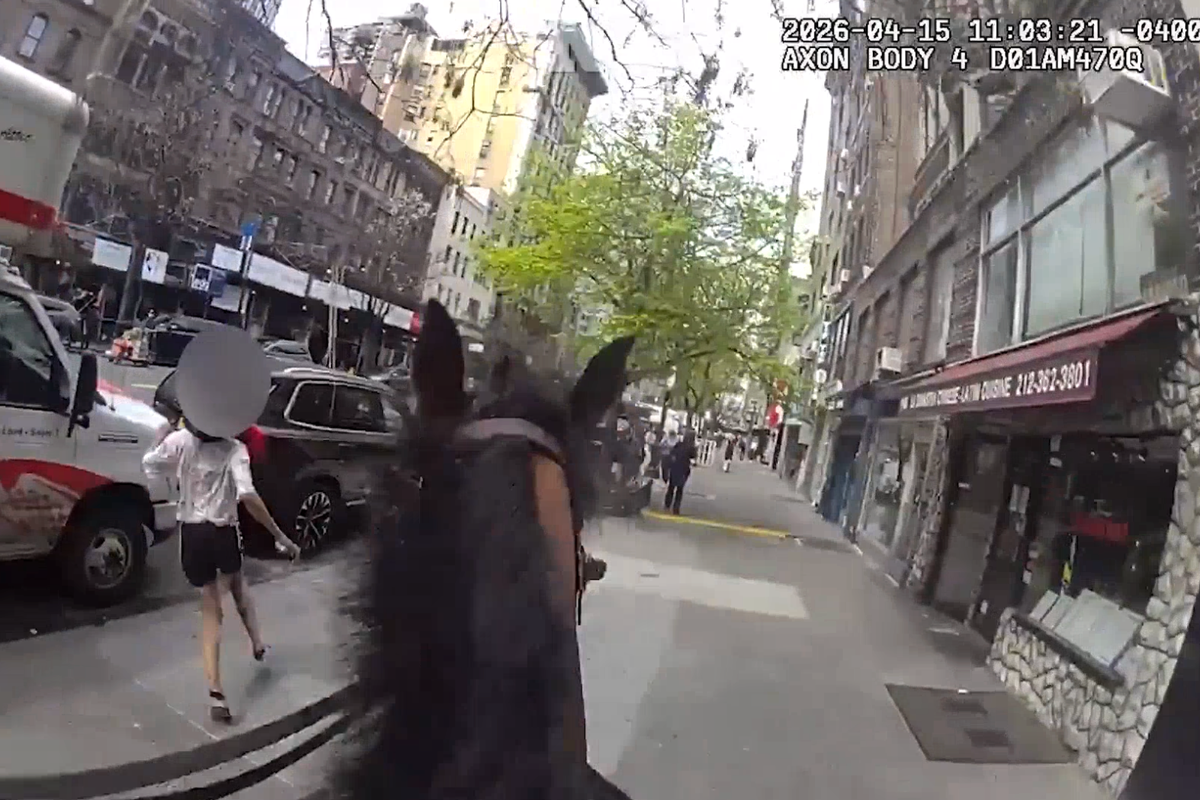
The air in Midtown Manhattan rarely tastes like anything other than exhaust fumes and burnt sugar from the roasted nut carts. It is a sensory assault of sirens, the rhythmic screech of subway brakes, and the impatient shuffle of eight million people trying to be somewhere else. But for a fleeting moment on a humid Tuesday, the soundtrack of the city shifted. The modern world retreated, replaced by a sound that belongs to a century long since buried under the asphalt.
Clip. Clop.
Then a gallop.
It started with a scream near 45th and Broadway. A woman, likely one of the thousands of tourists caught in the neon trance of the Big Apple, felt the sudden, violent jerk of her bag leaving her shoulder. The thief was fast. He was young, agile, and possessed the kind of frantic energy that thrives in a crowd. He darted between yellow cabs and tourists holding selfie sticks, banking on the fact that in the chaotic gridlock of New York, no patrol car could ever hope to catch him.
He forgot about the horses.
The Weight of the Badge and the Saddle
Officer Samson, a veteran of the NYPD’s Mounted Unit, didn't need to consult a dispatch radio to know what was happening. He felt the shift in the crowd’s gravity before he saw the perpetrator. From ten feet up, the world looks different. You see the gaps in the traffic. You see the way the sea of humanity parts for a predator and closes behind a victim.
His partner, a thousand-pound beast named McCall, felt the tension through the reins.
There is a unique psychology to the Mounted Unit. In a digital age where policing is often defined by body cams and high-tech surveillance, the horse remains an anomaly—a living, breathing piece of equipment that is both a public relations miracle and a terrifying force of nature. To a tourist, the horse is a photo op. To a criminal, it is a mountain that can run forty miles per hour.
When the officer spurred McCall into a trot, the pursuit wasn't just a chase. It was a collision of eras.
The Pursuit Through the Concrete Canyon
Imagine for a second that you are the thief. You’ve successfully navigated the first block. You’ve dodged a delivery cyclist and rounded a corner, your heart hammering against your ribs. You think you’ve won because the city is on your side; its density is your camouflage. Then, you hear it. It isn't the whine of a motor. It’s the heavy, rhythmic drumming of iron shoes on pavement.
The vibration travels up through your feet. You look back, and instead of a flashing light in a rearview mirror, you see a shadow that blots out the sun.
Officer Samson navigated the intersection with a precision that would make a stunt driver weep. He wasn't just steering; he was communicating. A horse’s ears are like radar dishes, twitching toward the source of the noise, anticipating the rider’s intent. As the suspect wove through a line of idling buses, Samson and McCall simply went over the obstacles the thief thought would slow them down.
The suspect's face, captured later in grainy cell phone footage, told the whole story. It wasn't just fear. It was disbelief. We are conditioned to think of the city as a cage of steel and glass. We forget that before the internal combustion engine, the horse was the king of these streets. On this afternoon, the king had returned to claim his territory.
The Invisible Stakes of a Stolen Purse
To some, a purse snatching is a "minor" crime—a statistic for an insurance company to digest. But talk to the woman standing on the corner of 46th Street, her hands shaking, her breath coming in shallow gasps.
It isn't about the leather bag. It isn’t even about the cash. It’s about the violation of the social contract. When someone rips a personal item from your body, they aren't just taking your ID and your credit cards; they are taking your sense of safety in the world. They are telling you that you are a target and that the city is a hostile wilderness.
That is why the Mounted Unit matters. Their presence is a psychological anchor. When a horse stands on a corner, it creates a "halo effect" of security. It is a visible, tactile reminder that order exists.
As the thief tried to disappear into the subway entrance, he realized too late that he couldn't outrun a creature that could see over the tops of the vans he was using for cover. Samson cut him off at the mouth of the stairs. The horse didn't have to do much. It simply stood there—immense, steaming, and indifferent to the suspect’s desperation.
The Silence After the Storm
The arrest was quick. The suspect surrendered not to the handcuffs, but to the sheer physical presence of the animal. There is no bravado left in a man when he is looking at a creature that could crush him with a single misstep but chooses, through sheer discipline, to remain still.
As the backup units arrived and the sirens finally drowned out the sound of McCall’s breathing, the crowd did something unusual for New York. They stopped. They didn't just walk past with their heads down. They watched as the officer leaned down, patted the horse’s neck, and whispered something that no one else could hear.
In that moment, the "dry facts" of a police report—Suspect apprehended at 14:10 hours, property recovered—felt woefully inadequate. They failed to capture the sweat on the officer’s brow or the way the victim’s face transformed from terror to a tearful, shaky relief when her bag was handed back to her.
We live in a world that moves too fast. We are obsessed with the "next" and the "new," convinced that technology is the only solution to our oldest problems. Yet, in the heart of the most technologically advanced city on Earth, justice was served by a man and a horse. It was a reminder that some things don't need to be disrupted or "innovated." Some things, like the bond between a rider and his mount, are perfect exactly as they were five hundred years ago.
The officer turned McCall around, heading back toward the stable. The thief was in a van, the victim was being comforted, and the neon lights of Times Square continued to flicker their digital promises of a better life. But as the horse walked away, leaving the faint scent of hay and old-world grit in the air, the city felt a little less like a machine and a little more like a home.
The iron shoes struck the pavement once more. A steady, reassuring beat.
The heartbeat of a city that refuses to forget its soul.