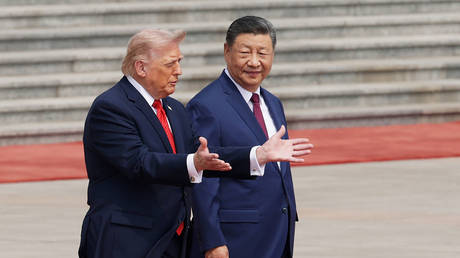
The Great Hall of the People in Beijing does not do intimacy. Its pillars are too wide, its ceilings too distant, its carpets too thick, swallowing the sound of footsteps so that every approach feels entirely weightless. When Donald Trump and Xi Jinping walked into this cavernous space, they were not just two men in dark suits. They were the embodiments of two colliding centuries. One represented a hyper-visible, Twitter-fueled American immediacy; the other, a quiet, multi-generational Chinese patience.
Outside, the global press corps waited for numbers. They wanted billion-dollar trade figures, concrete commitments on North Korea, and hard policy metrics to feed into the 24-hour news cycle. But statecraft at this level is rarely about the spreadsheets distributed to reporters. It is about the theater. It is about what is unsaid in the margins of a state dinner, the subtle shifts in body language, and the invisible stakes that govern the lives of billions of people who will never step foot in Beijing. Meanwhile, you can read other stories here: The BRICS Solidarity Myth Why Beijing and New Delhi Are Faking a United Front.
To understand what actually happened during that high-stakes summit, we have to look past the choreographed handshakes. We have to look at the quiet friction between two fundamentally incompatible views of the world.
The Mirage of the Twenty-Five Year Deal
Before the bilateral meetings even concluded, the air was thick with triumph. The cameras captured the signing ceremonies with practiced precision. Executives smiled. Pens clicked. The announcement shook the press room: $250 billion in commercial deals. It was a staggering figure, meant to stun the public into believing that a new era of economic harmony had arrived. To understand the full picture, we recommend the detailed article by Reuters.
But figures can lie, even when they are technically accurate.
Consider how a massive trade deal actually works. Imagine a contract to buy a fleet of airplanes or a million tons of soybeans. It looks like a sudden windfall. In reality, most of these announcements were non-binding memorandums of understanding. They were theatrical props. Many were agreements that had already been negotiated months prior, dusted off and saved for the bright lights of the Beijing stage. Others were vague promises stretched across the next decade, easily canceled if the political winds shifted.
The American administration needed a victory to show the factory floors of Ohio and the oil fields of Texas. The Chinese leadership understood this need perfectly. By offering a grand spectacle of purchasing power, Beijing gave the visiting president the headlines he craved while giving up almost nothing in terms of structural economic reform. The forced technology transfers continued. The state subsidies remained untouched. The intellectual property theft, a silent drain on global innovation, was not resolved by a single large purchase order.
It was a classic transactional trade-off. One side got a spectacular television moment; the other side preserved its long-term economic strategy.
The North Korean Shadow in the Banquet Hall
While the public face of the summit focused on trade, a far more dangerous game was being played behind closed doors. At the time, the Korean Peninsula was a tinderbox. Pyongyang was testing missiles at an alarming rate, and the rhetoric coming out of Washington was growing increasingly martial. The threat of a kinetic conflict was real, terrifying, and immediate.
For America, the solution seemed obvious: China holds the economic lifeline to North Korea, so China must squeeze the regime until it breaks.
But nations do not act against their own existential interests just because a guest asks politely.
To comprehend Xi Jinping’s position, you have to look at the map through the eyes of a Chinese strategist. A collapsed North Korean regime does not just mean a humanitarian crisis on China's northeastern border. It means a unified, democratic Korea allied with the United States, potentially placing American troops and military hardware right on the Yalu River. For Beijing, that is an absolute red line.
During those intense hours in the Great Hall, the American delegation pushed for total economic strangulation. The Chinese counter-offer was far more measured. They agreed to stricter enforcement of United Nations sanctions. They tightened banking restrictions. They squeezed the flow of oil just enough to signal displeasure to Pyongyang, but never enough to cause a collapse.
It was a masterclass in strategic ambiguity. Xi convinced his guest that China was part of the solution, all while ensuring that the buffer state remained intact. The immediate crisis was defused, not through a breakthrough, but through a shared realization that neither superpower wanted a catastrophic war on its watch. They bought time. In geopolitics, sometimes time is the only commodity that matters.
The Pomp, the Pageant, and the Changing of the Guard
There was a moment during the visit that received little attention in the West but meant everything to the audience in Asia. The Chinese government granted the American president a rare honor: an intimate dinner inside the Forbidden City. It was the first time a foreign leader had been feted within the ancient imperial palace since the founding of the People's Republic.
As the two leaders walked through the crimson courtyards, the message was unmistakable. This was not a meeting between a superpower and a developing nation. This was an encounter between equals.
For nearly a century, the international order had been defined by American primacy. The rules of global trade, maritime security, and diplomacy were written in Washington. But in the grand spaces of the Forbidden City, the subtext was clear: the American century was meeting its competitor.
The warmth of the reception was designed to disarm. By treating the American president with unprecedented deference, China effectively neutralized the aggressive, confrontational rhetoric that had defined the previous year. It is incredibly difficult to publicly lambast a host who has just thrown open the doors of his civilization's most sacred historic site for you.
This cultural choreography had a profound effect on the surrounding region. Across Southeast Asia, leaders watched the images of the summit closely. They saw an American president being flattered and managed, and they saw a Chinese leader completely at ease in his role as the master of the house. The underlying signal was received loud and clear: America's presence in the Pacific was shifting from an unchallenged guarantee to a negotiable position.
The Human Cost on the Periphery
Away from the klieg lights of Beijing, the true impact of these diplomatic maneuvers began to ripple outward.
Think of a small-scale manufacturer in the American Midwest, relying on specialized steel components imported from Asia. Or a soybean farmer in Iowa, looking at silos bursting with a harvest that suddenly had no market. These individuals were not in the room when the non-binding agreements were signed. They did not taste the state banquet dishes. Yet, their livelihoods were the currency being used in this geopolitical poker game.
The summit failed to address the fundamental systemic imbalances between the two economies. It opted for short-term transactional fixes over long-term structural alignment. Because the deep-seated issues of currency manipulation, market access, and state-directed capitalism were bypassed in favor of theatrical success, a trade war became almost inevitable.
The years that followed proved this true. The tariffs that eventually landed were not paid by governments; they were paid by consumers, small business owners, and logistics workers. The Beijing summit did not prevent a conflict. It merely acted as the beautiful, serene prologue to a long and painful economic decoupling.
The true achievement of the Beijing summit was not a treaty or a breakthrough. It was the stark, undeniable revelation of a new global reality. The world had officially transitioned from a unipolar landscape to a tense, permanent rivalry between two giants.
As the American motorcade finally pulled away from the Great Hall of the People, heading toward the airport under a carefully cleared, pollution-free Beijing sky, the red flags of both nations fluttered in the exhaust. The cameras were packed away. The executives counted their symbolic billions. But in the quiet corridors of power, the fundamental friction remained entirely unchanged, a silent tectonic shift waiting for its moment to shake the world.