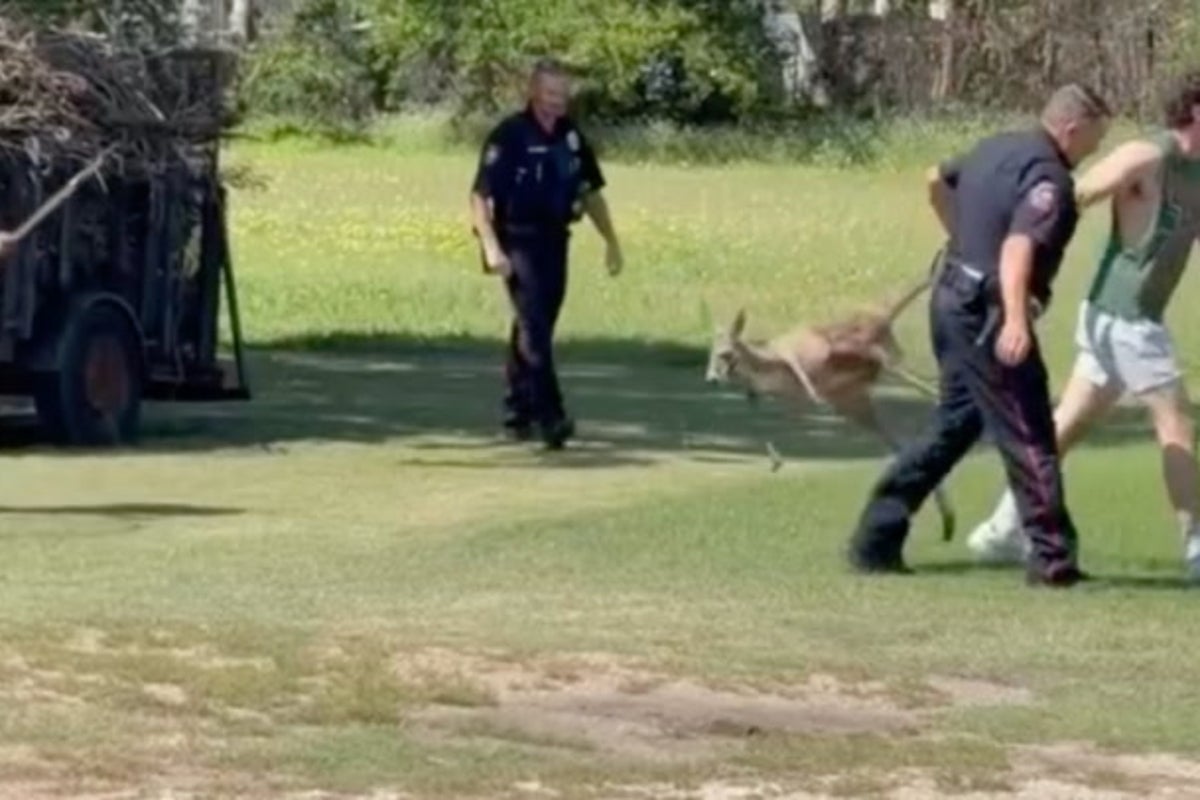
A viral video out of Texas recently showed police officers wrestling an escaped kangaroo on the side of a highway, eventually dragging the animal by its tail to secure it. While the internet treated the footage as another slice of bizarre Americana, the incident exposes a massive regulatory vacuum in the Lone Star State. Texas has become America’s wild west for exotic animal ownership, where loose laws create public safety hazards and leave local law enforcement completely unprepared to handle the fallout. This isn't a funny viral moment. It is a predictable consequence of a system that treats dangerous wildlife like common household pets.
The reality of exotic pet ownership in Texas is a patchwork of toothless municipal ordinances and wide-open state regulations. When a kangaroo, a tiger, or a primate escapes into a residential neighborhood, the burden of capture falls squarely on municipal police departments. These officers receive zero training in wildlife containment. They lack the proper tranquilizer equipment, and they are forced to improvise in high-stress situations. Dragging a kangaroo by its tail is incredibly dangerous for both the animal and the handler, yet the officers involved had no other viable options.
The Illusion of Regulation
Texas law requires a Certificate of Registration for certain "dangerous wild animals," including lions, tigers, and bears. However, the state completely excludes a vast catalog of potentially dangerous exotic species from this list. Kangaroos, wallabies, and various large primates slip through these legal cracks entirely.
Local counties can pass their own bans, but enforcement is virtually non-existent. A resident can buy a kangaroo online or at an exotic livestock auction, drive it across county lines, and house it in a suburban backyard without ever notifying local authorities.
State vs. Local Enforcement Gap:
- State Level: Monitors a specific list of large carnivores/primates.
- County Level: Can restrict ownership but lacks the budget to audit private properties.
- Municipal Level: Left to respond to 911 calls when an animal inevitably escapes.
This regulatory fragmentation creates an environment where nobody actually knows how many exotic animals reside within state borders. When an animal gets loose, police officers are walking into a situation blind, with no knowledge of the animal's medical history, temperament, or behavioral triggers.
The Mechanics of an Escaped Macropod
Kangaroos are not docile creatures. A full-grown male can weigh over 150 pounds and possesses immense kicking power capable of disemboweling a human or killing a domestic dog. Their tails are not handles; they are an extension of the spine used for balance and defense.
When an animal is dragged by its tail, it risks severe spinal trauma, muscle tearing, and capture myopathy. Capture myopathy is a metabolic disease associated with the chemical changes brought on by extreme exertion, fear, or stress in wild animals. It is frequently fatal. Police officers, operating under adrenaline and public pressure, cannot be blamed for utilizing crude capture methods when they are handed a problem they were never equipped to solve. The blame lies with the lawmakers who allowed the animal to be there in the first place.
The Secret Economy of Exotic Livestock Auctions
To understand how a kangaroo ends up on a Texas highway, you have to look at the commercial infrastructure driving the trade. Exotic livestock auctions operate openly across the state, serving as the primary pipeline for private collectors.
At these auctions, zebras, giraffes, camels, and large marsupials are sold to the highest bidder alongside standard cattle and goats. The barrier to entry is financial, not educational. Anyone with a checkbook and a trailer can walk away with an exotic animal.
- No background checks: Buyers are not vetted for their ability to provide adequate housing or veterinary care.
- No containment audits: State agencies do not inspect the fencing or enclosures where these animals will live.
- No mandatory microchipping: When an animal escapes, tracing it back to its owner relies entirely on self-reporting or neighborhood gossip.
This lack of oversight fuels a multi-million dollar underground economy. The animals are often bred in substandard facilities, sold as novelties, and abandoned or neglected once they reach maturity and become too difficult to manage.
The Public Safety Threat to Rural and Suburban Communities
The conversation around exotic pets often focuses heavily on animal welfare, but the human cost is equally severe. Suburban developments in Texas are expanding rapidly into previously rural areas, placing residential neighborhoods in direct contact with private exotic compounds.
A standard chain-link fence is entirely insufficient for an animal built to leap ten feet in the air. When these animals breach their enclosures, they present an immediate threat to motorists, children, and pets. A collision between a vehicle and a large exotic animal on a dark state highway is catastrophic.
"We aren't talking about a stray dog. We are talking about unpredictable, stressed, and powerful wildlife navigating an environment of asphalt, cars, and panicked humans."
First responders are forced to make split-second decisions. If an escaped exotic animal displays aggression toward the public, officers will use lethal force. This tragic outcome happens far more frequently than the occasional successful, albeit clumsy, capture.
The Failure of the Self-Regulation Argument
Proponents of the exotic pet trade argue that private ownership aids in conservation and that owners should have the personal freedom to keep whatever animals they choose. They claim that the market self-regulates because the high cost of the animals ensures only dedicated enthusiasts purchase them.
The data proves otherwise. Animal sanctuaries across Texas are consistently at maximum capacity, overwhelmed by surrenders from private owners who realized too late that they could not handle the financial or physical demands of exotic animal care.
Furthermore, conservation requires managed breeding programs with strict genetic tracking to prevent inbreeding and disease. Private backyard breeding does nothing to preserve wild populations; it merely creates a surplus of genetically compromised animals destined for the auction block or a roadside ditch.
Rebuilding the Enforcement Framework
Fixing this systemic crisis requires a complete overhaul of how Texas categorizes and regulates non-native wildlife. Patchwork county bans are a failed experiment that allows bad actors to exploit geographic loopholes.
Proposed Regulatory Overhaul:
1. Universal Registration: Every non-native mammal must be microchipped and registered at birth or sale.
2. Mandatory Liability Insurance: Owners must hold high-value policies to cover potential property damage or capture costs.
3. First Responder Funding: A tax on exotic animal sales must directly fund wildlife handling training for local police and sheriffs.
The state must establish a comprehensive permit system administered by the Texas Parks and Wildlife Department, moving the responsibility away from overwhelmed local municipalities. If an individual cannot prove they possess the professional facilities, veterinary partnerships, and financial reserves to manage a specific species, the permit must be denied.
The viral footage of a kangaroo being dragged down a Texas road should not be viewed as an isolated, amusing anecdote. It is a stark warning sign of a broken regulatory system that prioritizes the whims of private collectors over the safety of communities and the welfare of animals. Until the state closes these loopholes and holds owners accountable, local police will continue to serve as unwilling, untrained zookeepers on the taxpayers' dime. The next escape might not end with a crude capture; it could easily end in a tragedy that state lawmakers can no longer afford to ignore.


