If you were waiting for Tesla to finally pull the cover off its long-rumored supercar on October 1, you got familiar disappointment instead. Tesla pushed the highly anticipated Roadster demonstration back two weeks to October 15, pointing squarely at severe weather forecasts in central Texas. Elon Musk blamed high winds at the SpaceX rocket test site in McGregor. Weather happens. Storms roll across the plains. But when you are dealing with a vehicle first promised nearly a decade ago, a two-week weather delay feels less like an act of God and more like par for the course.
Car enthusiasts and patient reservation holders rolled their eyes globally. Everyone knows this machine has missed every single milestone it ever set. Yet, people keep paying attention because Tesla still knows how to command the oxygen in the room. This latest shuffle gives us a great excuse to look past the marketing gloss and examine what is actually happening behind closed doors in Austin. If you liked this post, you should check out: this related article.
Nine Years in Limbo and Counting
Let us ground ourselves in reality. Tesla originally unveiled the second-generation Roadster prototype back in November 2017. Back then, the pitch was simple and staggering. It would hit sixty miles per hour in 1.9 seconds, travel over six hundred miles on a single charge, and go into production by 2020.
That target date came and went. Then 2021 passed. Then 2022 brought supply chain excuses. By 2024, Musk was talking about a 2025 window. Now, official production guidance points toward 2028. Think about that timeline for a second. Children born when the prototype debuted are now in middle school. Entire automotive segments have risen, matured, and gone electric while the Roadster remains a digital rendering on a website. For another look on this event, see the recent coverage from Ars Technica.
Delays of this magnitude usually kill a car company. Startups go bankrupt for missing deadlines by six months. Tesla survived because its bread-and-butter crossovers printed enough cash to subsidize vanity projects. But the psychological wear and tear on early supporters is real. When you tie up five figures of hard cash for years without a VIN number in sight, patience wears thin.
The SpaceX Thruster Reality Check
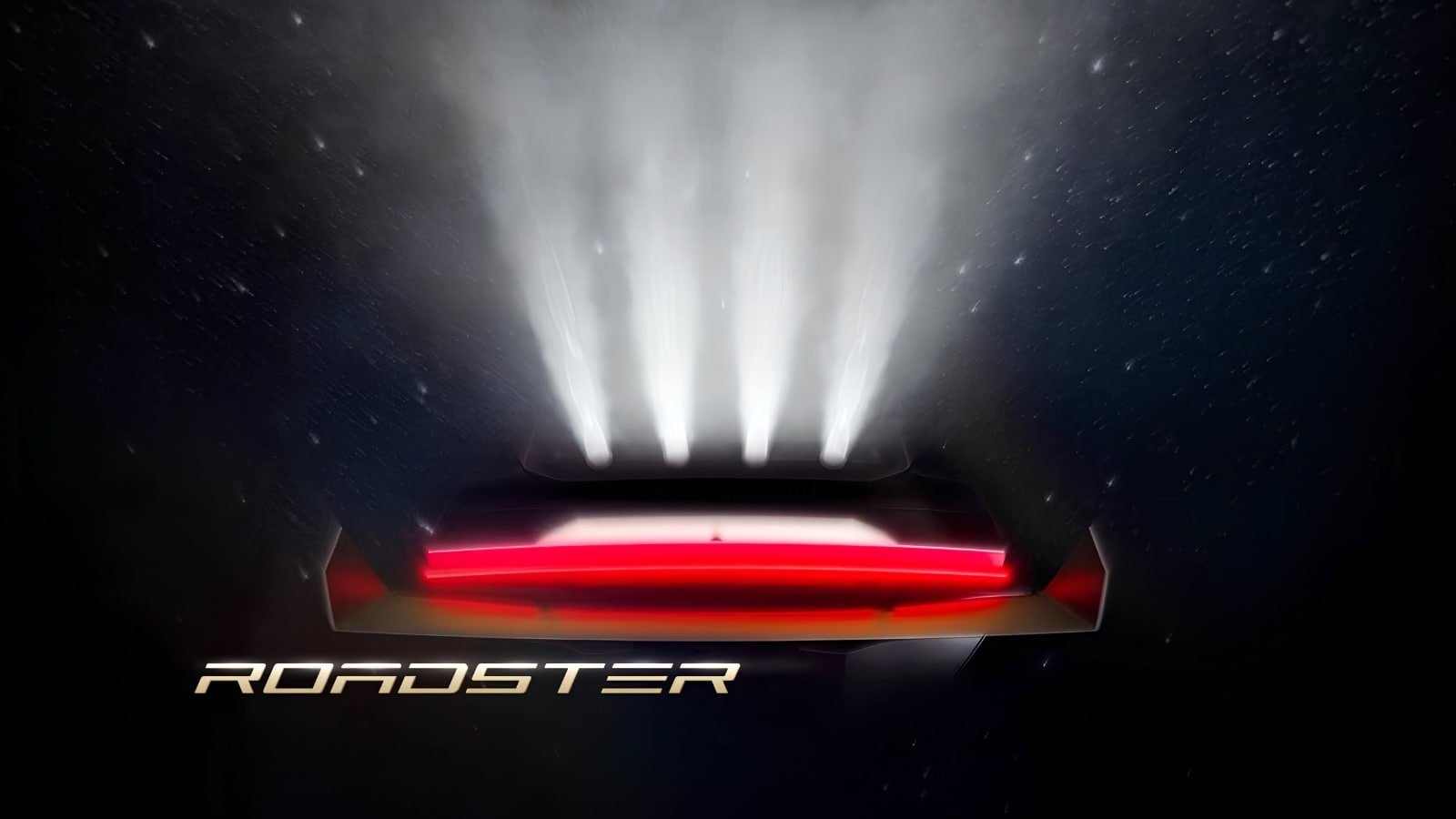
When Tesla finally held the rescheduled event on October 15 at the SpaceX facility in McGregor, Texas, the spectacle lived up to the hype. The company showed off a machine capable of stunts that looked straight out of a science fiction movie. We saw a vehicle equipped with cold-gas thrusters—actual aerospace technology adapted for a car chassis.
The engineering ambition here is wild. Tesla split the lineup into three distinct configurations. You have the standard two-seat Performance model. You have the Thrust model equipped with rear cold-gas jets designed to slash acceleration times down below one second. Then you have the insane, single-seat Rocket variant featuring thrusters positioned around the entire body.
Let us be brutally honest about the Rocket version. It basically cannot be driven on public asphalt. Regulators would have a collective heart attack if someone fired up cold-gas thrusters in a Wendy's drive-thru. This variant is a track-only toy, an engineering flex meant to generate headlines and push the boundaries of what an electric vehicle can do physically.
Integrating rocket science into a passenger car introduces nightmarish packaging hurdles. Storing high-pressure gas safely inside a carbon-fiber shell requires heavy containment systems. Managing the heat, the noise, and the sheer G-forces means the vehicle must be built like an aerospace craft rather than a commuter coupe. Musk himself admitted behind the scenes that pulling off this demonstration was monumentally difficult and prone to failure. That context makes the weather delay look much more like an engineering crunch than a simple wind advisory.
Breaking Down the Tiers and Financial Realities
If you want one of these machines parked in your garage, you need to understand how Tesla structures the transaction. Reservation pricing is aggressive. When reservations reopened after the October reveal, Tesla asked for a $50,000 deposit for the Performance trim and a hefty $250,000 for the Thrust variant. The ultimate Rocket trim sits behind an invite-only velvet rope.
Notice what is missing from those numbers. Total vehicle pricing remains unannounced. You are wiring tens of thousands of dollars to an automaker without knowing the final sticker price. That is a bold move that only a brand with Tesla's cult following could pull off.
Real-world buyers face tough choices. The Performance model offers standard supercar thrills with active aerodynamics and a multi-mode fan system designed to suck the car down to the road. It makes sense for collectors who actually want to drive their investments on weekends. The Thrust and Rocket variants are specialized instruments. They belong on closed circuits with professional support crews nearby. Treating them like normal sports cars is a recipe for disaster.
What You Should Do If You Are Waiting
If you hold an active reservation or find yourself tempted to wire a deposit for the 2028 production run, step back and evaluate your capital. Do not treat a Tesla reservation as an investment vehicle. Treat it as high-risk discretionary spending.
Keep your cash liquid until Tesla publishes firm vehicle pricing and actual delivery dates backed by assembly-line proof at Gigafactory Texas. Watch for independent testing of the braking, tire wear, and thermal management systems on the track variants. Until real customers take delivery and put miles on public pavement, everything remains an expensive science experiment.
Keep your expectations grounded. The Roadster will eventually arrive, but it will look and cost very different from the 2017 dream. Buy it for the sheer audacity of the engineering, not because you need reliable transportation.