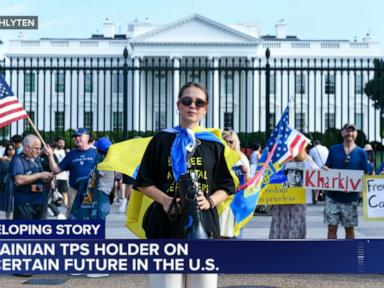
Bureaucracy thrives in ambiguity. When the Department of Homeland Security issues vague updates regarding Temporary Protected Status for nationals facing active conflict zones, the immediate reaction is often relief. That relief is usually a mistake.
Tens of thousands of Ukrainian nationals living and working in the United States currently find themselves caught in a structural holding pattern. The federal government has repeatedly signaled that protections will persist until further notice, leaving the core question of long-term stability entirely unresolved. For immigration lawyers, corporate human resources departments, and the affected families, this creates an operational nightmare disguised as administrative patience.
The Mechanics of the Extension Gap
To understand why an extension announcement without a clear expiration date is perilous, one must look at how federal agencies manage statutory workloads. Under standard administrative procedure, Temporary Protected Status designations require periodic review based on conditions in the country of origin. When the Department of Homeland Security delays formal publication in the Federal Register, it creates a cascading compliance failure for employment verification.
Consider a hypothetical firm in Chicago employing software engineers who rely on Employment Authorization Documents tied to this humanitarian program. When work permits expire without a timely, definitive federal register notice, human resources departments face impossible choices. They must navigate complex Form I-9 renewal rules, automatic extensions, and agency notices that often arrive months after old documents lapse.
The system treats administrative inertia as a feature rather than a bug. By postponing a definitive long-term decision, the agency avoids political confrontation while shifting the compliance burden entirely onto employers and workers.
Legal Realities and the Shrinking Judicial Safety Net
The institutional vulnerability of temporary humanitarian protections is deeper than bureaucratic lag. Recent federal court decisions and Supreme Court precedents have steadily narrowed the scope of judicial review over executive branch immigration determinations.
When status designations are left open-ended rather than permanently or semi-permanently codified, beneficiaries possess virtually no legal recourse if policy priorities shift overnight. A designation that rolls forward week by week or month by month can be terminated with minimal warning. This lack of predictability makes it impossible for individuals to plan mortgages, career trajectories, or family investments.
A software architect from Kyiv cannot build a five-year career strategy on a work permit that carries a rolling asterisk. The psychological toll of this perpetual temporariness is profound, fostering a continuous undercurrent of anxiety among communities that thought they had found temporary harbor.
What Employers and Beneficiaries Must Do Now
Waiting for Washington to provide absolute clarity is a losing strategy. Human resources professionals must audit their compliance pipelines immediately. They cannot rely on informal agency press releases or vague website alerts to satisfy federal employment eligibility verification mandates.
Every single file requires manual verification of the specific category codes—typically A-12 or C-19—alongside cross-referencing individual notices issued through official portals. If an employee's paperwork relies on an unverified assumption that protection will automatically roll over indefinitely, the organization is exposed to severe audit liabilities.
The reality of modern immigration administration is that temporary fixes are rarely stepping stones to permanence. They are administrative pauses designed to kick difficult political choices down the road. Until structural reform arrives, those caught in the middle must treat every temporary grace period as a countdown.