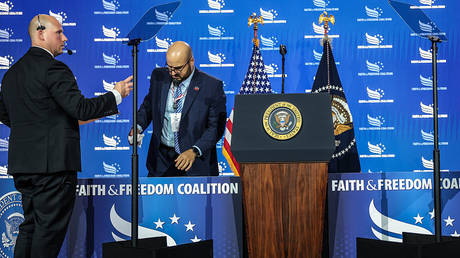
You can't make this stuff up. A White House technical staffer basically treated the President of the United States like a cash cow, and all it took was a teleprompter and a prediction market account.
Gabriel Perez, the guy who has loaded up Donald Trump’s speeches on the teleprompter since 2016, reportedly realized he had a literal goldmine at his fingertips. He had final eyes on almost every single speech before it went live. So, what did he do? He reportedly went on Kalshi, a regulated prediction market, and started betting on the specific words and phrases Trump would say during major public addresses.
He allegedly made over $100,000 doing this.
The scheme is brilliant in its simplicity, but incredibly dumb in its execution. Prediction markets aren't the Wild West anymore. Platforms like Kalshi use intense tracking systems to monitor weird trading spikes. Now, Perez is on unpaid administrative leave, and the Commodity Futures Trading Commission (CFTC) is knocking on his door.
How to Trade With the Ultimate Inside Information
Perez wasn't betting on major geopolitical events or who would win the next election. He was exploiting Kalshi’s "Mentions" markets. These are niche contracts where traders wager on whether a politician will say specific words—like "illegal alien," "bitcoin," or a country's name—during a live speech.
Think about how a teleprompter operator works. You don't just load the text and walk away. You sit there, scrolling the text to match the speaker's cadence. You see every single word seconds, minutes, and hours before the public hears it.
According to reports, Perez wagered on more than a dozen speeches. We are talking about massive events: the 2026 State of the Union, the World Economic Forum in Davos, and even a Medal of Honor ceremony. If Trump’s prepared remarks contained a specific buzzword, Perez allegedly knew it was a guaranteed win.
But it gets wilder. Investigators discovered that Perez actually adjusted his bets in the middle of a live speech. If Trump went off-script and skipped over a word, Perez would scramble on his phone to hedge or change his position. That isn't just using inside information; it is active trading from the front row of a presidential address.
Why the Tech Caught Him Immediately
If you think you can easily game a prediction market with a bit of secret knowledge, think again. Prediction markets rely on liquidity providers and market makers who lose real money when someone with an unfair advantage sweeps the board.
Kalshi’s internal surveillance team noticed something weird. A single account kept making highly precise, highly profitable trades right before and during major presidential speeches. The patterns didn't match normal retail trading behavior.
Kalshi did a quick internal probe, locked Perez’s account, and froze over $90,000 of his profits. They handed the data straight to the CFTC. To make matters worse for Perez, Kalshi recently updated its rules to force traders to disclose their place of employment for certain high-risk markets. Listing "The White House" on your profile while betting on the President’s vocabulary is an absolute fast track to a federal investigation.
Press Secretary Karoline Leavitt confirmed the White House has strict ethical guidelines against this and called the situation a "disgrace". Perez is reportedly cooperating and trying to hammer out a settlement with the CFTC. Federal prosecutors in New York passed on a criminal case, so this will likely end in a massive civil fine that wipes out whatever cash he has left.
The Massive Problem Facing Prediction Markets
This scandal exposes a massive vulnerability in the booming prediction market sector. Kalshi and its competitor Polymarket have exploded in popularity, letting people bet on everything from Federal Reserve interest rate hikes to pop culture drama.
But "mention markets" are notoriously easy to manipulate.
Last year, Coinbase CEO Brian Armstrong literally ended an earnings call by rattling off a list of random tech terms—"bitcoin, ethereum, blockchain, staking, and Web3"—just to mess with a Polymarket contract tracking what he would say. It was funny at the time, but it highlighted a structural flaw: the person speaking has total control over who wins the bet.
When you add a staffer who reads the script beforehand, the market breaks entirely. Wall Street has decades of strict compliance rules to stop insider trading. The White House even sent a memo in March 2026 telling staff not to bet on prediction markets using nonpublic data. Yet, individual bad actors will always try to exploit the system if they see an easy payday.
If you use prediction markets, stay far away from micro-events like speech mentions. Stick to macroeconomic data or major political outcomes where a single rogue staffer or a sudden ad-lib can’t instantly wipe out your position. The platforms are getting incredibly good at tracking anomalous data, and as this case proves, they will freeze your funds and call the feds before you can even cash out.