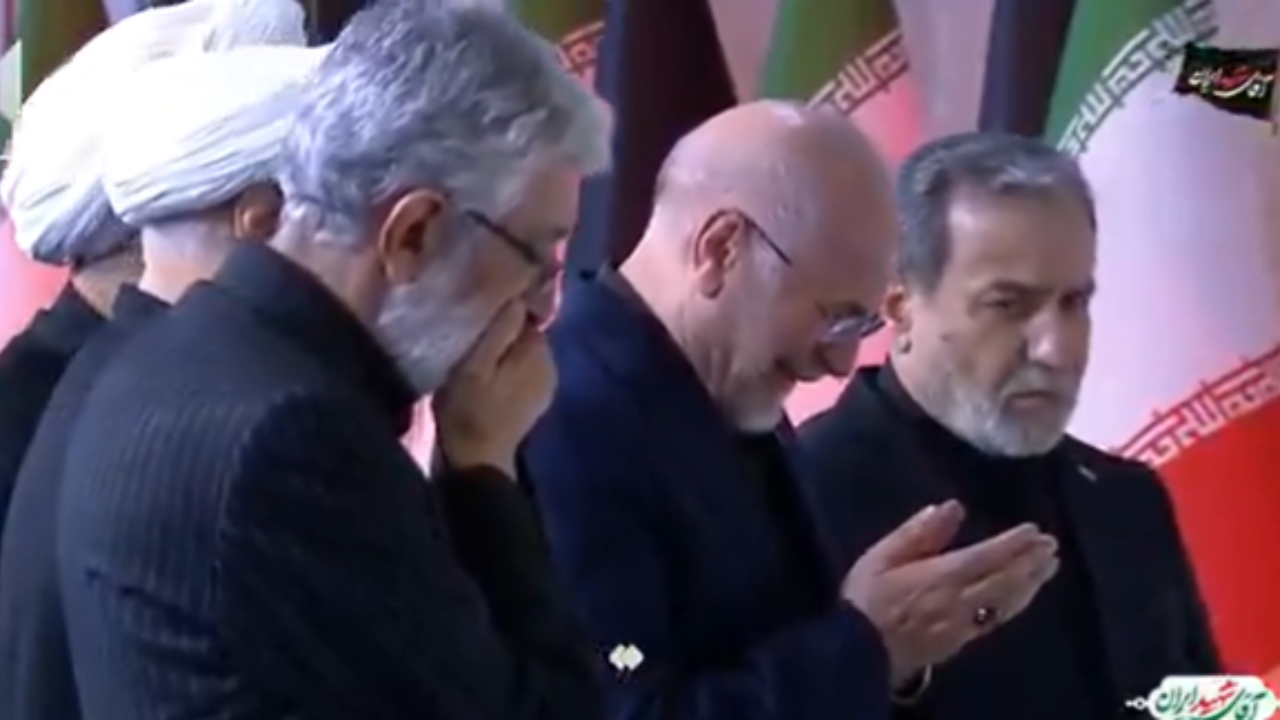
The air inside the grand hall tasted of heavy incense and damp stone. Outside, the morning heat was already baking the streets of Tehran, but under the high ceilings, a sudden, chilling gravity took hold. The cameras were rolling. State television broadcast the feed to millions of homes across the nation and the wider world, capturing a moment that was never supposed to betray weakness. Yet, as the state funeral of Supreme Leader Ayatollah Ali Khamenei began, the carefully curated facade of absolute composure cracked wide open.
Parliament Speaker Mohammad Bagher Ghalibaf stood near the center of the gathering, his shoulders rigid. For decades, Ghalibaf had projected the image of a hardened technocrat and former military commander—a man forged in the crucible of war and political survival. But as the rhythmic, somber chanting filled the room, his jaw tightened. His eyes grew glassy. Beside him, Foreign Minister Abbas Araghchi, a diplomat accustomed to masking his emotions behind the neutral mask of international negotiations, swallowed hard, his face contorting as the first tears tracked down his cheeks.
It was a display of raw emotion that stopped viewers in their tracks. In a political ecosystem where strength is measured by stoicism and authority is deemed divinely sanctioned, the sight of the regime’s chief architects weeping openly was jarring. This was not just grief. It was the visceral realization that an era had ended, and the ground beneath their feet was shifting.
The Weight of the Empty Chair
To understand why those tears mattered, one must look past the official mourning garb and the state-sanctioned sorrow. Power in this region has long been anchored by a singular, towering figure. For more than three decades, the Supreme Leader was the final arbiter of every major decision, the ultimate authority balancing the competing factions of hardliners, pragmatists, military commanders, and clerics. He was the gravity that held the system together.
When that gravity disappears, a terrifying weightlessness sets in.
Imagine standing on a frozen lake when the first loud crack echoes beneath the ice. You do not know exactly where the fracture will spread, but you know the surface is no longer solid. That is the unseen anxiety animating the men in that room. The weeping of figures like Ghalibaf and Araghchi reflects a profound vulnerability. They are mourning a leader, yes, but they are also confronting the terrifying ambiguity of what happens next.
The political structure they inhabit is remarkably complex, a labyrinth of overlapping councils, religious authorities, and military apparatuses like the Islamic Revolutionary Guard Corps. Without a single, undisputed referee at the top, every unresolved grievance, every ideological divide, and every economic frustration threatens to bubble to the surface. The tears caught on camera were the physical manifestation of high-stakes stress, the outward sign of a ruling elite realizing they are now entirely on their own.
The Diplomat and the Commander
Consider the specific roles of the men who broke down.
Ghalibaf represents the pragmatist-conservative faction, a man who has consistently tried to manage the day-to-day machinery of the state while keeping the public’s simmering discontent from boiling over. He knows the grim economic realities facing the country—the crushing inflation, the strained infrastructure, the restlessness of a young population that feels increasingly disconnected from the rhetoric of the old guard. For him, the loss of the Supreme Leader means losing the ultimate political cover. Every policy failure, every legislative deadlock will now land squarely on the shoulders of the surviving leadership.
Then there is Araghchi. His domain is the international stage, a delicate arena where he has spent years trying to navigate the complex web of sanctions, nuclear diplomacy, and regional proxy conflicts. A changing of the guard at home introduces a massive variable into an already volatile equation. Foreign adversaries and allies alike are watching Tehran with predatory intensity, looking for signs of instability or indecision. Araghchi’s tears speak to the immense pressure of maintaining a posture of defiance and stability to the outside world while the internal foundation is undergoing a seismic realignment.
The immediate challenge facing these men is the mechanism of succession. The Assembly of Experts is tasked with selecting the next Supreme Leader, a process shrouded in secrecy and fraught with intense behind-the-scenes lobbying. It is a transition that has only happened once before in the history of the Islamic Republic. The rules are unwritten, the precedents are few, and the potential for miscalculation is immense.
The Silent Observers
Away from the cameras, in the residential neighborhoods of Tehran, the bustling bazaars of Isfahan, and the oil-rich regions of the south, the public watched the broadcast with a different kind of intensity. For the average citizen, the emotional display by state officials did not evoke sympathy so much as it heightened a sense of profound uncertainty.
The relationship between the people and the state has been strained by years of economic hardship and social unrest. When citizens see their leaders weeping, they do not just see grief; they see a leadership that looks vulnerable. In the delicate psychology of authoritarian governance, the perception of vulnerability can be highly combustible. It invites questions that were previously whispered in private: Can the system hold? Will the factions turn on each other? What does this mean for the price of bread, the stability of the currency, the safety of our streets?
The invisible stakes are not confined within the borders of the country. The entire Middle East operates on a delicate balance of power, where misperceptions can lead to catastrophic miscalculations. Neighbors and global superpowers are analyzing every frame of the funeral footage, trying to read the body language of the elite to predict whether the state will turn inward to manage its domestic transition or project aggression outward to signal continued strength.
The Realignment Begins
The funeral procession eventually moved out into the streets, a sea of black banners and chanting crowds filling the avenues. But the true story was not the scale of the crowd or the formality of the rituals. It was the quiet panic in the eyes of the men left behind to run the state.
The transition of power is never merely a bureaucratic transfer of titles. It is a psychological reckoning. The weeping of Ghalibaf and Araghchi serves as a stark reminder that beneath the grand ideological pronouncements and the rigid institutional structures, history is ultimately driven by flawed, anxious human beings navigating the unknown.
The mourning period will end. The banners will be taken down. The state media will attempt to project an aura of seamless continuity and unbreakable resolve. But the memory of that morning in the hall will linger—a moment when the mask slipped, revealing the deep, trembling anxiety of an elite facing a future they can no longer accurately predict. The cracks in the ice have formed, and the long, hazardous walk across the surface has just begun.