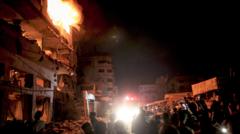
The targeted kinetic operation executed against Izz al-Din al-Haddad in Gaza City exposes the fragile equilibrium between high-value targeting and long-term geopolitical stabilization. On May 15, 2026, Israeli airstrikes hit a localized safehouse apartment in the Rimal neighborhood and a secondary escape vehicle, leaving seven dead and at least 50 injured. This intervention was not merely an act of tactical retribution against a remaining architect of the October 7, 2023 attacks. It represents a calculated disruption of the command architecture governing the al-Qassam Brigades, specifically designed to alter the bargaining power within ongoing multilateral diplomatic negotiations.
Understanding the implications of this strike requires separating immediate tactical metrics from structural strategic friction. Media reports frequently assess targeted assassinations through a binary lens of success or failure. A rigorous analysis demands a multi-tiered framework analyzing operational methodology, structural command degradation, and the diplomatic feedback loop.
The Operational Mechanics: Dual-Vector Kinetic Execution
The execution of the strike on western Gaza City reveals a deliberate methodology designed to bypass strict counter-surveillance protocols. Al-Haddad, colloquially designated the "Ghost of al-Qassam," had survived multiple historical kinetic attempts, signaling highly advanced operational security (OPSEC).
The May 15 engagement utilized a dual-vector interception model:
- The Primary Strike (Static Interdiction): Israeli warplanes delivered at least three precision-guided munitions into a specific residential unit within the Al-Mu'taz building. This targeted an established intelligence node or temporary hideout rather than a hardened military installation.
- The Secondary Strike (Dynamic Interdiction): Almost immediately following the initial detonation, an unmanned aerial vehicle (UAV) struck a moving vehicle on nearby Al-Wehda Street. Military radio reports indicate this secondary vector was deployed to prevent the escape of high-value assets fleeing the primary blast perimeter.
This combination of structural breaching and mobile containment indicates a high-fidelity intelligence loop operating with compressed sensor-to-shooter timelines. To achieve this level of precision inside a densely populated sector like Rimal requires real-time signals intelligence (SIGINT) correlated against localized human intelligence (HUMINT).
The Command Replacement Paradox
The primary military justification for high-value targeting is decapitation theory: the systematic removal of leadership to induce systemic failure within a non-state armed group. However, empirical history demonstrates that the elasticity of leadership replacement varies by organizational design.
Hamas utilizes a highly decentralized, cellular command network structured to withstand severe attrition. Al-Haddad assumed the role of Gaza Strip military chief only after Israel assassinated his predecessor, Mohammad Sinwar, in May 2025. This rapid succession highlights the presence of a pre-established institutional contingency plan.
The organizational impact of losing a senior commander follows a clear cost function:
$$C_d = f(V_i, T_r) - S_a$$
Where:
- $C_d$ is the total structural degradation of the organization.
- $V_i$ represents the institutional memory and operational expertise of the targeted asset.
- $T_r$ is the operational time required to clear a successor.
- $S_a$ represents the autonomous capacity of localized field units to operate without central command.
Because the al-Qassam Brigades operate with high localized autonomy ($S_a$), removing a top-tier commander does not yield immediate tactical paralysis on the ground. Instead, it creates a temporary friction point in macro-level command coordination. The loss of institutional memory ($V_i$) scales with the tenure of the commander; since Al-Haddad held the apex position for exactly one year, his removal inflicts mid-level friction rather than total systemic collapse.
Diplomatic Friction and the Demilitarization Bottleneck
The timing of this kinetic intervention intersects directly with broader diplomatic deadlock. While standard reporting frames these events as isolated military exchanges, this operation functions as an explicit policy instrument aimed at U.S.-backed post-war planning frameworks.
A joint statement by Prime Minister Benjamin Netanyahu and Defense Minister Israel Katz explicitly noted that Al-Haddad rejected terms aimed at the comprehensive disarmament of Hamas and the demilitarization of the Gaza Strip. According to intelligence leaks published via Channel 12, Israeli leadership authorized the strike after identifying Al-Haddad as a primary structural barrier to coaxing internal elements toward organizational capitulation.
This creates an immediate diplomatic bottleneck:
- The Israeli Objective: By eliminating hardline military commanders who hold veto power over disarmament clauses, Israel aims to lower the internal resistance within Hamas toward structural concessions.
- The Counter-Reaction: In the immediate term, asymmetric organizations historically respond to high-level decapitation by pausing active negotiations. The elimination of a key interlocutor or military chief introduces internal security reviews, delaying diplomatic timelines.
The ongoing enforcement of the fragile October ceasefire has already been challenged by persistent attrition, resulting in more than 850 casualties since its implementation. This latest strike risks transforming a porous truce into an unviable framework, as both parties trade accusations of operational violations.
Tactical De-escalation vs. Strategic Entrenchment
A critical limitation of kinetic attrition is its inability to resolve underlying systemic drivers. High-value targeting effectively degrades immediate operational capabilities, yet it simultaneously yields long-term compounding challenges.
The civilian toll of the May 15 operation—seven confirmed fatalities and dozens of injuries processed through Al-Saraya Field Hospital and Shifa Hospital—increases the political costs for regional actors attempting to mediate a durable settlement. This dynamic hardens civilian alignment with resistant factions, maintaining the recruitment pipelines that replace depleted cadre layers.
While state-owned broadcast networks like Kan TV quote security officials claiming the strike was highly successful, tactical precision must not be conflated with strategic victory. The systematic degradation of leadership nodes offers diminishing marginal returns if the political architecture of the territory remains unresolved.
The immediate trajectory will be dictated by Hamas's upcoming internal succession announcement. If the organization elevates an equally hardline commander from the operational wing, the kinetic operation will have achieved a costly reset of the leadership timeline without altering the underlying strategic deadlock. If the political wing uses the vacuum to assert control over the remaining security apparatus, a narrow window for negotiated demilitarization may emerge.