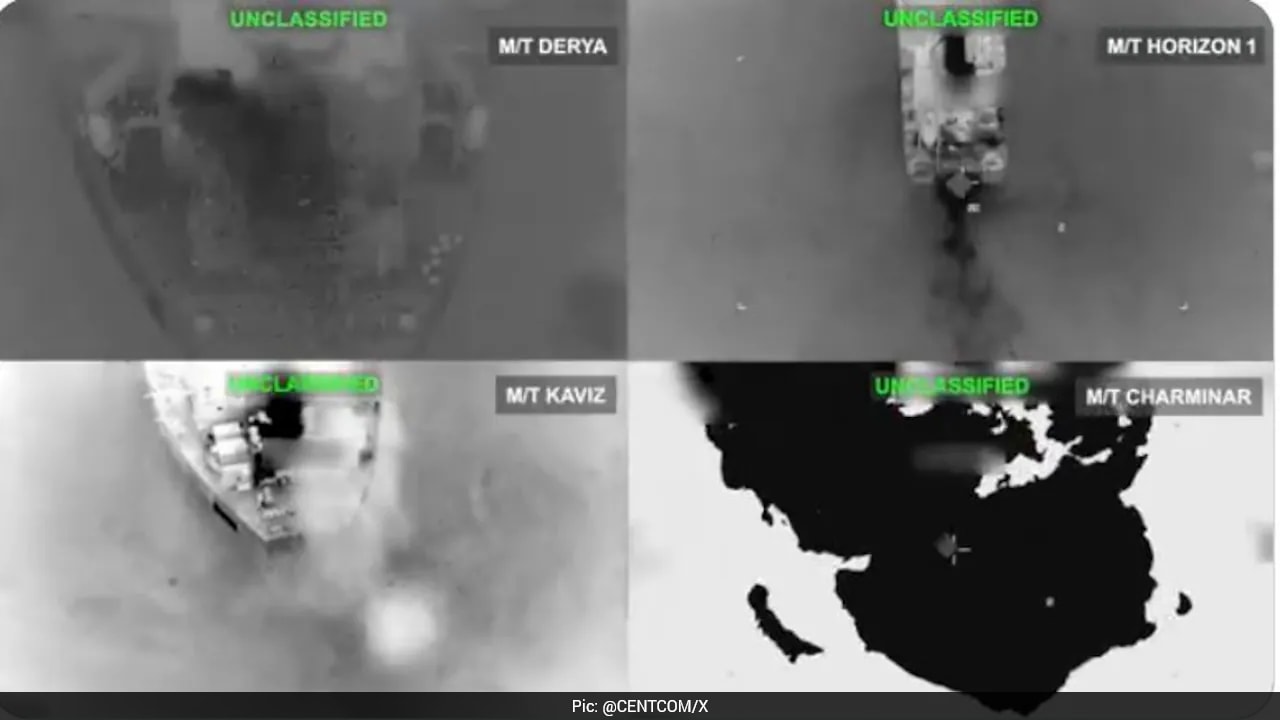
United States Central Command forces destroyed five Iranian crude oil carriers in the Gulf of Oman and near Kharg Island after the Islamic Revolutionary Guard Corps targeted a U.S. Navy warship with ballistic missiles. The operation—which involved the systematic targeting of the motor tankers Kaviz, Charminar, Horizon 1, Riesco, and Derya—marks a violent acceleration of the six-month-old war in the Middle East. While military spokesmen emphasize force protection and the successful evasion of incoming threats by American vessels, the systematic destruction of commercial cargo reveals a stark reality. Washington has shifted from reactive defense to a punitive economic doctrine.
For every missile fired at a U.S. warship, the Pentagon is exacting payment in maritime infrastructure. It is a calculated trade designed to dismantle the financial lifeblood of the Iranian state one hull at a time.
The Arithmetic of Escalation
When Adm. Brad Cooper stated that the United States would impose a higher economic cost for every hostile act, he was not speaking hypothetically. The arithmetic of the current campaign relies on an asymmetric reprisal model. Iran launches ballistic missiles from coastal batteries or fast-attack craft. American defense systems, honed by months of continuous combat operations, calculate trajectories and neutralize the threat. The U.S. warship remains unharmed.
Then comes the counter-strike. Rather than merely suppressing the launch site, American forces target the shadow fleet. These are the multi-billion-dollar vessels responsible for carrying sanctioned crude through the Strait of Hormuz and out to international buyers.
The mechanics of these strikes are precise. U.S. military forces direct the civilian crews to abandon ship before ordnance is delivered, minimizing personnel casualties while maximizing material destruction.
- M/T Kaviz: Neutralized in the Gulf of Oman.
- M/T Charminar: Neutralized in the Gulf of Oman.
- M/T Horizon 1: Neutralized in the Gulf of Oman.
- M/T Riesco: Neutralized in the Gulf of Oman.
- M/T Derya: Neutralized near the strategic Kharg Island export hub.
This is a war of attrition fought on balance sheets. Iran's paramilitary leadership relies on these tankers to bypass international restrictions, generate hard currency, and fund regional proxies. By systematically reducing the size of this operational fleet, Washington aims to choke off state revenues while maintaining a tight naval blockade around Iranian ports.
The Kharg Island Calculus
At the center of this maritime chess match lies Kharg Island. Handling roughly ninety percent of the nation's crude oil exports, the island is the ultimate strategic prize and the most vulnerable point in the Iranian economy.
President Donald Trump has repeatedly signaled that Kharg Island remains a preeminent target. Previous operations have damaged regional infrastructure, and the persistent presence of U.S. naval assets near its anchorage zones keeps Tehran's defense planners in a state of perpetual anxiety. When the motor tanker Derya was hit just off the coast of the island, it served as a kinetic reminder of American reach.
Yet, striking too close to the terminal carries profound global risks. The Strait of Hormuz handles roughly one-fifth of the world's petroleum shipments. Every explosion in these congested waters sends immediate shockwaves through international energy markets. Brent crude spiked toward the one-hundred-dollar threshold following the latest engagements, placing renewed pressure on Western economies and threatening political fallout ahead of domestic midterms.
Tehran understands this leverage. By maintaining a blockade of the strait and threatening third-party shipping, Iran attempts to weaponize global inflation against the White House. In response, the U.S. Navy escorts a limited number of approved vessels through safe corridors off Oman, attempting to keep global commerce flowing while starving the adversary.
The Limits of Kinetic Containment
Military analysts point out a fundamental flaw in relying solely on naval force to solve a geopolitical crisis. There is no permanent kinetic solution to the geography of the Strait of Hormuz.
Sink a tanker today, and another will be pressed into service tomorrow from the global network of dark-net shipping. Furthermore, the cycle of provocation invites dangerous miscalculation. Following the destruction of the five tankers, the Revolutionary Guard Navy issued warnings to commercial crews near Kuwait and Bahrain, threatening retaliation against states that host American forces.
Diplomatic channels remain largely frozen. Proposals from regional mediators, such as Qatar, struggle to gain traction as both Washington and Tehran calculate that they can improve their position through force. The White House insists that sustained military pressure will ultimately break Iran's resolve and force a capitulation that lowers energy prices over the long term.
Meanwhile, the shadow war expands into the skies and financial networks. Alongside the maritime strikes, the administration layered new sanctions onto dozens of private and commercial Iranian aviation entities, tightening the commercial isolation of the country.
The burning hulls resting on the seabed of the Gulf of Oman tell the immediate story of American military dominance. Whether that dominance can force a strategic surrender before global markets fracture remains the unanswered question of a conflict sliding deeper into uncharted waters


/dandelion--taraxacum--in-the-wind-200194596-001-5c8d4453c9e77c00014a9d5d.jpg)
