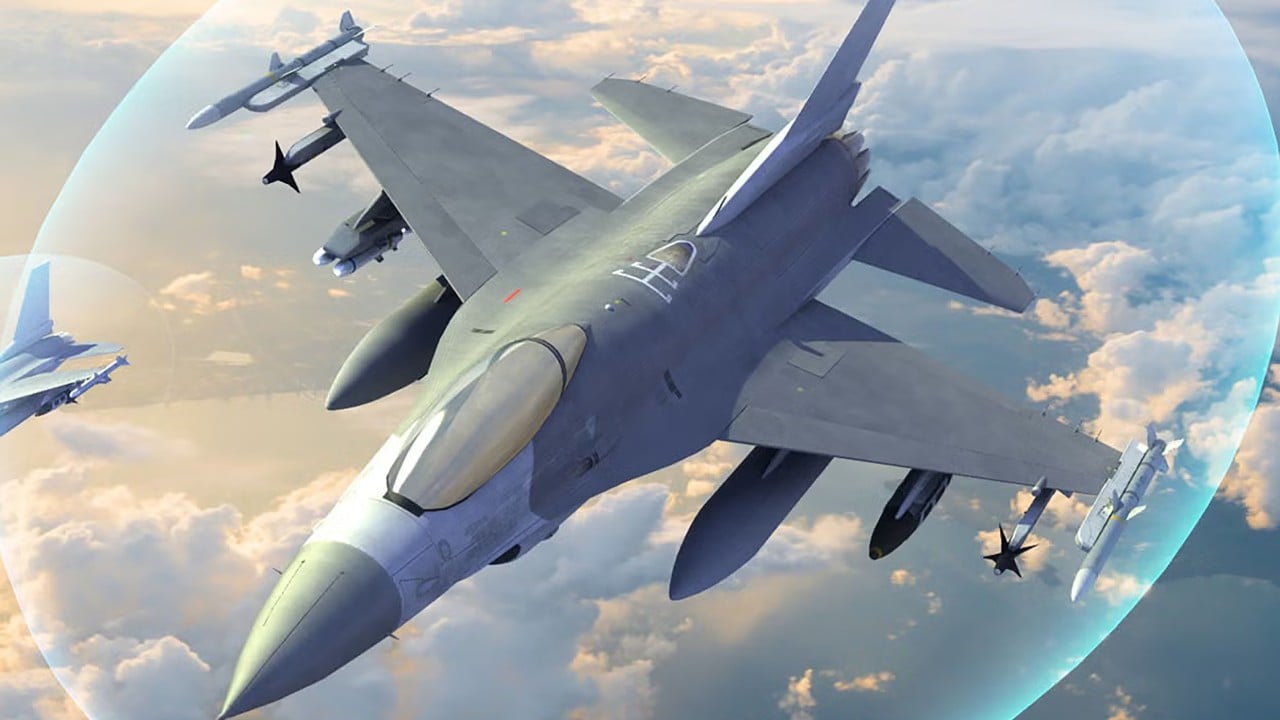
A 17 percent defense budget increase dedicated to upgrading Taiwan's new F-16V fighter fleet is not a routine procurement adjustment; it is a mathematical admission that airframe acquisition costs represent a fraction of modern combat readiness. Standard reporting treats defense allocations as simple ledger entries, ignoring the compounding capital demands of sensor integration, electronic warfare survival, and logistics resilience. To understand the operational reality behind this budget expansion, analysts must separate the baseline airframe cost from the escalating marginal cost of keeping a fourth-generation-plus fighter survivable inside a contested anti-access/area denial (A2/AD) bubble.
The Structural Anatomy of the F-16V Cost Function
Defense procurement follows a non-linear cost curve where the final 15 percent of combat capability consumes over half of the lifecycle capital. When Taiwan committed to acquiring 66 new-build F-16C/D Block 70 aircraft—designated locally as F-16V—alongside upgrading its existing fleet of roughly 140 older Block 20 airframes, the initial sticker price reflected baseline manufacturing. The subsequent 17 percent budget surge captures the hidden variables of modern aerospace integration.
The total expenditure divides into three distinct operational buckets:
- Sensor and Avionics Hardware: The core of the Viper configuration is the AN/APG-83 Scalable Agile Beam Radar (SABR). Unlike legacy mechanically scanned arrays, an Active Electronically Scanned Array (AESA) radar requires substantial power generation, liquid cooling modifications, and high-throughput mission computers. Supply chain bottlenecks in gallium nitride (GaN) semiconductor components and specialized microelectronics drive unit costs upward between contract signing and physical delivery.
- Electronic Warfare and Self-Protection Suites: An airframe without survivability upgrades is a depreciating asset in the Taiwan Strait. A significant portion of the budget expansion addresses the integration of internal electronic warfare systems—specifically the AN/ALQ-254(V)1 Viper Shield or equivalent digital radar warning receivers and jammers. Retrofitting or building in full-spectrum jamming requires extensive electromagnetic compatibility testing so the aircraft's own defensive emissions do not blind its AESA radar.
- Munitions and Stand-Off Integration: The physical aircraft functions merely as a launch rail. The budget boost absorbs the software integration costs required to certify advanced munitions, including AGM-88B High-Speed Anti-Radiation Missiles (HARM), AGM-154 Joint Standoff Weapons (JSOW), and extended-range AIM-120D air-to-air missiles. Each weapon demands specific operational flight program (OFP) software loads and flight-test validation.
Why Airframe Upgrades Outpace Baseline Inflation
Observers frequently misinterpret defense budget hikes as simple inflationary adjustments. While aerospace labor and raw materials—specifically titanium and specialized aluminum-lithium alloys—have experienced persistent price escalation, inflation accounts for less than a third of a 17 percent jump. The primary driver is configuration drift.
Between the initial Foreign Military Sales (FMS) Letter of Offer and Acceptance and final assembly, the threat environment evolves. In the Indo-Pacific theater, the rapid deployment of fifth-generation stealth platforms like the J-20 and long-range surface-to-air missile batteries (such as the S-400 and HQ-9B) alters the survivability calculus. To prevent the F-16V from becoming obsolete before its first operational squadron reaches full capacity, defense planners inject mid-stream engineering change proposals (ECPs).
Every ECP triggers a cascade of secondary expenses:
- Non-Recurring Engineering (NRE): Redesigning wiring harnesses, bulkheads, or cooling ducts to accommodate late-stage avionics changes.
- Software Regression Testing: Re-verifying millions of lines of flight-control and mission-system code whenever a new sensor or weapon interface is added.
- Training Pipeline Recalibration: Updating full-mission simulators and maintenance diagnostic rigs to match the altered cockpit and avionics architecture.
When a defense ministry expands an existing upgrade budget by 17 percent, it is paying to compress the timeline between threat emergence and fleet-wide countermeasure deployment.
The Three Pillars of Operational Readiness in the Taiwan Strait
To evaluate whether this capital allocation yields genuine combat power, we must measure it against the specific tactical constraints of a cross-strait conflict. Possessing 200+ upgraded F-16Vs means nothing if those aircraft cannot generate sorties under continuous ballistic missile bombardment.
Pillar 1: Distributed Sortie Generation and Logistics
A fighter jet on the tarmac is a target; a fighter jet in the air is an asset. The budget surge inevitably funds more than cockpit hardware—it must underwrite expeditionary maintenance infrastructure. Standard F-16 operations rely on fixed main operating bases with long, pristine runways. Under a saturation strike scenario, those runways will be cratered within the first 30 minutes of hostilities.
Upgrading the fleet requires parallel investments in hardened aircraft shelters, mobile arresting gear, rapid runway repair kits, and decentralized spare parts depots. If the 17 percent increase allocates capital to conformal fuel tanks (CFTs) and auxiliary power units, it directly extends loiter time and reduces dependence on vulnerable aerial refueling tankers or exposed forward airfields.
Pillar 2: Sensor Fusion and Networked Lethality
In isolation, an F-16V is a fourth-generation airframe with a high radar cross-section compared to true low-observable aircraft. Its tactical value relies entirely on network-centric warfare. Through Link-16 tactical data links and upgraded cryptographic radios, the F-16V acts as a forward sensor node.
Consider a conceptual engagement scenario: a low-flying F-16V uses its AN/APG-83 radar in a low-probability-of-intercept (LPI) mode to detect incoming cruise missiles or surface vessels over the horizon. Rather than illuminating its own position by firing immediately, it transmits targeting coordinates via Link-16 to land-based Patriot PAC-3 batteries or naval vessels. The budget boost directly funds the high-bandwidth datalinks and anti-jamming waveforms required to keep this kill web intact under heavy electronic attack.
Pillar 3: Asymmetrical Attrition Management
Warfare in the Taiwan Strait is a math problem of magazine depth versus attrition rates. China's People's Liberation Army Air Force (PLAAF) enjoys a substantial numerical advantage in total airframes and proximity to mainland industrial repair hubs. Taiwan cannot win a one-for-one battle of attrition.
The economic logic behind upgrading the F-16V rather than pursuing an immediate, prohibitively expensive fifth-generation alternative rests on exchange-ratio optimization. By equipping a proven, maintainable airframe with fifth-generation sensors (the APG-83 shares 95 percent of its software and hardware modes with the F-35's APG-81 radar), Taiwan maximizes combat capability per dollar spent. A 17 percent cost increase remains vastly cheaper than building the logistical tail required to support an entirely new aircraft type, such as the F-35, even if political hurdles to acquiring stealth fighters disappeared overnight.
Assessing the Hidden Bottlenecks and Strategic Limitations
No capital injection eliminates structural constraints. Even with an expanded budget, Taiwan's F-16V modernization faces three severe operational bottlenecks that money alone cannot quickly resolve.
The Pilot-to-Airframe Deficit
Hardware scales faster than human capital. Expanding and upgrading a fleet to over 200 advanced multirole fighters requires a corresponding surge in qualified fighter pilots and specialized avionics technicians. Training a combat-ready F-16V pilot capable of managing complex sensor fusion, electronic warfare, and beyond-visual-range (BVR) engagements takes years of flight hours.
If pilot recruitment and retention lag behind airframe delivery, the Republic of China Air Force (ROCAF) faces a classic hollow force trap: possessing high-tech aircraft grounded by crew shortages or pilot fatigue. High operational tempo—driven by near-daily intercepts of PLAAF air defense identification zone (ADIZ) incursions—already burns through airframe fatigue life and pilot stamina at an unsustainable rate.
Foreign Military Sales Delivery Backlogs
Budget approval in Taipei does not equate to immediate hardware arrival on the flight line. Taiwan's defense procurement operates through the U.S. Foreign Military Sales pipeline, which currently suffers from multi-billion-dollar delivery backlogs. American defense contractors face acute shortages in skilled aerospace machinists, specialized castings, and sub-tier electronics suppliers.
Allocating 17 percent more capital secures Taiwan's place in the production queue and covers price escalations, but it cannot bypass physical manufacturing constraints in Greenville, South Carolina, or Fort Worth, Texas. The lag between budget authorization and operational capability creates a dangerous window of vulnerability where funds are committed, legacy systems are retired or undergoing depot maintenance, and new capabilities have yet to arrive.
Runway Vulnerability and Airfield Survivability
Upgrading an F-16V with the finest radar and electronic warfare suite on earth solves zero problems if the aircraft is destroyed inside its hangar. The ROCAF's primary airbases on Taiwan's west coast—such as Chiayi, Hsinchu, and Tainan—sit within minutes of flight time from mainland ballistic and cruise missile batteries. Even hardened mountain facilities like Chiashan and Taitung on the east coast face threats from precision bunker-busting munitions targeting tunnel entrances and taxiways.
Without a massive, parallel investment in integrated air and missile defense (IAMD) around these specific airfields, the F-16V fleet remains tethered to fragile infrastructure. Critics of conventional fighter spending argue that capital directed toward high-end jets yields diminishing returns compared to mobile, dispersed asymmetric systems like truck-mounted anti-ship missiles, loitering munitions, and portable air defenses.
Capital Allocation Trade-Offs in Asymmetric Defense
This budget expansion sits at the center of a fundamental doctrinal debate: the Overall Defense Concept (ODC) versus conventional deterrence.
Pure asymmetric theorists argue that every dollar spent on exquisite, runway-dependent platforms like the F-16V is a dollar stolen from mobile, survivable coastal defense missiles and naval mines. From this perspective, conventional air forces are too brittle to survive the opening salvos of a high-intensity conflict.
Conversely, conventional deterrence practitioners point out that an asymmetric-only force surrenders peacetime sovereignty. You cannot intercept an adversarial bomber violating your airspace with a mobile anti-ship missile, nor can you project presence across maritime chokepoints using coastal batteries. Peacetime gray-zone coercion requires manned aircraft capable of visual identification, escort, and calibrated escalation control.
The 17 percent budget boost represents a calculated compromise. Rather than abandoning manned aviation or attempting to match mainland fighter production hull-for-hull, Taiwan is concentrating capital on quality multipliers—sensors, electronic survival, and stand-off munitions—that allow a smaller, aging fleet to remain relevant in both peacetime policing and high-intensity warfighting.
Operational Imperatives for the Next 36 Months
To convert this 17 percent budget expansion from an accounting line item into measurable deterrence, defense planners must subordinate hardware vanity to logistical survivability. The capital must be aggressively gated toward three immediate execution priorities:
- Enforce Strict Configuration Freeze: Lock the Block 70 and Block 20 upgrade baselines immediately. Resist further mid-stream hardware modifications that trigger non-recurring engineering delays, prioritizing rapid delivery of existing airframes over theoretical perfection in 2030.
- Shift Capital to Expeditionary Sustainment: Dedicate the discretionary margin of the budget increase to mobile maintenance kits, decentralized munitions storage, and austere runway operations training—specifically practicing highway strip landings and rapid turnaround procedures under simulated electronic jamming.
- Automate Peacetime Intercepts: Offload routine ADIZ policing to lower-cost unmanned aerial vehicles (UAVs) and ground-based radar networks wherever tactically viable, preserving F-16V airframe hours and pilot readiness strictly for high-end combat training and crisis response.
Without ruthless discipline in logistics and pilot preservation, a 17 percent budget surge merely buys more expensive targets for an opening strike. Executed with operational focus, it extends the credible deterrence window of Taiwan's air arm through the end of the decade.



