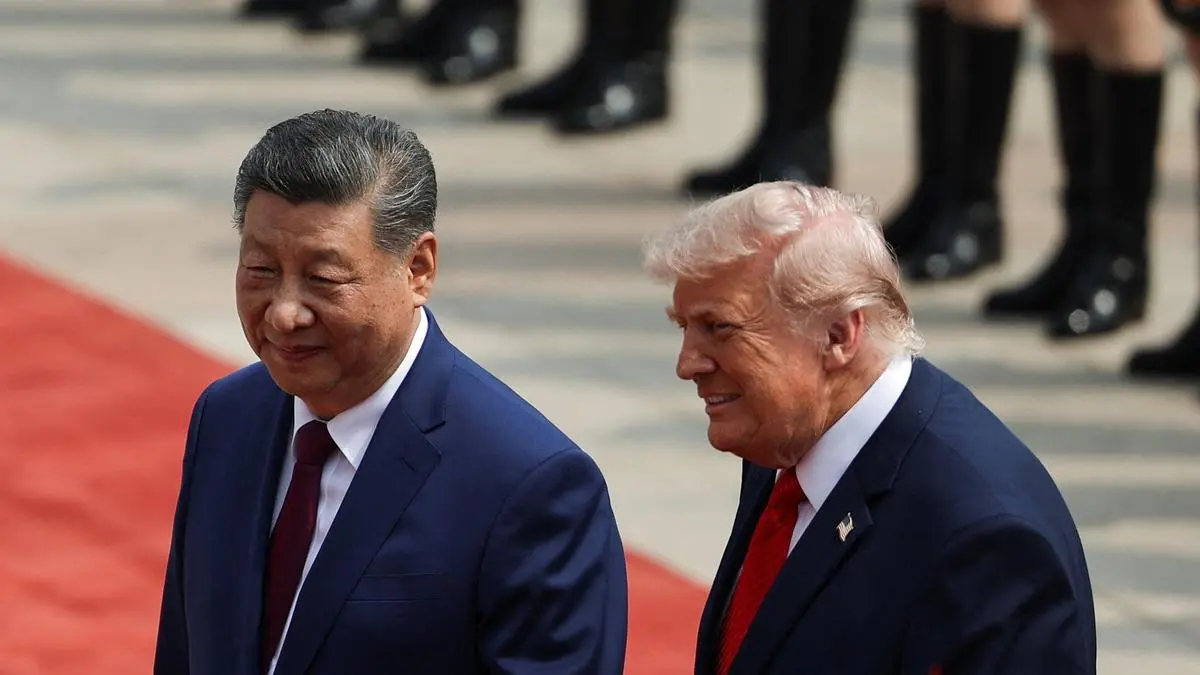
Don't let the red carpets and the gun salutes at the Great Hall of the People fool you. While Donald Trump and Xi Jinping were busy trading compliments in Beijing this Thursday, the actual subtext was far more aggressive. Xi didn't waste any time getting to the point. He told Trump flat out that if they don't handle the "Taiwan question" properly, the world's two biggest powers are headed for a literal collision.
It's the first time a US president has set foot in China in nine years. You’d think the mood would be celebratory, but the tension over Taiwan is basically at a boiling point. Xi’s message was blunt. He called Taiwan the most important issue in the entire relationship. He used a pretty vivid metaphor too, saying that peace in the strait and Taiwan’s independence are "irreconcilable as fire and water."
The $14 billion problem sitting on Trump's desk
The real friction isn't just about rhetoric; it's about hardware. Right now, there’s a massive $14 billion weapons package for Taiwan that’s been stalled at the State Department for months. This follows an $11 billion sale from last year. Beijing is furious about it. To them, every missile and radar system the US sends to Taipei is a direct violation of their "One China" principle.
Xi is playing a high-stakes game of leverage. He knows Trump wants things from him. Trump brought a literal army of CEOs with him—names like Elon Musk, Jensen Huang, and Tim Cook. He wants China to "open up" more for American business. He also needs Xi’s help to pressure Iran and keep the Strait of Hormuz open. Xi’s response? If you want help with trade or the Middle East, you need to back off on Taiwan.
Why 2026 feels different for US China relations
If you’ve followed this saga for years, you might think this is just the usual saber-rattling. It isn't. The dynamic has shifted. In 2025, we saw a brutal trade war where tariffs soared over 100%. China fought back by restricting rare earth exports, which are vital for US tech and defense. They feel like they held their ground.
Now, Beijing sees an opening. They think Trump might be willing to trade Taiwan’s security for a "win" on trade or a big purchase of American soybeans and Boeing jets. Trump has already publicly grumbled that Taiwan "stole" the US semiconductor business. He’s even suggested they should pay the US for protection. That kind of talk makes people in Taipei extremely nervous and gives Beijing a lot of confidence.
The red lines nobody can cross
China isn't just asking for a pause in arms sales. They want a total shift in how the US talks about the island. For decades, the US has used "strategic ambiguity"—basically not saying clearly whether we’d fight for Taiwan or not. Xi wants Trump to drop that and explicitly "oppose" Taiwan independence.
- The Trade Trap: China might link the purchase of US goods (the "Three Bs": Beef, Boeing, and Beans) to the cancellation of arms deals.
- The Tech Tussle: With Nvidia and Tesla bosses in the room, the chip war is the elephant in the hall. Taiwan produces the vast majority of the world's high-end chips.
- The Iran Factor: Trump needs China to help stabilize the Middle East, but that help comes with a "Taiwan tax."
What this means for you and the global economy
If these two actually "collide" as Xi warned, we aren't just talking about a diplomatic spat. We're talking about a complete shutdown of global supply chains. A conflict in the Taiwan Strait would likely tank the global GDP by trillions of dollars almost overnight.
You’re seeing a classic "irresistible force meets immovable object" scenario. Trump wants to be the ultimate dealmaker, but Xi is signaling that Taiwan is the one thing he won't trade away. Honestly, the risk isn't just a planned invasion; it's a miscalculation. With more US and Chinese ships and planes in the area than ever before, one wrong move by a pilot or a captain could trigger the "conflict" Xi is warning about.
Keep an eye on that $14 billion weapons package. If Trump suddenly decides to "delay" it further or cancel it after this trip, we’ll know he’s made a choice. He might get his trade deal, but the price could be the long-term security of the Pacific.
Watch the official readouts from the rest of the summit. If they stay focused on "friendship" and "cooperation" without mentioning specific agreements on the Strait, it means the fire and water are still very much clashing behind closed doors.