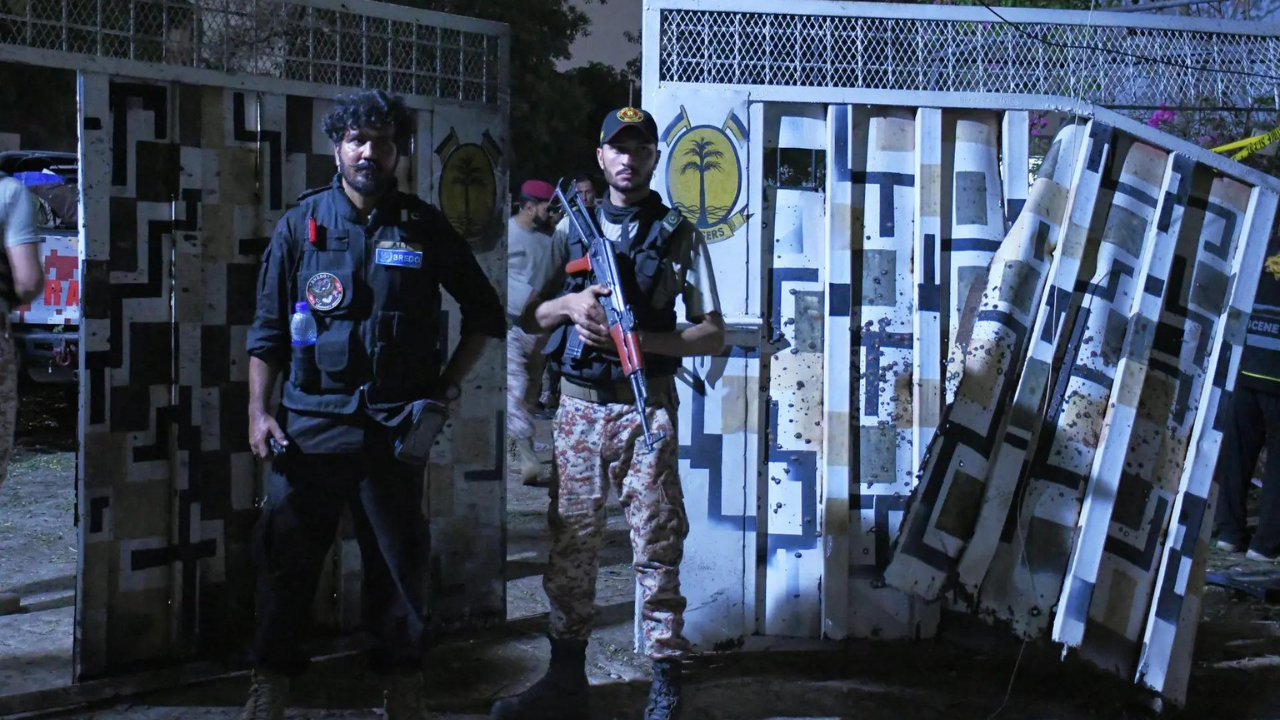
The 90-minute engagement at the Sindh Rangers’ Bhittai Wing headquarters in Karachi on June 27, 2026, exposes a critical shift in the tactical calculus of urban asymmetric warfare within Pakistan. By employing a high-kinetic penetration vector—specifically, ramming an explosives-laden vehicle into a fortified perimeter gate—the militant faction Jamaat-ul-Ahrar bypassed traditional outer layered defenses to force an immediate close-quarters battle inside a secure military installation. This operation resulted in the deaths of six attackers, the capture of one injured operative, and the loss of four Rangers paramilitary personnel. Analyzing this engagement requires dismantling the operational mechanics of target hardening, response latency, and the shifting geography of localized insurgent alliances.
The Breach Vector and Structural Vulnerabilities
Securing a high-value urban military asset relies on the principle of nested containment zones. The initial phase of the assault exploited a known vulnerability in urban perimeter design: the transition point between public infrastructure and military territory.
[Public Infrastructure] ---> (Vulnerable Transition Point / Gate) ---> [Nested Containment Zone]
When an asset is situated near dense civilian traffic networks, such as University Road in Gulistan-e-Jauhar, the physical standoff distance—the space required to identify, intercept, and neutralize an incoming vehicular threat before it reaches structural perimeters—is severely compressed.
The attackers utilized a vehicle-borne improvised explosive device not merely as a psychological tool, but as a kinetic breaching mechanism to eliminate the gate asset. This neutralized the structural barrier and created an immediate corridor for the five accompanying armed assault elements. By using hand grenades to generate secondary explosions immediately following the primary breach, the attackers disrupted the garrison’s immediate sensory situational awareness, establishing a temporary tactical asymmetry within the first minutes of the confrontation.
Friction and Response Latency
The duration of the engagement—approximately 90 minutes—indicates the velocity of the counter-offensive rather than a prolonged siege. In urban counter-terror operations, response latency is governed by three distinct phases:
- The In-Situ Engagement Phase: The immediate kinetic exchange between the penetrating force and the on-duty quarter-guard or perimeter sentries. The death of four Rangers personnel occurred primarily during this phase, as they absorbed the initial impact of the breach and fixed the attackers in position, preventing deeper penetration into the residential or command sectors of the compound.
- The Containment Phase: The arrival of external specialized reinforcement vectors. In this instance, local police infrastructure, the Sindh Police Special Security Unit, and the Anti-Terrorist Force established an outer perimeter, isolating the kinetic zone to prevent the escape of the attackers or the introduction of secondary militant elements.
- The Elimination and Clearance Phase: The systematic clearing of the structure. The termination of six attackers and the live capture of an injured operative demonstrate that the reinforcing forces systematically compromised the attackers' cover using superior numbers and specialized tactical maneuvers.
The live capture of a militant represents a major failure in typical suicide-assault operational design, which usually dictates absolute non-surrender to protect operational security and intelligence silos. This capture suggests either a breakdown in the operative's psychological conditioning or a failure in the weapon systems meant to ensure self-detonation upon operational compromise.
Geopolitical Alignment and Strategic Redirection
The attribution of the attack to Jamaat-ul-Ahrar, an active faction of the banned Tehreek-e-Taliban Pakistan, signals a calculated geographic dispersion of force. Historically, Jamaat-ul-Ahrar's primary operational theater has been concentrated within the northwestern rugged terrain of Khyber Pakhtunkhwa along the porous Durand Line. Executing a highly coordinated assault in Karachi—Pakistan’s primary economic engine and a coastal metropolis located over a thousand kilometers from the group’s core territorial base—requires a sophisticated logistical architecture.
This geographic leap points to the utilization of localized logistical nodes. Transnational or regional insurgent groups cannot operate in a metropolis like Karachi without deep-cover networks capable of managing reconnaissance, safe houses, arms procurement, and vehicular modification. The selection of a paramilitary target rather than a soft civilian asset indicates a strategic intent to project capability, signal resilience against state pressure, and impose a high material cost on the state apparatus.
Furthermore, the timing of the assault coincides with deep diplomatic friction between Islamabad and Kabul regarding cross-border sanctuaries. The state's defensive framework must now account for a dual-threat matrix in Karachi: the Balochistan Liberation Army, which targeted Chinese nationals in the city in October 2024, and the TTP-affiliated elements targeting state security infrastructure.
Hardening the Urban Security Framework
To counter the tactical innovations demonstrated in this assault, urban military architecture must evolve beyond passive perimeter barriers. Relying on reinforced gates is insufficient when facing velocity-driven vehicular breaches.
The immediate tactical requirement is the implementation of automated, heavy-duty anti-ram bollards capable of stopping multi-ton vehicles traveling at high speeds, positioned well ahead of the primary access gates. These must be paired with offset entrance designs—serpentine approach channels—that force vehicles to decelerate completely before reaching an entry checkpoint, neutralizing the kinetic energy required to force a gate breach.
Operational doctrines must also integrate rapid-deployment automated counter-measures, such as remote-controlled weapon stations covering entrance funnels, to suppress penetrating infantry elements instantly without placing human sentries in high-exposure containment zones. The Karachi assault confirms that structural defense is an active, evolving calculation of kinetic energy, time delay, and immediate firepower application.