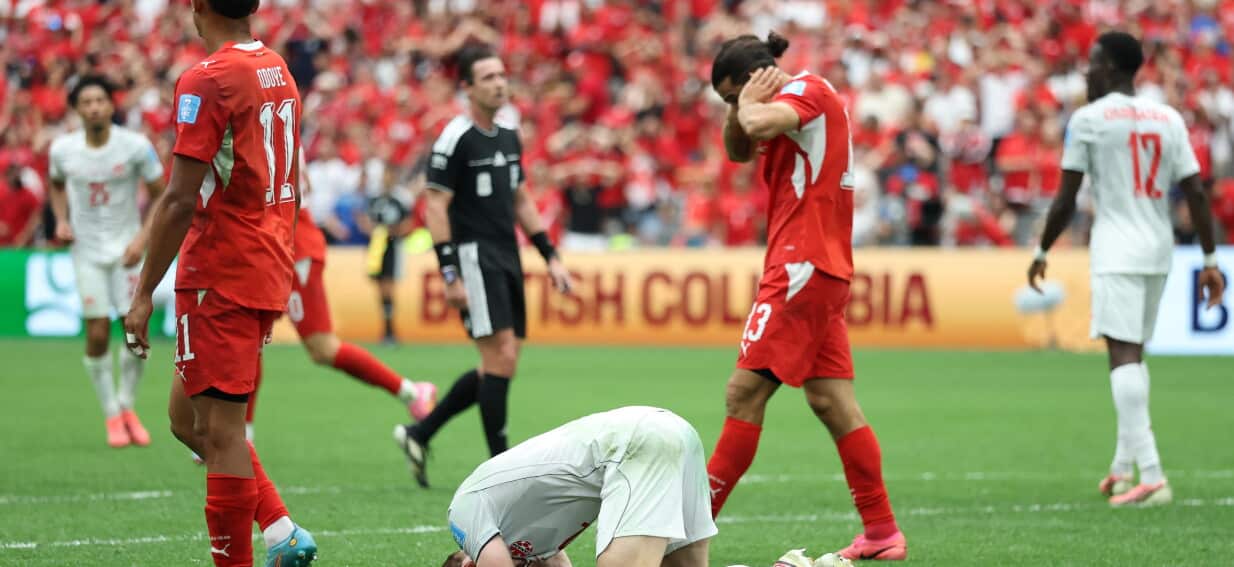
The margins of international soccer are notoriously thin, but Bosnia’s 3-2 victory over Qatar did more than just alter the standings. It fundamentally shifted the calculus of the tournament. With this result, Bosnia secured a lifeline to keep their hopes of reaching the World Cup round of 32 intact, while simultaneously sending Qatar packing in a match that exposed deep-seated tactical vulnerabilities. Most post-match analysis focuses on the final scoreline. That is a mistake. The real story lies in how Bosnia exploited a structural mismatch that Qatar’s coaching staff failed to adjust to over ninety grueling minutes.
This was not a standard group stage match where two teams played conservative, risk-averse football. It was a high-stakes tactical chess match that quickly turned into a physical war of attrition.
The Flaw in the Qatari Low Block
Qatar entered the match needing only a draw to progress, a psychological trap that has claimed far better teams in the history of international tournament play. Their defensive strategy relied on a deep-lying defensive line meant to compress the space between the midfield and the goalkeeper. The objective was clear. They wanted to force Bosnia into playing long, hopeful balls into the penalty box.
Bosnia did not take the bait. Instead of crossing blindly from deep positions, the Bosnian midfielders systematically targeted the half-spaces—the zones between Qatar's central defenders and fullbacks.
By overloading these specific areas, Bosnia forced Qatar's central defenders to step out of the penalty box to challenge for the ball. This movement created a catastrophic chain reaction in the Qatari defense. Every time a center-back stepped up, it left a massive void behind them. Bosnia’s wingers, playing as inverted forwards, cut directly into these vacated spaces. The first two Bosnian goals were direct results of this exact pattern of play. It was not luck. It was a mathematical exploitation of a rigid defensive system that refused to adapt.
The Midfield Engine Room
To understand how Bosnia sustained this pressure, you have to look at the data governing possession retention in the middle third of the pitch. Bosnia controlled 58 percent of the ball, but more importantly, they won nearly 65 percent of the second balls—the loose possessions that occur immediately after a tackle or a cleared header.
Qatar’s midfield pair was entirely overrun. They played too far apart, leaving an ocean of space for Bosnia's deep-lying playmaker to dictate the tempo of the match without facing a single direct press.
When a team allows an elite passer time and space on the ball, the defensive line is effectively dead. Bosnia used this freedom to switch the point of attack rapidly, shifting Qatar’s defensive block from left to right until the gaps widened into chasms. Qatar attempted to counter this by dropping their wing-backs even deeper, effectively forming a six-man defensive wall. This backfired spectacularly. By pulling their wide players so deep, Qatar completely surrendered their ability to launch counter-attacks, allowing Bosnia to commit eight players forward without fear of reprisal.
Anatomy of a Structural Collapse
The breaking point arrived midway through the second half. Leading 2-1, Qatar attempted to transition from their ultra-defensive posture to a mid-press to run down the clock. This hybrid approach proved fatal. Half the team pushed up to press, while the backline remained anchored near their own penalty area.
The resulting disconnect left a thirty-yard gap in the center of the pitch. Bosnia exploited this instantly.
A vertical pass sliced through the non-existent Qatari midfield, finding the Bosnian striker who turned and unleashed a strike into the bottom corner. Minutes later, a near-identical breakdown led to the penalty that sealed Qatar’s fate. It was a masterclass in how psychological hesitation translates into physical positioning errors on the pitch. You cannot play two defensive systems simultaneously at this level of competition.
The Realities of the Round of 32
Bosnia’s survival is a compelling narrative, but it comes with severe caveats that their coaching staff must address immediately if they expect to survive the knockout rounds. While their offensive output was highly efficient, their own defensive transition was fragile.
Qatar scored twice on just three shots on target. Both goals originated from simple individual errors in the Bosnian penalty box—a missed clearance and a failure to track a runner on a set piece. Advanced sides in the round of 32 will not require an opponent to open up structurally to score; they will punish these minor lapses with clinical precision. Bosnia proved they have the tactical intelligence to dismantle a rigid defensive block, but tournament football rarely rewards teams that give away soft goals at the other end of the pitch.
The victory keeps the dream alive, but the celebration must be brief. Bosnia found the flaws in Qatar's system, but the elite teams waiting in the next round are already drawing up the blueprint to expose theirs. Balance is no longer a luxury for Bosnia. It is the sole requirement for survival.