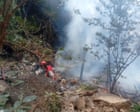
Accidents involving tourism transport infrastructure expose structural vulnerabilities in regulatory enforcement, operational risk management, and emergency response infrastructure. The fatal safari helicopter crash in Kenya, which claimed the lives of five American tourists and two local crew members, functions as a high-consequence stress test for the commercial aviation sector operating within high-risk geographic and environmental conditions.
Evaluating this incident requires moving past immediate emotional reactions and superficial reporting. A systematic dissection of the event reveals critical failure points across three distinct vectors: environmental hazard mapping, commercial incentive structures in remote tourism, and the regulatory oversight gap that permits high-risk excursions to operate with inadequate standardization.
The Operating Environment: Topography and Microclimate Hazards
Helicopter operations in East Africa face unique environmental stressors that compound mechanical and human performance risks. Unlike commercial aviation governed by rigid radar-vectored corridors, safari aviation frequently operates in visual flight rules conditions over unmapped or poorly charted terrain.
The primary variable governing safety in this domain is altitude density altitude interaction. High ambient temperatures combined with elevated terrain degrade engine performance and rotor lift capability. When an aircraft operates near maximum takeoff weight with passengers, fuel, and equipment, the operational margin for error shrinks significantly.
Wind shear and localized downdrafts present secondary hazards, particularly near escarpments, river valleys, and volcanic formations common across safari routes. Operators must balance client demand for low-altitude wildlife viewing against the aerodynamic penalties of flying below optimal contour heights. Low-altitude flight reduces reaction time for autorotation maneuvers in the event of a power plant failure, transforming a survivable engine anomaly into a catastrophic impact event.
Commercial Pressures and Risk Mitigation Failure
The economics of high-end tourism create persistent downward pressure on safety margins. Premium operators charge substantial premiums for bespoke aerial wildlife safaris, which incentivizes high fleet utilization rates. High utilization directly impacts maintenance turnaround times and increases exposure hours for aircrews.
Risk management in boutique aviation relies heavily on pilot judgment rather than institutionalized hard stops. When weather deteriorates or mechanical anomalies manifest, the financial and reputational cost of canceling a high-value excursion often biases decision-making toward mission completion.
To quantify the operational exposure, consider the risk matrix governing remote air safaris:
- High consequence of failure paired with low probability of immediate rescue creates an asymmetric risk profile.
- Passenger load factors frequently approach maximum capacity to optimize margin per flight hour.
- Maintenance supply chains in remote airstrips rely on imported parts, occasionally leading to deferred service items that meet minimum legal thresholds but degrade optimal reliability.
Mitigating these commercial hazards requires decoupling flight dispatch decisions from individual pilot discretion through automated safety management systems. Operators must establish hard operational thresholds regarding wind velocities, cloud ceiling limits, and weight-to-power ratios that override commercial imperatives.
Regulatory Oversight and Institutional Gaps
Aviation safety in developing tourism destinations often suffers from regulatory fragmentation. National civil aviation authorities face resource constraints that limit ramp inspections, pilot proficiency checks, and oversight of maintenance facilities.
When international carriers or inbound tourists contract local operators, they assume regulatory equivalence with domestic standards in the United States or Europe. This assumption is structurally flawed. International safety standards, such as those promulgated by the International Civil Aviation Organization, provide a baseline, but enforcement variance between jurisdictions remains wide.
The systemic gap manifests in three ways:
- Infrequent audit cycles for commercial helicopter operators flying non-scheduled routes.
- Ambiguous standards regarding mandatory equipment payloads, such as crash-resistant fuel systems and localized emergency locator transmitters.
- Inadequate cross-border sharing of incident data, preventing predictive modeling of recurring mechanical or environmental failure modes.
Bridging this gap requires international insurance underwriters and tourism boards to mandate third-party safety audits, such as basic aviation risk standard certifications, before commercial partnerships are authorized.
Emergency Response Logistics and Survivability
In remote wilderness accidents, the timeline between impact and definitive medical care dictates survival rates. The golden hour of trauma care is frequently violated when wreckage occurs in national reserves or conservation areas lacking immediate ground access.
Search and rescue infrastructure in East Africa relies on a fragmented network of private operators, wildlife conservancy wardens, and government security units. The absence of a unified coordination center introduces delays in initial notification and asset dispatch. Furthermore, specialized night-vision search capabilities and hoist-equipped rescue helicopters are scarce outside major metropolitan hubs.
Survival is therefore a function of secondary crash protection. This encompasses cabin energy absorption characteristics, seatbelt harness integrity, post-crash fire prevention systems, and the availability of personal locator beacons carried by passengers. When accidents occur in rugged terrain, structural cabin collapse often precedes thermal events, magnifying trauma severity.
Strategic Operational Recommendations
Addressing the systemic vulnerabilities exposed by remote safari aviation fatalities requires a fundamental shift in stakeholder accountability. Tour operators, regulatory bodies, and consumers must adopt structured interventions to alter the risk calculus of adventure travel.
Insurance syndicates must condition policy underwriting on mandatory flight data monitoring installation across all commercial turbine helicopters. Flight data monitoring transforms safety from a reactive investigation tool into a proactive predictive mechanism, identifying hard landings, excessive torque applications, and unauthorized low-altitude excursions before they manifest as fatal events.
Travel intermediaries and luxury tour agencies must abandon informal vetting procedures. High-net-worth travel planners should implement strict procurement protocols that independently verify pilot turbine hours, maintenance log integrity, and company safety management system certifications prior to booking aerial excursions.
Finally, regional aviation authorities must institutionalize mandatory safety reporting protections. Creating a confidential, non-punitive reporting channel for pilots and maintenance technicians to disclose near-misses and operational hazards will illuminate the latent failure paths that currently remain hidden beneath the commercial veneer of luxury tourism.