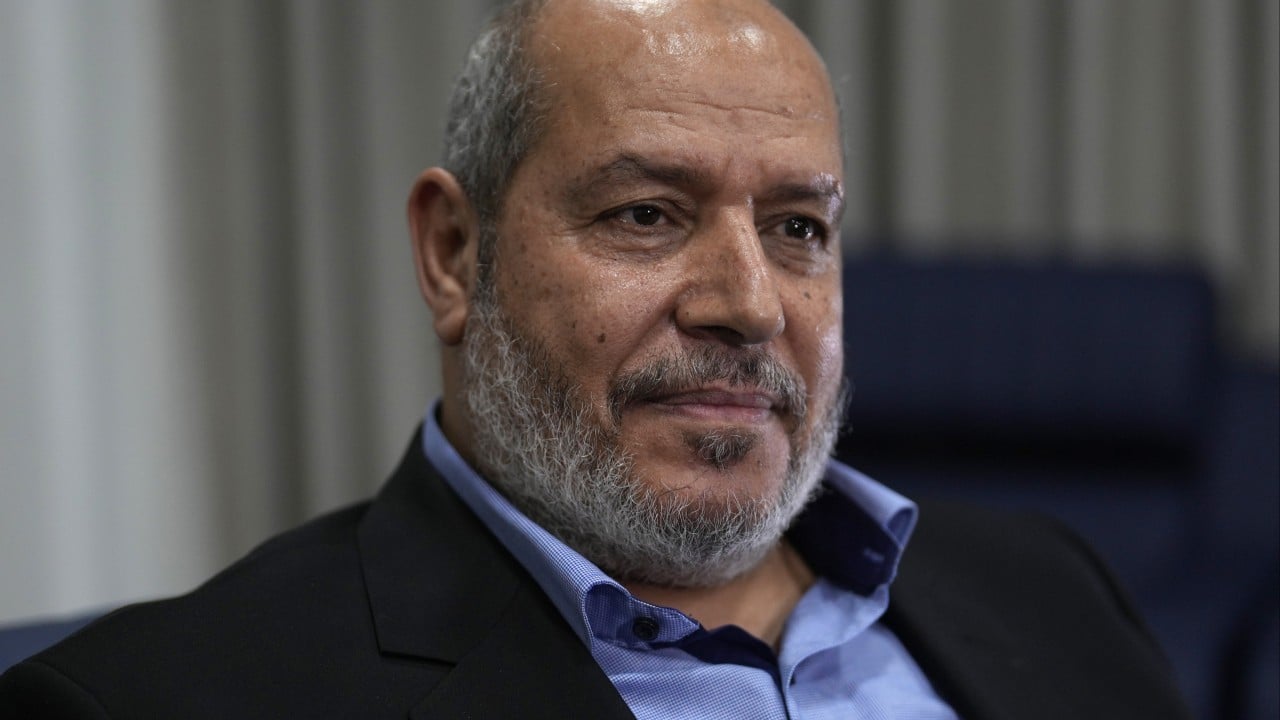
The ascension of Khalil al-Hayya to the political leadership of Hamas represents a structural pivot from a decentralized ideological movement to an integrated operational proxy. When a militant organization replaces a localized political figurehead with its primary international diplomat and ceasefire negotiator, it is not merely filling a vacancy; it is optimizing its leadership architecture for a prolonged war of attrition. The core strategic challenge facing the organization is the reconciliation of acute territorial losses in Gaza with the requirement to maintain diplomatic leverage in regional negotiations. By analyzing this transition through the lens of organizational survival and proxy warfare mechanics, we can map the future trajectory of the conflict with analytical precision.
The selection of al-Hayya reveals a deliberate consolidation of power that bridges the historical divide between the external political bureau (based in Doha and Cairo) and the internal military command (the Izz ad-Din al-Qassam Brigades in Gaza). This structural integration alters the group’s decision-making calculus across three distinct vectors: diplomatic leverage, internal command cohesion, and Iranian patron-client dynamics.
The Strategic Triad of Hamas Organizational Survival
To evaluate the impact of this leadership transition, we must deconstruct the movement's operational framework into three interdependent pillars.
                          [ Iranian Patronage ]
                                /       \
                               /         \
                              /           \
         [ Diplomatic Leverage ] --------- [ Military Cohesion ]
Each pillar functions as a variable in the organization's survival equation. A failure in one directly degrades the efficacy of the others.
1. The Diplomatic-Leverage Function
The primary asset Hamas retains in asymmetric warfare is its capacity to trade hostage assets for structural concessions—specifically, permanent ceasefires and Israeli military withdrawals. Under previous leadership, a friction point existed between the external negotiators who understood the parameters of international diplomacy and the internal commanders who held physical custody of the leverage.
Al-Hayya’s dual profile as the chief negotiator and a trusted ally of the late Yahya Sinwar eliminates this friction. The negotiation process is no longer a multi-tiered communication loop prone to interception and signaling delays. It is now a direct instrument of the military command, transforming diplomatic talks from a mechanism to end the war into a tactical tool to manage the tempo of military operations.
2. The Internal Command Cohesion Variable
Militant organizations facing decapitation strikes typically devolve into fractionalized cells. The elevation of a consensus figure residing outside the immediate kinetic zone mitigates this fragmentation.
- Command Continuity: Al-Hayya provides a singular point of authority for scattered battalions operating in Gaza.
- Logistical Synchronization: He bridges the gap between the underground tactical units and the international financial networks funding them.
- Operational Control: The command structure transitions from a localized hierarchy to a distributed network managed from secure regional sanctuaries.
3. The Iranian Patron-Client Alignment
The most critical consequence of this leadership selection is the explicit tightening of the alliance with the Islamic Revolutionary Guard Corps (IRGC) and the broader Axis of Resistance. Al-Hayya has historically maintained deep, uncompromised ties with Tehran, contrasting with previous leaders who occasionally sought to balance relations between Sunni Arab states and the Shia Islamist regime.
This alignment guarantees a continuous flow of capital, anti-tank guided missiles, and cyber capabilities. It positions Hamas not as an isolated actor fighting a localized campaign, but as a synchronized front in a multi-theater regional containment strategy against Israel.
Operational Impact on Ceasefire Mechanics
The change in leadership alters the basic architecture of regional mediation. Standard diplomatic assumptions regarding ceasefire negotiations rely on the premise that both parties seek an exit strategy from active hostilities. This assumption is flawed when applied to the restructured Hamas leadership.
The organization's negotiation posture under al-Hayya will likely shift toward a fixed-variable strategy. Rather than negotiating the specific identity or volume of prisoner exchanges—which are fluid variables—the leadership will insist on structural guarantees that ensure the survival of the governing apparatus in Gaza.
This creates a structural bottleneck for mediators from Qatar and Egypt. The Israeli political establishment requires the complete dismantling of Hamas’ military capabilities as a non-negotiable end state. Conversely, al-Hayya's mandate is to leverage the remaining hostages to secure a total Israeli withdrawal, thereby converting a severe tactical military defeat into a strategic survival victory.
Regional Implications and the Axis Network
The selection of a pro-Iran chief negotiator structurally binds Hamas to the operational timelines of Hezbollah and the Houthi movement. The conflict can no longer be analyzed as a self-contained counter-insurgency operation within the boundaries of Gaza.
The strategic consequence is a unified bargaining position across the Axis of Resistance. Al-Hayya’s proximity to Tehran allows for real-time synchronization of escalatory measures. For example, negotiations regarding maritime security in the Red Sea or rocket volumes along the Lebanese border will be calibrated to match the status of talks in Cairo or Doha.
This interdependence increases the complexity of regional deterrence. A localized breakthrough in Gaza becomes mathematically less probable because the incentives governing the Hamas leadership are now tied to the broader geopolitical objectives of its primary state sponsor.
Strategic Forecast
Israel will likely intensify its targeted elimination campaign, focusing on the remaining mid-level commanders within Gaza to prevent the external political bureau from translating its diplomatic directives into tactical actions on the ground. This counter-strategy aims to force a total decoupling of the external leadership from the internal operational reality, rendering al-Hayya’s diplomatic maneuvers irrelevant.
Concurrently, expect Hamas to dig into an uncompromising diplomatic position. The organization will treat the remaining hostage pool as an exhaustible capital asset, rationing its release exclusively for high-value strategic concessions rather than temporary humanitarian pauses.
The conflict enters a phase defined by structural institutionalization. Hamas has successfully institutionalized its leadership structure against the threat of physical liquidation, ensuring that the death of individual leaders does not result in the collapse of the organizational framework. The war transitions from an intense campaign of territorial maneuvering to a protracted, highly politicized war of attrition designed to test the limits of domestic political will in Israel and international patience in the West.