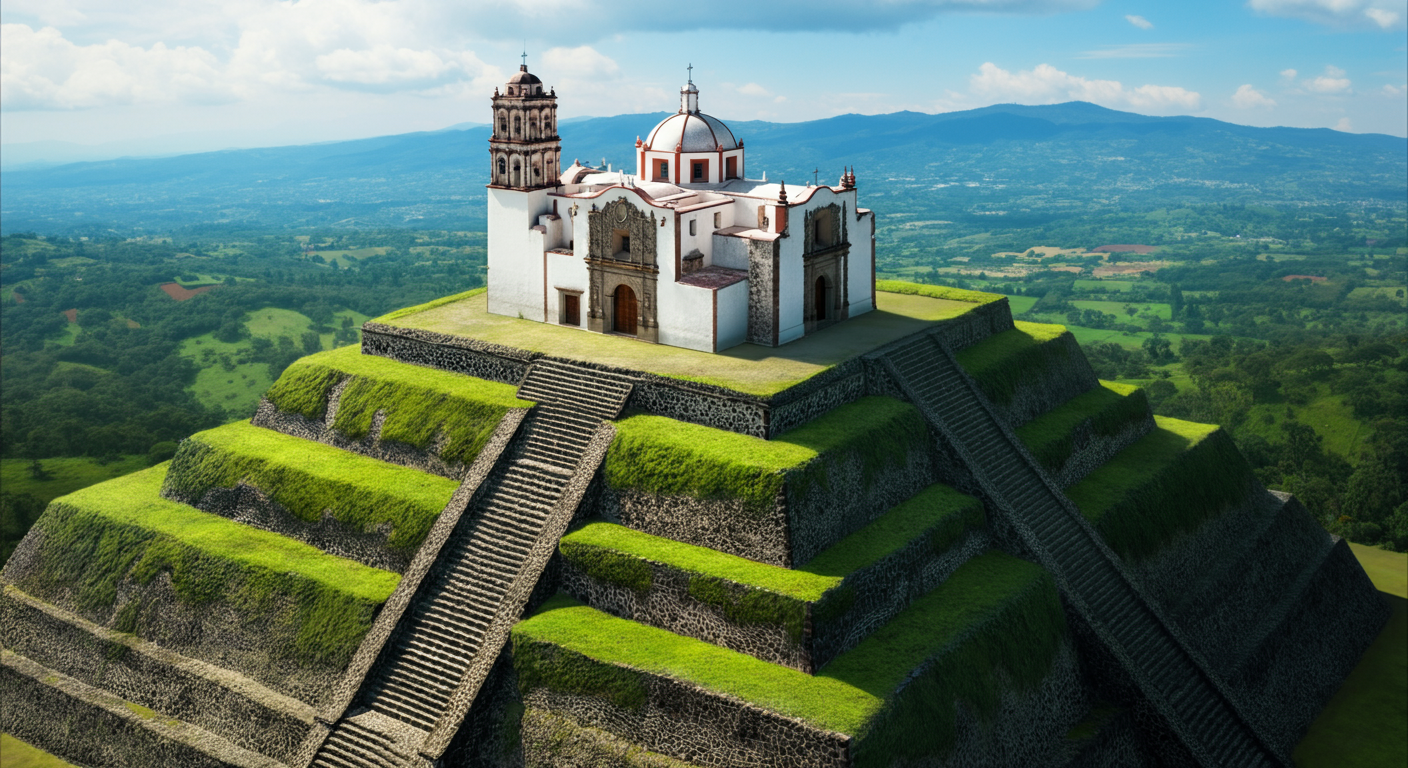
The global distribution of pyramidal structures is often misinterpreted through a Eurocentric or Egypt-focused lens, leading to a persistent misunderstanding of volume versus height as the primary metric of engineering prowess. While the Great Pyramid of Giza maintains the record for vertical displacement, the Great Pyramid of Cholula in Mexico represents a superior achievement in total volumetric displacement and mass accumulation. Evaluating these structures requires a rigorous framework that accounts for geographical constraints, material density, and the specific functional requirements of the civilizations that produced them.
The Volumetric Displacement Paradox
The common assumption that the "largest" pyramid must reside in Egypt stems from a failure to define "large." If height is the variable, Khufu’s monument wins. If the metric is base area or total volume, the Great Pyramid of Cholula (Tlachihualtepetl) is the undisputed outlier.
The structural logic of Cholula differs fundamentally from Giza. While Giza was a singular, planned project executed over a distinct timeframe, Cholula represents a multi-generational "layered" construction. This "onion-skin" growth model allowed the structure to reach a base of 450 by 450 meters—four times the footprint of the Great Pyramid of Giza. The resulting volume is estimated at 4.45 million cubic meters, compared to Giza’s 2.58 million.
Material Science and Structural Integrity
The disparity in volume is a function of material availability and climate-specific engineering.
- The Stone Monolith Model (Egypt): Utilizing high-density limestone and granite, Egyptian engineers focused on verticality. The compressive strength of these materials allowed for internal chambers that could withstand immense pressure.
- The Adobe Composite Model (Mexico): Cholula was constructed primarily of mud bricks (adobe). The lower compressive strength of sun-dried brick necessitates a wider base to distribute the load, resulting in a mountain-like profile rather than a sharp, steep-angled peak.
The Five Extant Volumetric Leaders
Ranking these structures requires isolating them from modern reconstructions and focusing on the core mass that survives.
1. The Great Pyramid of Cholula (Mexico)
The sheer mass of Tlachihualtepetl is deceptive because much of it is overgrown or built upon. The Spanish colonial church sitting atop the mound serves as a permanent cap, complicating modern excavation. The engineering intent here was not to reach the heavens in a single point, but to create a terrestrial platform for a succession of temples. This creates a "nested" structural history where each new ruler built over the previous layer, a method of psychological and political consolidation through architecture.
2. The Great Pyramid of Giza (Egypt)
Khufu’s pyramid remains the benchmark for precision. The alignment to true north within three-sixtieths of a degree suggests a level of stellar observation and mathematical application that exceeds its successors. The primary engineering challenge was the "Grand Gallery"—a corbelled vault that manages the weight of the masonry above the King's Chamber. This is a high-risk, high-reward design that utilized stress-relieving chambers to prevent the structural collapse of the interior voids.
3. The Red Pyramid of Dahshur (Egypt)
Built by Sneferu, this structure represents the first successful transition from "step" geometry to "true" pyramid geometry. Its success lies in the 43-degree angle of its slopes. The previous attempt, the Bent Pyramid, failed because the initial 54-degree angle created structural instability, forcing a mid-build adjustment. The Red Pyramid is the result of that failure analysis, utilizing a shallower angle to ensure long-term stability without the risk of masonry shear.
4. The Pyramid of the Sun (Mexico)
Located in Teotihuacan, this structure is defined by its massive base and its alignment with the sunset on specific days of the year. Unlike the Egyptian tombs, this was a public-facing ritual platform. The core is composed of rubble and earth, faced with stone. This "fill-and-shell" technique allowed for rapid scaling of size compared to the slow, precise block-laying of Giza. It represents an optimization of labor: maximizing visual impact while minimizing the need for skilled masonry in the core.
5. The Great Ziggurat of Ur (Iraq)
While technically a ziggurat, its function as a multi-tiered artificial mountain places it within the same structural category. The primary engineering innovation here was the use of bitumen (natural asphalt) as mortar and the inclusion of "weeper holes" in the exterior walls to allow moisture to escape the mud-brick core. Without this drainage system, the internal pressure from moisture expansion would have caused the structure to burst from the inside out.
The Geopolitical Logic of Megalithic Construction
Pyramid construction is never an aesthetic choice; it is a resource management strategy. The decision to build "large" serves three primary functions in a developing state:
- Labor Sequestration: During non-farming seasons, large-scale construction keeps a massive workforce occupied and dependent on the state for rations, preventing regional uprisings.
- Signaling Theory: A pyramid is a "costly signal." It demonstrates to rivals that the state has such a surplus of calories and labor that it can afford to "waste" them on non-productive monuments.
- Geographical Anchoring: In flat landscapes (the Nile Valley or the plains of Puebla), a pyramid creates a permanent, visible center of gravity for the bureaucracy.
Structural Decay and Preservation Variables
The survival of these five structures is an anomaly dictated by local geology. In humid environments, such as the jungles of Tikal (Guatemala), limestone structures are rapidly reclaimed by biological growth. The root systems of tropical trees act as hydraulic jacks, prying apart masonry. The survivors in Egypt and the high Mexican plateaus benefited from arid or semi-arid climates that slowed chemical weathering.
The "disappearance" of many pyramids is often due to human recycling. The outer casing stones of the Great Pyramid were stripped to build Cairo. Cholula survived because the Spanish mistook it for a natural hill, inadvertently preserving the pre-Columbian core. This highlights a critical lesson in strategic concealment: the structures that survived were often those that ceased to look like man-made assets.
Engineering the Impossible: The Workforce Variable
The logistics of moving 2.3 million blocks for Giza or millions of adobe bricks for Cholula require a sophisticated supply chain. Analysis of the "Lost City of the Pyramid Builders" in Giza reveals a high-protein diet (cattle and goat) for the workers, debunking the myth of slave labor. These were professional cohorts organized into "phyles" (teams).
At Cholula, the labor was likely decentralized. Because the structure was built in layers over 1,000 years, the economic burden was amortized over dozens of generations. This suggests a more sustainable, albeit slower, model of civic development compared to the high-intensity, single-reign bursts seen in the Fourth Dynasty of Egypt.
The Technological Ceiling
Why did we stop building pyramids? The transition from masonry to steel and concrete changed the "Cost-per-Square-Foot" equation. Pyramids are the most inefficient way to create interior space; they are nearly 100% solid mass. As soon as civilizations developed the arch and later the steel frame, the pyramid became obsolete for anything other than commemorative purposes.
The shift was from stability through mass to stability through tension.
Ancient engineers hit a technological ceiling where they could only go higher by making the base wider. The Great Pyramid of Giza is essentially the maximum height achievable with limestone before the weight of the stones starts to crush the bottom layers. Modern skyscrapers bypass this by using high-tensile steel to carry the load, allowing for a 1:100 ratio of footprint to height, whereas a pyramid requires a 1:1 or 2:1 ratio.
Strategic Assessment of Archaeological Sites
For the modern strategist or traveler, the value of these sites is not in their "mystery" but in their testimony to centralized planning.
- Giza is a masterclass in precision and finite project management.
- Cholula is a lesson in iterative design and institutional longevity.
- Teotihuacan demonstrates the power of urban planning and mass-scale public engagement.
Understanding the difference between the "tallest" and "largest" requires a shift in perspective from vertical ambition to volumetric reality. The Great Pyramid of Cholula stands as the most significant man-made monument by volume because its builders prioritized a wide, inclusive foundation over a singular, fragile peak. This architectural philosophy ensured its survival through multiple conquests and climatic shifts, whereas Giza remains a singular, non-repeatable event in human history.
Future analysis should focus on the subterranean radar mapping of Cholula to identify the exact transition points between its six major building phases. This will provide a data-backed timeline of how the largest structure on Earth was actually assembled, layer by agonizing layer.