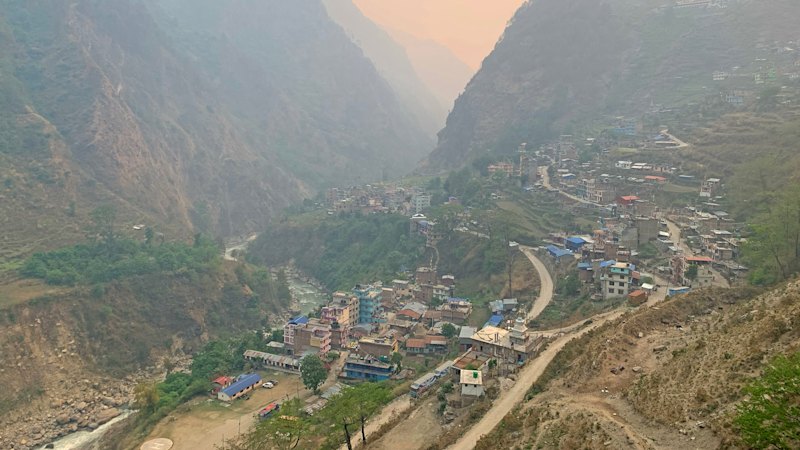
National reconstruction following a catastrophic shock is fundamentally an exercise in resource allocation, institutional capacity, and systemic stress testing. When a country absorbs a major seismic or climatic disaster, the recovery vector is rarely determined by the sheer volume of incoming aid. Instead, the trajectory depends entirely on the pre-existing baseline of structural integrity, bureaucratic friction, and economic diversification. Nepal presents a compelling case study in iterative crisis management. Having navigated the compounding shocks of the 2015 Gorkha earthquake sequence and subsequent macroeconomic pressures, the country faces a recurring mandate for reconstruction. Analyzing this recovery requires stripping away superficial narratives of resilience to examine the hard mechanics of capital distribution, supply chain bottlenecks, and structural reform.
The Economic Mechanics of Seismic Shocks
Macroeconomic shocks triggered by natural disasters operate through two distinct channels: the destruction of physical capital and the disruption of flow variables such as trade, tourism, and remittance inflows. In Nepal, the 2015 earthquake destroyed over six hundred thousand private homes, alongside critical transport infrastructure, heritage sites, and commercial real estate. The immediate economic impact was characterized by a sharp contraction in gross domestic product growth relative to baseline projections, driven by halted construction activity and paralyzed agricultural supply chains in affected hill districts.
Recovery from this baseline requires a clear distinction between reconstruction and development. Reconstruction replaces what was lost, bringing capital stock back to pre-disaster levels. Development alters the production function of the economy to generate higher productivity. Following 2015, the National Reconstruction Authority was established to centralize authority and fast-track capital deployment. However, centralized command structures often encounter friction at the local implementation tier.
Capital Distribution Bottlenecks
The deployment of reconstruction grants to private homeowners illustrates the friction between macroeconomic policy design and micro-level execution. The financing mechanism relied on tranche-based disbursements tied to compliance with hazard-resilient building codes. While theoretically sound for risk mitigation, this approach created severe liquidity constraints for rural households lacking bridge financing.
Liquidity Gaps
Homeowners were required to self-finance initial construction phases before unlocking subsequent government tranches. This mechanism disproportionately penalized low-income agrarian households, driving them into informal credit markets with predatory interest rates.
Logistical Constraints
Mountainous terrain and limited road infrastructure transformed the transport of raw materials—such as cement, steel, and timber—into a major cost driver. Spikes in logistics costs eroded the purchasing power of recovery grants, reducing the ultimate square footage and structural quality of rebuilt housing stock.
Administrative Delays
Verification bottlenecks at the local ward level slowed down inspection processes. Each tranche release required engineering sign-offs, creating a queue that frequently stalled construction momentum across entire districts.
These variables demonstrate that capital availability is a necessary but insufficient condition for recovery. The velocity of money in a post-disaster environment is governed by administrative throughput and the physical capacity of local supply chains.
Institutional Adaptation and Governance Deficits
Systemic resilience relies heavily on the adaptability of governing institutions. When recurring shocks strike a developing economy, institutional memory must translate into proactive legislative frameworks rather than ad hoc responses. Nepal’s governance framework has historically suffered from political fragmentation and high turnover among civil servants, which disrupts long-term project continuity.
The transition from a centralized unitary state to a federalist structure, finalized under the 2015 Constitution, fundamentally altered the architecture of disaster risk management. Sub-national governments—provincial and municipal authorities—were granted decentralized mandates for local infrastructure development and emergency response.
This decentralization introduced both efficiencies and vulnerabilities. Local governments possess superior contextual knowledge regarding regional vulnerabilities, allowing for more targeted resource allocation than a distant capital bureaucracy could manage. However, municipal entities frequently lack the technical human capital required to oversee complex engineering projects, execute rigorous public procurement, and manage disaster risk reduction funds transparently.
The Structural Vulnerability Matrix
To evaluate Nepal's ongoing exposure to systemic shocks, analysts must disaggregate vulnerability into three distinct vectors: infrastructural, financial, and ecological.
Infrastructure vulnerability in Nepal is concentrated in the transportation and energy sectors. The strategic highway corridors, such as the Prithvi Highway and the Araniko Highway, are highly susceptible to monsoon-induced landslides and seismic liquefaction. When these arteries fail, domestic trade halts, and the cost of essential goods spikes across urban centers.
Financial vulnerability stems from a high reliance on external economic buffers, primarily remittances from migrant workers in the Middle East and Southeast Asia, alongside international tourism. Remittances constitute roughly a quarter of Nepal's gross domestic product. While these funds provide a vital cushion for household consumption during crises, they are external variables that remain completely insulated from domestic policy control. A macroeconomic slowdown in destination countries directly contracts domestic liquidity in Nepal, compounding the strain of local disasters.
Ecological vulnerability is driven by unregulated land-use planning and rapid, uncoordinated urbanization in the Kathmandu Valley and expanding hill towns. Construction on steep slopes without adequate retaining structures or drainage systems converts moderate rainfall events into destructive flash floods and debris flows.
Strategic Realignment for Future Resilience
Mitigating future shocks requires shifting the national expenditure profile from reactive disaster relief to preemptive structural hardening. Capital must be systematically front-loaded into risk reduction rather than back-loaded into reconstruction.
First, municipal engineering capacity must be systematically upgraded. Decentralized governance can only function if local bodies possess the technical staff required to enforce building codes rigorously and design resilient public utilities.
Second, the financial architecture for disaster response must incorporate parametric insurance and contingent credit lines. Traditional donor-pledge conferences following disasters are notoriously slow, with significant lag times between pledges and actual cash disbursements. Pre-arranged financing mechanisms allow governments to deploy liquidity within hours of a shock, stabilizing local markets before panic-driven inflation takes hold.
Third, economic diversification must move beyond rhetorical policy goals. Over-reliance on remittances and seasonal tourism leaves the macroeconomy exposed to external variables. Scaling domestic manufacturing, modernizing commercial agriculture through cold-chain logistics, and expanding hydroelectric export capacity will distribute economic risk across a broader foundation, ensuring that future natural shocks do not automatically translate into total macroeconomic paralysis.