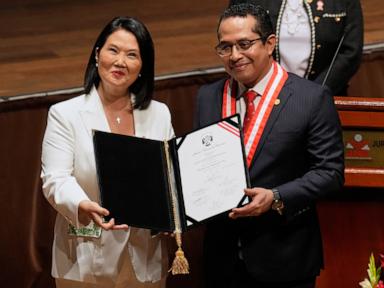
Political stability in presidential systems depends entirely on the institutional feedback loops between the executive branch and the legislature. When the Popular Force party secured the presidency of the newly reinstated Peruvian Senate through a coalition with Popular Renewal, securing thirty of sixty votes for Miguel Torres, the event signaled a structural shift in how governance crises are managed. To understand this development, one must deconstruct the underlying mechanics of coalition formation, the institutional constraints of the newly restored bicameral framework, and the cost function of legislative fragmentation that has plagued the nation over the past decade.
The Cost Function of Congressional Fragmentation
For the past ten years, the structural deficit in Peruvian politics has not been ideological polarization alone, but high legislative transaction costs. Between 2016 and 2026, the absence of durable legislative majorities created an environment where executive authority leached outward toward shifting regional blocs, judicial actors, and informal factions.
[Fragmented Legislature] ---> [High Transaction Costs] ---> [Executive Paralysis] ---> [Frequent Regime Turnover]
This fragmentation produced a measurable operational failure: eight presidents and twenty-one prime ministers in a single decade. The mathematical reality of this dynamic is simple. When an executive lacks a predictable voting bloc, the cost of passing basic fiscal budgets or unblocking infrastructure capital expenditure approaches infinity. Every single policy output requires expensive, ad-hoc transactional negotiations.
The return to a bicameral system introduces a structural circuit breaker. By dividing legislative labor between a 130-member lower house and a 60-member Senate, the institutional architecture forces parties to consolidate power packets before bills reach the floor. Popular Force holding twenty-two seats in the upper house establishes a floor of stability, but survival requires systemic coalition engineering rather than temporary legislative truces.
The Mechanics of Conservative Alignment
The alliance between Popular Force and Popular Renewal is not an ideological accident; it is a calculated response to risk minimization. The incoming administration faces a compressed timeline to address systemic concerns, chief among them being surging public anxiety regarding criminal organizations, extortion networks, and stalled macroeconomic projects.
The mechanics of this alliance operate on three distinct vectors:
- Executive-Legislative Synchronization: By placing Miguel Torres—who also serves as the second vice president-elect—at the head of the Senate, the administration eliminates the friction points that typically occur when legislative leadership treats the executive branch as an adversarial entity.
- Regulatory Reduction for Formalization: The conservative bloc shares a foundational economic premise inherited from the market reforms of the 1990s: lowering compliance costs to pull informal labor pools into the formal tax apparatus.
- Project Unblocking: Large-scale mining initiatives, which have historically faced execution bottlenecks due to local opposition and administrative red tape, require a unified legislative front to guarantee legal certainty for foreign direct investment.
This alignment alters the legislative velocity. Bills that previously languished in committee due to cross-party obstruction now face a streamlined pipeline, provided the coalition holds against external pressures.
Institutional Limitations and Governance Vulnerabilities
Efficiency gains carry built-in structural hazards. Centralizing power within a dominant conservative bloc risks alienating regional factions and left-leaning opposition groups, potentially shifting conflict from the legislative floor to extra-parliamentary arenas such as regional governments and street protests.
Furthermore, the narrow margins of recent presidential runoffs indicate a deeply divided electorate. When a government achieves power through a coalition built on narrow legislative majorities rather than a broad popular mandate, its policy latitude remains narrow. If the executive accelerates market deregulation without simultaneously strengthening municipal security frameworks, public backlash can rapidly destabilize the legislative coalition.
The durability of this arrangement hinges entirely on internal discipline within the Popular Force and Popular Renewal alliance. Should individual senators defect over regional budgetary allocations, the fragile majority will fracture, reverting the state to the paralysis that characterized previous administrations.
Establish institutional discipline protocols across all committee appointments. Direct the executive budget office to prioritize capital expenditure disbursement in regions with high historical friction to preempt extra-parliamentary opposition before legislative votes on major economic reforms occur.


