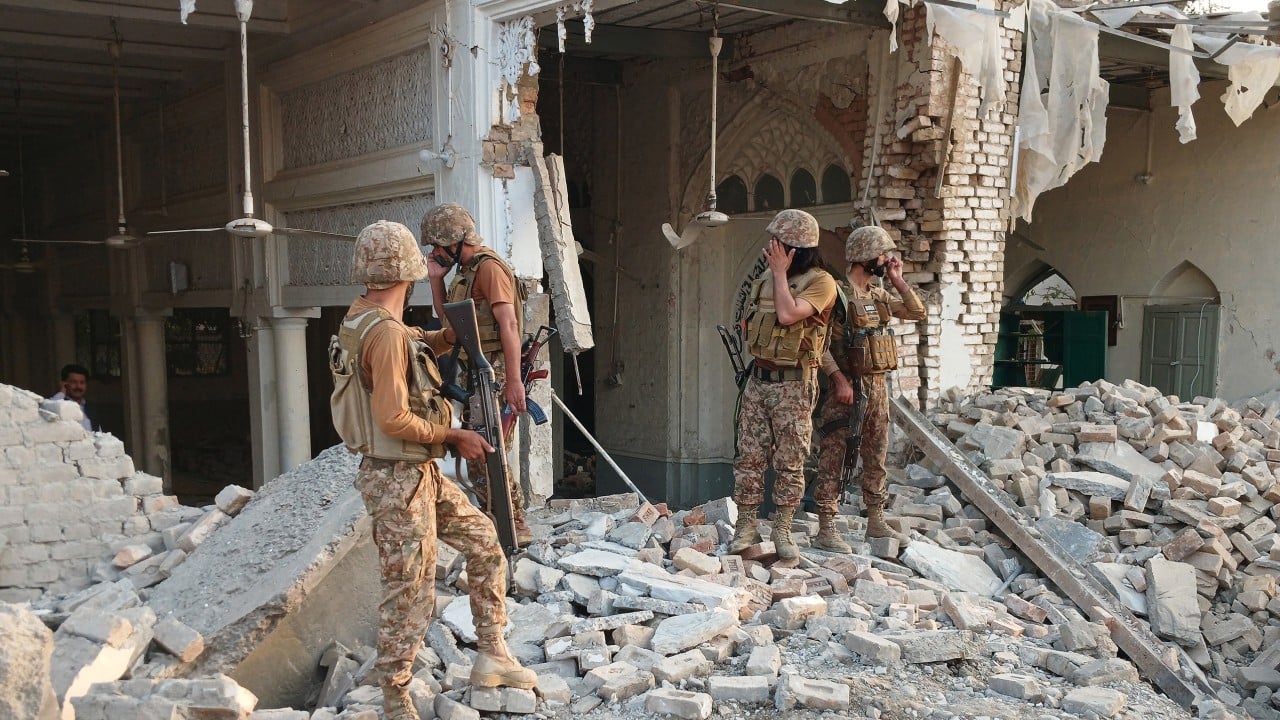
The attack on the police complex in Pakistan, which resulted in 31 fatalities following a coordinated assault by a suicide bomber and armed combatants, represents a distinct tactical escalation in asymmetric warfare directed against state security apparatuses. Analyzing such events requires moving past episodic reporting to examine the structural mechanics of fortified-compound penetrations. Security architecture failure is rarely a single point of collapse; it is an accumulation of vulnerabilities across perimeter defense, intelligence integration, and rapid response deployment.
Understanding the operational efficiency of an insurgent assault involves breaking down the event into three distinct operational phases: pre-operational reconnaissance, kinetic breach execution, and internal exploitation. Each phase exposes systemic weaknesses in conventional law enforcement fortification models. For another perspective, check out: this related article.
The Economics of Perimeter Penetration
Fortified compounds rely on concentric layers of defense, typically moving from outer access control points to inner administrative and tactical nodes. When an assailant successfully bypasses initial checkpoints using a suicide vest as a dynamic breaching tool, the primary objective is the kinetic neutralization of the outer defensive perimeter.
A suicide bomber deployed at a gate or security portal functions as a force multiplier for subsequent armed infiltrators. The physical blast wave and the resulting kinetic shock accomplish three immediate tactical aims: Similar coverage regarding this has been shared by Reuters.
- Destruction of immediate access control infrastructure, including blast gates, barriers, and electronic surveillance nodes.
- Neutralization or severe incapacitation of the primary guard force stationed at the entry corridor.
- Psychological saturation of the broader compound, which triggers a defensive paralysis and delays the transmission of accurate situational intelligence to command elements.
Once the perimeter is structurally compromised, armed combatants enter the exploitation phase. The operational efficiency of the attackers depends on interior familiarity, pre-positioned munitions caches within or near the target zone, and the speed with which they can establish interior fire discipline before a localized counter-attack can be organized.
Intelligence Deficits and Indicator Integration
Preventing compound-scale assaults requires mapping the precursor signatures that precede kinetic execution. Insurgent networks planning high-casualty operations against state infrastructure must execute several observable operational steps:
- Surveillance and pattern-of-life analysis of target shifts, guard rotations, and structural vulnerabilities.
- Procurement and transit of high-explosive materials, detonators, and tactical-grade weaponry.
- Assembly and test-fitting of explosive vests or vehicle-borne improvised explosive devices in safehouses within operational range.
- Insertion and staging of assault teams close to the target perimeter.
The failure to intercept these preparations points to structural gaps in human intelligence collection and signals intelligence integration between municipal law enforcement and federal counter-terrorism units. When intelligence architectures operate in silos, tactical indicators fail to aggregate into a predictive threat assessment.
Command, Control, and Response Latency
The lethality of an assault inside a confined complex correlates directly with the response latency of external or backup security forces. In large-scale incursions, the initial minutes are characterized by high entropy. Communication lines are often severed by the initial blast, internal command posts are targeted or forced into a defensive posture, and unit commanders lack real-time telemetry from interior sectors.
This creates a tactical window where the assailants retain the initiative. To mitigate this vulnerability, modern high-threat facility design incorporates compartmentalized safe zones, automated internal lockdown mechanisms, and redundant, hardened communication relays that survive initial kinetic impacts. Without these infrastructural safeguards, law enforcement personnel inside the complex are forced into reactive, uncoordinated engagements against entrenched attackers who dictate the tactical tempo.
Strategic Realignment of Defensive Postures
The 31 fatalities recorded in this incident underscore the limits of static defense models when confronted with determined, asymmetric combatants willing to utilize suicide tactics to force entry. Strengthening state security complexes necessitates a shift from perimeter hardening alone to integrated defensive-in-depth strategies.
Future security resilience depends on three structural adjustments:
- Implementing biometric and behavioral access verification that catches anomalies prior to the threshold of the primary gate.
- Decentralizing quick-reaction forces to eliminate transit-time bottlenecks during the critical first ten minutes of an incursion.
- Mandating continuous red-teaming exercises to stress-test compound defenses against combined suicide and armed assault vectors before real-world exploitation occurs.