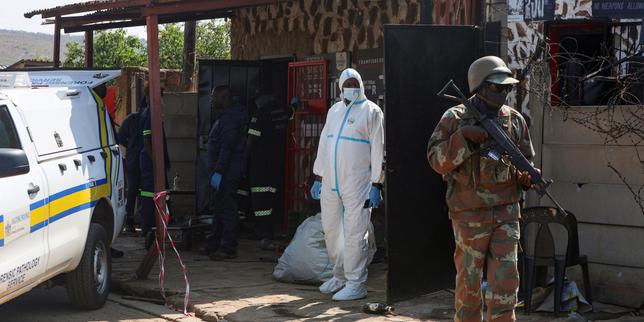
The concentration of mass casualty firearm incidents in peripheral entertainment districts across Cape Town and Johannesburg exposes critical vulnerabilities in municipal policing architectures and private security deployment models. When twenty-seven fatalities are generated across two isolated operational nodes—specifically drinking establishments in distinct metropolitan jurisdictions—the event cannot be dismissed as stochastic criminal variance. It represents a systemic failure of situational deterrence, spatial containment, and intelligence-led asset allocation within high-density commercial micro-environments.
To understand the mechanics of these multi-assailant, high-fatality shooting events, analysts must deconstruct the operational environment into three primary variables: target accessibility, containment friction, and response latency.
The Operational Anatomy of Urban Nightlife Attacks
Commercial hospitality venues operating in high-crime metropolitan sectors function within an asymmetric risk landscape. Unlike institutional assets protected by hardened perimeters, bars and taverns prioritize high ingress and egress velocity to maximize commercial throughput. This architectural imperative directly compromises security integrity.
Target accessibility is governed by the friction of entry. In the reported incidents across the Western Cape and Gauteng, perpetrators exploited the fluid boundary between informal street commerce and formal venue interiors. When access control mechanisms rely solely on visual observation or manual pat-downs executed by untrained personnel, the threshold for introducing high-capacity firearms approaches zero. The economic cost of implementing strict biometric or electronic screening is traded off against customer acquisition friction, creating an environment where high-leverage weaponry can be introduced with impunity.
Containment friction refers to the physical and tactical barriers that limit an assailant's mobility and field of fire once an engagement begins. Standard entertainment venues are typically characterized by open-plan floor layouts, minimal structural cover for patrons, and single-vector escape routes. When a coordinated assault is initiated, these spatial characteristics transform from commercial assets into tactical bottlenecks. The absence of compartmentalized safe zones or ballistic shielding ensures that casualty accumulation rates remain exponential during the initial deployment phase of the attack.
The Response Latency Equation
The third variable, response latency, dictates the operational window available to perpetrators. In metropolitan policing models burdened by high service-call volumes and sprawling territorial jurisdictions, the time delta between initial weapon discharge and tactical unit arrival routinely exceeds five minutes.
[Incident Initiation]
       │
       ▼
[Detection Gap (1-3 mins)] ──> [Private Security Reaction Lag]
       │
       ▼
[Kinetic Phase (Perpetrators Active)]
       │
       ▼
[Law Enforcement Arrival (>5 mins)] ──> [Evidence Preservation / Triage]
This temporal delay creates an operational vacuum. Private security guards stationed at individual venues are rarely equipped, trained, or legally mandated to engage multiple armed assailants utilizing military-style tactics or handguns with extended magazines. Consequently, the tactical initiative remains entirely with the perpetrators until they choose to exfiltrate. The absence of real-time acoustic gunshot detection systems linked directly to automated rapid-response dispatchers ensures that law enforcement intervention remains reactive rather than preemptive.
Economic and Structural Drivers of Metropolitan Violence
The prevalence of high-fatality urban shootings is structurally coupled with the black-market economy of protection services and localized turf competition. In many townships and peri-urban sectors surrounding Johannesburg and Cape Town, formal municipal policing resources are chronically under-allocated relative to population density and commercial concentration.
This protection deficit is filled by informal protection networks and localized extortion rings. Establishments that fail or refuse to integrate into these protection networks frequently experience targeted kinetic violence designed to enforce compliance or destabilize local economic competitors. The distinction between random violent crime and targeted racketeering operations is often obscured in initial reporting, yet the underlying economic incentives remain the primary driver of organized armed incursions into commercial spaces.
The proliferation of illicit firearms further exacerbates the casualty yield of these encounters. The secondary market for small arms in South Africa relies heavily on leakage from state armories, judicial forfeiture rooms, and cross-border smuggling networks. Because these weapons bypass formal ballistic registry and tracking systems, forensic attribution post-event is severely delayed, inhibiting the ability of investigative units to map criminal supply chains before subsequent attacks occur.
Strategic Resource Reallocation
Mitigating the recurrence of multi-fatality urban assaults requires a fundamental pivot from generalized visible patrols to precision-targeted municipal hardening strategies. Standard reactive policing models must be replaced by an integrated risk-reduction framework that addresses the economic and spatial realities of high-risk commercial zones.
Municipal authorities must mandate minimum baseline security standards for commercial hospitality venues operating in designated high-threat zones. These standards must extend beyond basic licensing to require certified physical security audits, standardized electronic access control points, and mandatory integration with municipal CCTV and automated emergency dispatch networks.
Concurrently, investigative intelligence units must deprioritize broad-spectrum sweeps in favor of network-centric targeting of illegal firearm distribution nodes and protection syndicates. By disrupting the financial and logistical pipelines that supply high-capacity weaponry to urban criminal elements, the frequency of catastrophic mass-casualty events can be systematically suppressed. Intelligence collection must focus on the financial transactions underpinning localized extortion networks, utilizing asset forfeiture and targeted disruption operations to dismantle the operational command structures of urban armed groups before kinetic deployments occur.