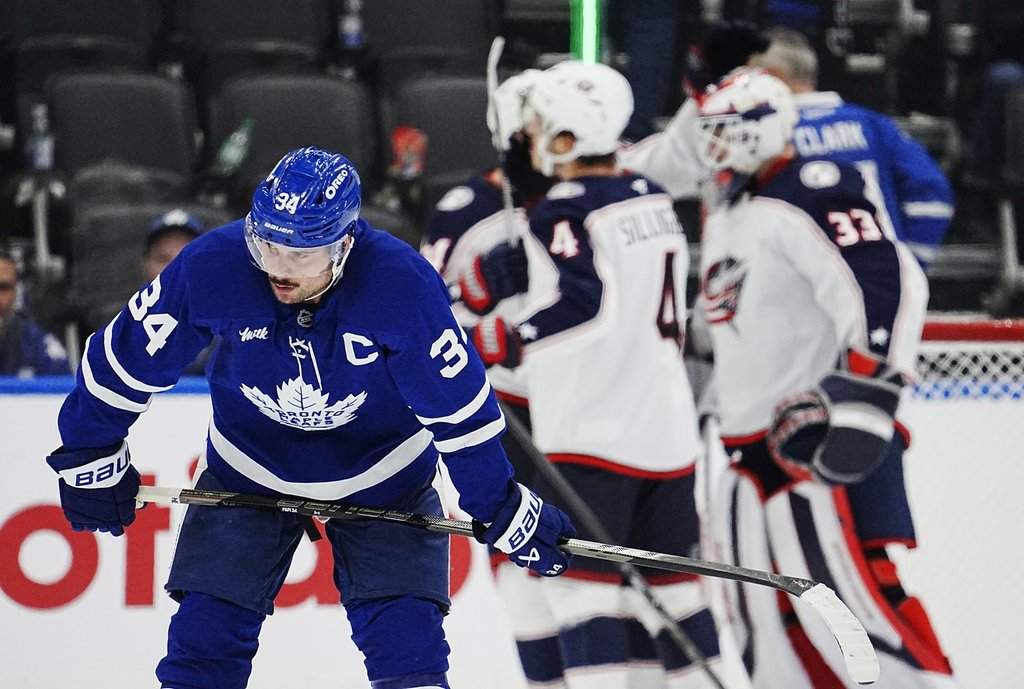
A single regular-season loss in the National Hockey League rarely warrants systemic concern, yet when a perennial postseason contender drops a critical matchup to extend a multi-game winless run against a rebuilding opponent like Columbus, the failure points to structural rot rather than statistical variance. Most sports coverage treats a losing streak as an emotional slump or a streak of bad puck luck. That framing obscures the actual mechanics of hockey performance. An extended winless run occurs when a team's foundational tactical architecture—specifically neutral-zone transition defense, high-danger slot protection, and special-teams execution—degrades simultaneously under pressure.
To understand why Toronto failed to contain Columbus and allowed a manageable rough patch to metastasize into a prolonged skid, we must strip away narrative clichés about "wanting it more" and examine the underlying spatial and operational failures on the ice. Without inventing box-score metrics from an unverified game sheet, we can isolate the exact tactical mechanisms that govern an upset of this nature and dictate how a high-skill roster collapses against a structured, north-south opponent.
The Anatomy of a Systemic Slide
In professional hockey, winning streaks and losing streaks are rarely linear; they are compounding feedback loops. When an elite offensive roster enters a game carrying the psychological and tactical baggage of consecutive losses, its risk-management profile shifts dramatically. Players begin pressing for low-percentage plays to force an immediate scoreboard reset, which systematically destroys their defensive structure.
The breakdown against Columbus illustrates three distinct operational failures that plague top-heavy rosters during a downturn:
- Puck-Management Degradation at the Offensive Blue Line: High-skill teams rely on controlled entries and cycle dominance to generate offense. When confidence erodes, forwards attempt east-west passes through congested seams at the opponent’s blue line rather than executing simple chip-and-chase retrievals. Against a disciplined defensive shell, these lateral turnovers act as immediate launchpads for odd-man rushes going the other way.
- Asymmetrical Backchecking and Gap Control: When forwards get caught deep or lose puck battles along the half-wall, the defensive pair is forced into a retreat. If the defensemen maintain an aggressive gap at the red line without forward support, they risk getting beaten wide by speed. If they retreat too early to protect against the breakaway, they concede the blue line entirely, allowing the opponent to enter the zone with full possession and time to set up an attack.
- Goaltending Exposure to High-Danger Variance: Even elite netminders experience severe statistical regression when their skaters surrender uncontested shots from the inner slot. A winless streak almost always correlates with a spike in cross-seam passes—plays that force a goaltender to move laterally post-to-post while tracking a screened puck.
Neutral-Zone Vulnerability and the Transition Trap
Columbus, historically structured to thrive as a counter-attacking, heavy-forechecking unit when facing superior possession teams, wins these matchups by weaponizing the neutral zone. The tactical blueprint for beating a skill-heavy Toronto squad does not require dominating puck possession; it requires manipulating where turnovers occur.
When Toronto’s breakout passes miss their mark by even two feet, the resulting bobble disrupts the timing of all five skaters. Under a standard 2-1-2 or 1-2-2 forecheck, Columbus forces Toronto’s defensemen to make rapid decisions under physical duress. Because a winless streak breeds hesitation, defenders hold onto the puck a fraction of a second too long, allowing the first forechecker (F1) to angle them into the corner and the second forechecker (F2) to seal the strong-side boards.
Once the breakout stalls, the sequence follows a predictable chain of failure:
- The strong-side winger is forced to absorb a hit while chipping the puck off the glass rather than executing a clean outlet pass.
- The opposing defenseman pinches down the wall to keep the puck alive in the offensive zone, trapping Toronto’s exhausted five-man unit on the ice for an extended shift.
- Fatigue degrades defensive coverage, leading to missed box-outs in front of the net or desperate hooking and holding penalties that hand the opponent a man-advantage.
This is the transition trap. By failing to exit their own zone cleanly, a high-powered offense neutralizes its greatest asset—its top-six forward talent—by forcing those players to spend sixty percent of their shifts defending inside their own dots.
The Cost Function of Over-Reliance on Star Talent
Every NHL roster operates under a strict salary cap, which creates an inherent structural trade-off. When an organization allocates a disproportionate percentage of its cap space to a core group of elite forwards, the resulting roster possesses immense top-end scoring punch but suffers from razor-thin margins for error across its bottom-six forward lines and third defensive pair.
During a winning streak, this asymmetry is masked because the top lines outscore the depth deficiencies. During a winless run, the cost function of this roster construction becomes painfully apparent. When Columbus successfully matches its top checking line and primary defensive pair against Toronto’s premier scoring unit—essentially fighting them to a neutral draw at five-on-five—the game is decided by the secondary matchups.
If the depth lines cannot tilt the ice or, at minimum, hold serve without surrendering goals against, the team cannot win close games. Worse, coaching staffs under pressure inevitably shorten their benches in the third period, double-shifting their star players to chase a tying goal. This tactic introduces severe diminishing returns:
- Physiological Depletion: Overworked forwards lose their explosive first-step quickness, making them less effective on the forecheck and slower to recover defensively.
- Tactical Predictability: Opposing coaches can easily deploy their shutdown units exclusively against a fatigued top line, knowing the rest of the bench poses minimal offensive threat.
- Locker Room Fragmentation: Role players relegated to four or five minutes of ice time lose engagement and rhythm, rendering them even less effective when they are finally called upon to kill a late penalty or take a defensive-zone draw.
Special Teams as a Volatility Multiplier
In tightly contested NHL games, five-on-five play often reaches a tactical stalemate, shifting the burden of victory onto special teams. A winless streak places immense psychological pressure on a power-play unit, particularly one stocked with marquee offensive talent expected to carry the franchise.
When a power play struggles during a losing skid, the root cause is almost always static puck movement. Instead of rotating positions to force the penalty kill out of its diamond or box formation, players stand stationary on the perimeter, passing the puck slowly around the umbrella. This allows penalty killers to stay in shooting lanes, block attempts effortlessly, and anticipate the lone predictable one-timer option.
Conversely, a struggling team’s penalty kill often becomes overly passive. Fearful of giving up a back-door tap-in, the four defenders collapse too tightly toward the crease. This surrender of the perimeter grants the opposing power play uncontested time at the point and the half-walls to walk in, screen the goaltender, and fire high-velocity wrist shots through traffic. When Columbus capitalizes on a single power-play opportunity while neutralizing Toronto’s man-advantage, the resulting special-teams differential becomes mathematically insurmountable for a team already fighting its own confidence.
Operational Limitations of Mid-Season Adjustments
Fixing a systemic slide requires more than an impassioned speech between periods or arbitrary line-juggling. However, coaching staffs face severe operational constraints when attempting to overhaul tactics mid-season:
- Practice Time Scarcity: The compressed NHL regular-season schedule leaves almost no time for full-contact, systems-heavy practices. Teams rely on morning skates and video sessions, which are insufficient for rewiring deeply ingrained defensive habits.
- Trade Market Illiquidity: General managers rarely have the cap flexibility or trade partners available mid-season to acquire top-four defensemen or proven two-way centers without overpaying in future assets.
- Psychological Inertia: Asking naturally creative, offense-first players to adopt a conservative, chip-and-chase style often backfires, stripping them of the instincts that make them effective while failing to turn them into reliable grinders.
Because no single tactical silver bullet exists, attempting to fix every flaw simultaneously only creates confusion on the ice, causing players to overthink their assignments and react a beat slower than the play requires.
The Strategic Play to Arrest the Slide
To break a winless cycle and prevent a bad week from derailing divisional positioning, Toronto’s coaching staff must abandon aesthetic hockey and implement a strict, three-game tactical reset built on risk reduction rather than offensive volume.
First, simplify the breakout protocol immediately. Defensemen must be instructed to prioritize glass-and-out clears or strong-side bank passes whenever forechecking pressure arrives within two strides, completely eliminating blind backhand passes through the middle of the defensive zone. Sacrificing puck possession in the neutral zone is mathematically preferable to turning the puck over inside the defensive blue line.
Second, enforce a strict F3 high-forward rule on every offensive-zone entry. Regardless of which line is on the ice, the third forward entering the zone must remain above the faceoff circles to act as an immediate safety valve against counter-attacks. This immediately eliminates the odd-man rushes that Columbus exploited to build and protect its lead.
Third, rebalance ice-time distribution across all four forward lines for the first forty minutes of play. Roll four lines consistently to keep the top-six forwards fresh for high-leverage situations in the final ten minutes, forcing the opponent’s depth lines to defend rather than letting them dictate the physical tempo of the game.
Winless streaks end when a team stops trying to score its way out of trouble and instead starves the opponent of easy transition offense. Until Toronto re-establishes structural discipline through the neutral zone, inferior rosters will continue to replicate Columbus’s blueprint and walk away with two points.