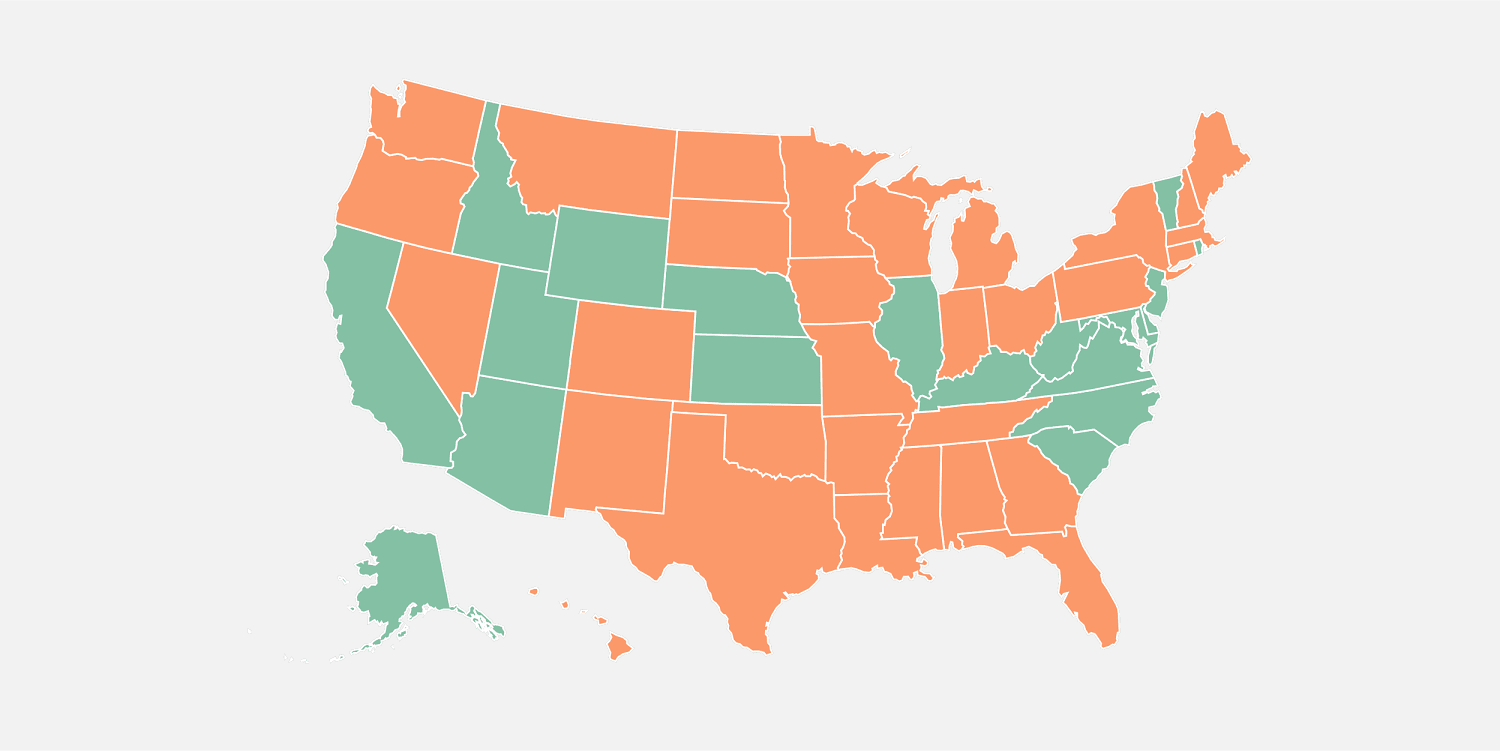
Control of the United States Senate is rarely decided by national mood alone; it is dictated by a six-year rotational calendar that creates severe structural asymmetries before a single dollar is spent. When political commentators analyze a "shifting Senate map," they routinely conflate short-term polling fluctuations with long-term demographic realignment, misdiagnosing the true mechanics of chamber control. To accurately model Senate outcomes, strategists must separate cyclical exposure from structural partisan elasticity, evaluating each seat not as an isolated campaign, but as a node within a rigid institutional architecture.
The Architecture of Six-Year Class Exposure
The fundamental error in surface-level political reporting is treating every Senate cycle as a national referendum. Because the Senate is divided into three classes—each facing voters every six years—any given election cycle tests a geographically arbitrary subset of the electorate.
This creates an immediate mathematical distortion known as exposure asymmetry. In a cycle where one party must defend a disproportionate number of seats in states won by the opposing party's presidential nominee, the defending party faces an uphill structural gradient regardless of legislative performance or macroeconomic indicators.
- The Incumbency Decay Curve: Historically, ticket-splitting allowed popular incumbents to survive in states trending against their national party. Over the past two decades, the correlation between presidential vote share and Senate vote share has tightened dramatically. Incumbency advantage, once worth upwards of five to eight percentage points in margin, has compressed to roughly two points or less in federalized races.
- Geographic Concentration vs. Distribution: A party can win the national popular vote by millions of ballots while losing Senate seats because its coalition is inefficiently distributed across high-population urban centers. The Senate rewards geographic breadth, turning low-population, homogenous states into high-yield structural anchors for the party that dominates rural and exurban electorates.
- The Defense-Offense Resource Trap: When a party is forced to defend six or seven vulnerable seats while only targeting one or two offensive opportunities, its capital allocation becomes purely defensive. National party committees and allied super PACs must burn reserves to protect existing margins, starving potential expansion targets of the early media buys required to build name recognition.
When a map "shifts," it is usually not because voters have suddenly changed their minds about an incumbent. Rather, the nationalization of local media has finally eroded the protective barrier that previously insulated that specific seat from the state's underlying partisan baseline.
Deconstructing Partisan Elasticity and Ticket-Splitting
To understand why certain seats enter or exit the competitive tier, analysts must measure partisan elasticity—the degree to which a state's electorate responds to shifts in the national political environment.
Inelastic states possess entrenched demographic coalitions with low rates of persuadable swing voters. In these jurisdictions, outcomes are determined almost entirely by base mobilization and turnout differentials. Elastic states, conversely, contain higher concentrations of independent or weakly affiliated voters who react sharply to national economic conditions, candidate quality, and top-of-the-ticket dynamics.
Consider the operational difference between these two environments. In an inelastic state that leans toward Party A by six points, Party B cannot win through persuasion advertising alone; it requires a massive turnout collapse among Party A's base combined with near-perfect mobilization of its own. In an elastic state with the exact same six-point baseline lean, a modest shift in independent sentiment—driven by inflation, a unpopular administration, or a flawed opposing candidate—can flip the seat within a single cycle.
- Suburban Realignment: The primary driver of shifting maps over recent cycles has been the steady migration of college-educated suburban voters away from traditional conservative alignments, paired with the counter-migration of non-college-educated rural and working-class voters away from traditional liberal coalitions.
- The Ticket-Splitting Threshold: True ticket-splitting now requires an extraordinary divergence in candidate quality. Voters will rarely split their ballot over policy nuances; they do so only when one candidate crosses a threshold of perceived disqualification, creating a localized permission structure for partisan defection.
- Primary Radicalization: Closed or low-turnout partisan primaries frequently reward candidates who optimize for base ideological purity at the expense of general election viability. When an extremist candidate captures a nomination in a competitive state, they artificially expand the opposing party's map, forcing both sides to reallocate tens of millions of dollars into a race that baseline fundamentals suggested should be safe.
The Capital Allocation Paradox in Modern Campaigns
Modern Senate campaigns operate under a capital allocation paradox: the races that receive the most money are often the ones where marginal dollars yield the lowest return on investment.
Once a Senate race reaches saturation—defined as the point where every persuadable voter in a media market has been exposed to a campaign's core message dozens of times—additional spending on broadcast television produces diminishing returns. Yet, because donors and institutional committees evaluate risk through polling volatility, capital floods disproportionately into the top five or six toss-up races.
This dynamic creates severe strategic blind spots on the periphery of the map.
- Late-Breaking Expansion: A state rated as "Likely" for one party often receives minimal early investment. If a late-stage economic shock or candidate scandal shifts the environment by three points in October, the challenging party lacks the field infrastructure and reserved ad inventory to capitalize on the opening.
- The Small-State Multiplier: Because media market costs scale with population, a $10 million investment in a small-population state buys total informational dominance, whereas the same sum in a major metropolitan media market buys barely two weeks of competitive air time. Savvy strategists exploit this pricing inefficiency by targeting lower-cost states early, forcing the opposing party to either cede the seat or divert funds from expensive battlegrounds.
- The Fundraising Illusion: High-profile challengers frequently raise massive sums from out-of-state small-dollar donors angered by an incumbent's national profile. However, out-of-state fundraising rarely correlates with in-state persuasion capacity. Campaigns flush with small-dollar cash often misallocate resources into nationalized messaging that alienates the exact moderate, in-state voters required to cross the 50 percent threshold.
Candidate Quality as a Quantifiable Variable
Political journalism treats "candidate quality" as an abstract, subjective trait. In rigorous electoral modeling, candidate quality is a quantifiable variable measured by the gap between a candidate's vote share and the baseline partisan performance of their state.
A high-quality candidate is not necessarily charismatic or ideologically moderate; rather, they possess institutional credibility and message discipline tailored to their specific electorate. They avoid unforced errors that allow opponents to nationalize the race around divisive cultural issues, keeping the focus squarely on localized economic grievances or incumbent failures.
Conversely, a low-quality candidate introduces severe downside risk through three predictable failure modes:
- Biographical Vulnerabilities: Unvetted personal, financial, or legal histories that provide opponents with devastating, easily digestible attack ads, forcing the candidate onto the defensive during peak persuasion weeks.
- Ideological Overreach: Taking hardline positions during a primary that are fundamentally incompatible with the general electorate, creating a permanent credibility gap when the candidate inevitably attempts to pivot toward the center.
- Structural Mismatch: Running a campaign style suited for a deep-red or deep-blue media ecosystem inside a purple state, where the median voter rejects partisan grievance in favor of pragmatic governance.
When a party nominates candidates with these liabilities in competitive states, it artificially depresses its own ceiling. Even in a favorable national environment, a flawed candidate can underperform the top of the ticket by four to six points—more than enough to forfeit a winnable seat.
Limitations of Predictive Modeling and Polling
Relying solely on public polling to track a shifting Senate map introduces systemic bias. Modern polling faces two compounding structural challenges: non-response bias and turnout modeling uncertainty.
Non-response bias occurs when specific demographic groups—often low-trust, rural, or working-class voters—refuse to participate in surveys at higher rates than college-educated voters. While pollsters weight their samples to account for education and geography, weighting cannot correct for attitudinal differences between a voter who answers a pollster's call and one who does not.
Furthermore, midterm and off-year Senate elections are fundamentally turnout contests. A pollster's likely voter screen is an educated hypothesis about who will actually cast a ballot, not a measurement of physical reality. If an unforeseen external event—such as a Supreme Court ruling, an international crisis, or a sudden shift in gas prices—alters the enthusiasm gap between the two bases in the final three weeks, every likely voter model built prior to that event becomes obsolete.
Analysts must therefore treat polling as a lagging indicator of sentiment rather than a precise predictive instrument. Leading indicators—such as voter registration trends, early vote ballot requests by party affiliation, and shifts in the partisan composition of generic congressional ballot tracking—provide far earlier signals of structural movement on the map.
The Strategic Imperative for Cycle Management
Managing a national Senate portfolio requires abandoning reactive, poll-chasing tactics in favor of disciplined portfolio theory. Party committees and major institutional donors must treat Senate seats as assets with distinct risk-return profiles, balancing capital between defensive holds and asymmetric offensive plays.
The definitive strategic play for any cycle is early, asymmetric expansion into second-tier targets. Rather than dumping the final $50 million of a cycle into saturated toss-up states where the marginal cost per vote has skyrocketed, strategists must commit capital six to nine months prior to Election Day in two or three low-cost, structurally competitive states currently rated as "Lean" or "Likely" for the opposition. This forces the opposing party into a zero-sum defensive posture: they must either dilute their spending in core battlegrounds to defend their periphery, or leave their flank exposed to a late-cycle wave. By dictating where the battleground lines are drawn early, a campaign operation converts financial capital into structural pressure, forcing the opposition to fight on unfavorable terrain.