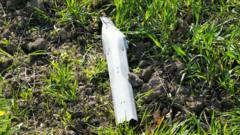
A Romanian F-16 fighter jet just blasted a stray drone out of the sky over central Estonia. The target wasn't Russian. It was almost certainly Ukrainian.
If that sounds backwards, you aren't paying close enough attention to the dirty, invisible electronic war happening over Eastern Europe right now.
On May 19, 2026, Estonian radar systems picked up a rogue aircraft crossing over from Latvia. Minutes later, Lieutenant Colonel Costel-Alexandru Pavelescu, a Romanian pilot flying under NATO's Baltic Air Policing mission, locked onto the bird and fired a single missile. The drone crumpled and splashed down into a swampy area near the village of Kablakula. It landed just 30 meters from a residential home. Loud bangs shook the countryside, and local police quickly cordoned off the field.
Kyiv immediately issued an apology. Russia threatened "just retribution." The Baltic states are caught right in the crossfire of a electronic warfare mess they didn't start.
Here is what is actually going on behind the headlines, why this keeps happening, and what it means for the security of NATO's eastern flank.
The Invisible Culprit Disabling Ukraine's Guidance Systems
You might wonder how a Ukrainian drone meant for a Russian oil refinery or military outpost ends up hundreds of miles off course, flying over a NATO member state. The answer is massive, industrial-scale electronic jamming.
Russia has ringed its borders and critical infrastructure with powerful electronic warfare complexes. These systems don't shoot down drones with metal; they fry their brains with invisible radio waves. When a long-range Ukrainian strike drone flies into these defense zones, two things happen:
- GPS Spoofing: The drone's navigation system is fed fake satellite signals, convincing the onboard computer that it is somewhere it isn't.
- Signal Jamming: The connection to the operator is completely severed, forcing the drone into an unguided, blind flight path until it runs out of fuel.
Estonian Defense Forces explicitly stated that the May 19 intercept occurred under conditions of heavy Russian electronic warfare, including intense GPS spoofing. When a drone gets blinded this way, it doesn't just crash on the spot. It turns into a ghost ship, flying in random directions based on corrupted data.
This wasn't a one-off mistake. It's a systemic hazard. In March, a rogue drone slammed into the chimney of the Auvere power plant in northeastern Estonia. Last week, the Latvian government literally collapsed, with Prime Minister Evika Silina's coalition dissolving after intense public fury over how the defense ministry handled multiple stray drones exploding at a local oil storage facility.
The Delicate Geopolitical Tightrope
The fallout from these rogue drones is creating a massive headache for frontline NATO allies who desperately want to support Ukraine without giving Moscow an excuse to escalate.
Estonian Foreign Minister Margus Tsahkna and Defense Minister Hanno Pevkur have both been incredibly clear: Ukraine has a sovereign right to hit military targets inside Russia. But that support comes with strict boundaries. Tallin has never given permission for Ukraine to use its airspace, and behind closed doors, Baltic officials are telling Kyiv to change its flight paths.
Pevkur admitted they have told the Ukrainians repeatedly that if they are going to strike deep inside Russian territory, those trajectories have to stay as far away from NATO borders as humanly possible.
Meanwhile, the Kremlin is weaponizing the chaos. Russia's Foreign Intelligence Service (SVR) put out a fiercely aggressive statement claiming, without any real evidence, that Ukraine is secretly deploying troops to Latvia to launch drone strikes from Baltic soil. The SVR went so far as to warn that NATO membership "will not protect the accomplices of terrorists."
It's a classic Moscow disinformation play. They use electronic warfare to push Ukrainian drones into NATO territory, then use the presence of those drones to claim NATO is actively launching attacks against Russia.
What Happens the Next Time a Drone Crosses the Border
NATO's air defense strategy on the eastern flank is changing rapidly because it has to. For years, the Baltic Air Policing mission was mostly about scrambling jets to shadow Russian bombers playing chicken with border airspace. Now, allied pilots are performing live-fire interceptions of explosive-laden kamikaze drones over civilian areas.
If you live in or travel to the Baltic region, you need to understand the new reality on the ground. Air defense forces are no longer hesitant. If an unidentified system crosses the border and shows an erratic trajectory, they will shoot it down.
If you find yourself near an active airspace incident in eastern Europe, take these three steps immediately:
- Heed the Digital Alerts: During the Estonian intercept, the government pushed an emergency EE-Alarm text alert to multiple counties, telling residents to take immediate cover. If your phone goes off with a civil defense warning, don't ignore it to take video.
- Stay Away from Debris Fields: If you see smoke or find mechanical wreckage in a field, do not approach it. Stray strike drones often carry unexploded military warheads or highly toxic chemical fuels. Call emergency services immediately.
- Expect Travel Disruptions: Expect sudden, temporary airspace closures over regional transit hubs in Poland, Lithuania, Latvia, and Estonia as military forces prioritize clearing rogue flight paths.
The skies over the Baltics are no longer a peaceful buffer zone. They are an active electronic battleground where a single stray signal can send an explosive drone careening into a quiet village. NATO's air policing forces proved their systems work on Tuesday, but as long as Russia keeps jamming the skies, it's only a matter of time before the next rogue aircraft crosses the line.