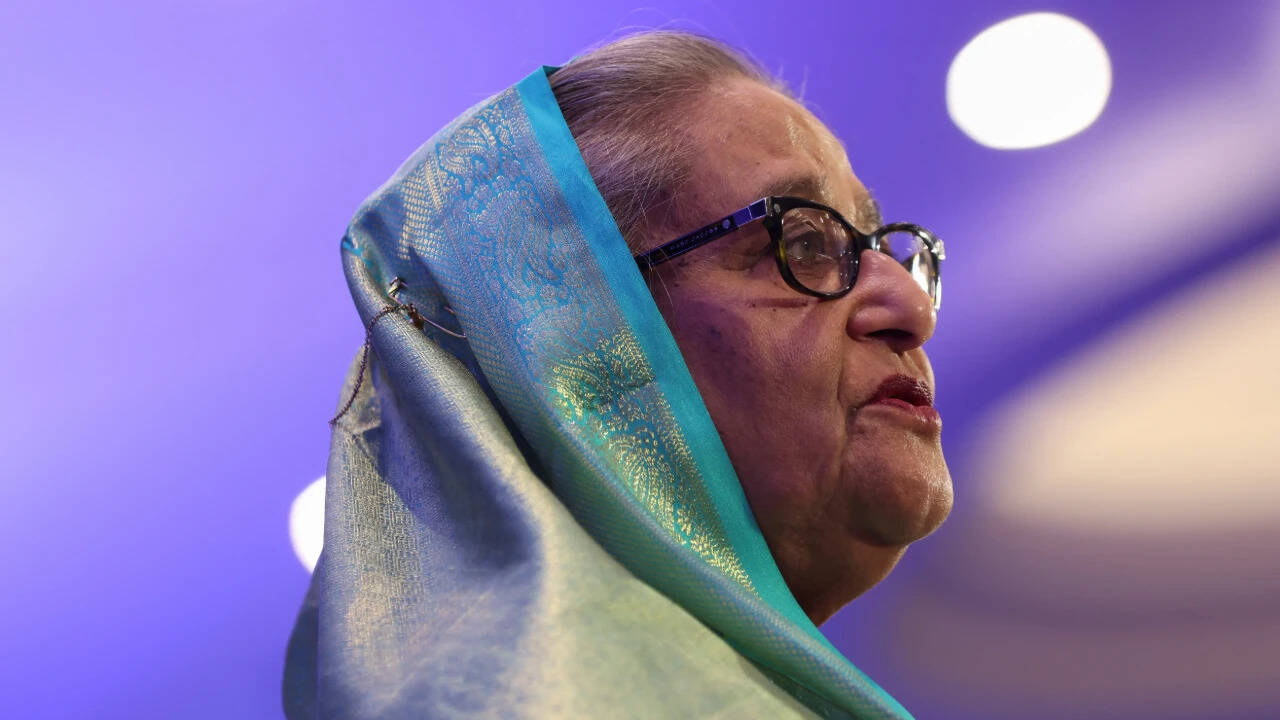
Political exile rarely ends through spontaneous sentiment; it concludes through calculated asymmetric warfare. Former Bangladeshi Prime Minister Sheikh Hasina’s declaration that she intends to return to Dhaka in December—framed publicly through fatalistic rhetoric regarding her personal survival—represents a high-stakes informational operation designed to test institutional cohesion inside Bangladesh while arresting the organizational decay of the Awami League. To understand the viability of this maneuver, analysts must strip away the dramatic phrasing and evaluate the underlying structural mechanics: legal exposure, security apparatus alignment, regional diplomatic constraints, and domestic mobilization capacity.
The Architecture of Martyrdom Rhetoric
Public statements invoking mortality serve a specific operational function in South Asian political mobilization. When a deposed leader frames a physical return around personal sacrifice, the messaging targets three distinct audiences simultaneously, each requiring a different psychological trigger.
First, the rhetoric functions as a loyalty test for the fragmented Awami League leadership. Following the August 2024 ouster and her subsequent departure to India, the party suffered severe organizational paralysis. Mid-tier cadres went underground, senior figures faced arrest or exile, and the chain of command fractured. By projecting absolute resolve, Hasina attempts to impose a moral cost on domestic party operatives who have remained passive. If the leader signals willingness to face incarceration or physical danger, local organizers lose the rhetorical justification for inaction.
Second, the framing attempts to shift the international narrative from administrative accountability to political persecution. Interim authorities in Dhaka, led by Chief Adviser Muhammad Yunus, have anchored their legitimacy in restoring rule of law, prosecuting corruption, and investigating state violence during the 2024 student-led uprising. Fatalistic messaging seeks to rebrand impending judicial proceedings as existential political vengeance, complicating the diplomatic posture of Western observers who monitor human rights compliance during democratic transitions.
Third, the December timeline establishes an artificial deadline that forces reactive decision-making in Dhaka. Strategic ambiguity regarding the exact date or port of entry compels the interim administration to allocate intelligence and security bandwidth toward contingency planning, diverting focus from economic stabilization and institutional reform.
Legal Exposure and the Judicial Bottleneck
A physical return to Bangladeshi territory immediately triggers an unavoidable legal mechanism. Unlike informal political negotiations, active criminal warrants and tribunal indictments operate through statutory procedures that the interim government cannot easily suspend without triggering domestic unrest.
Since August 2024, dozens of cases—ranging from mass murder and enforced disappearances to financial embezzlement—have been filed against Hasina across domestic courts and the reconstituted International Crimes Tribunal (ICT). The legal reality creates a rigid binary outcome upon arrival:
- Immediate Detention and Arraignment: Border security and police forces would be legally obligated to execute standing arrest warrants at the point of entry, likely Hazrat Shahjalal International Airport in Dhaka or a designated land port. Once in custody, bail remains statistically improbable given the severity of the charges and the political volatility surrounding the tribunal.
- Institutional Collapse: The only scenario in which Hasina avoids immediate detention is one where the state security apparatus actively refuses to execute judicial orders. That outcome requires a total breakdown of command authority within the interim administration—a condition that currently lacks empirical support.
The distinction between political ambition and procedural reality is absolute here. Public declarations do not neutralize arrest warrants. Unless an external diplomatic arrangement guarantees immunity—an arrangement that would provoke immediate mass protests from the student movements and opposition coalitions that dismantled her government—physical presence in Bangladesh equates to physical custody.
Security Apparatus Alignment and Command Integrity
The decisive variable in any regime-return scenario is not street-level party loyalty, but the institutional alignment of the armed forces and law enforcement agencies. During the final days of the Awami League administration in August 2024, the Bangladesh Army made a calculated institutional decision to prioritize corporate survival and national stability over regime preservation.
That structural shift remains intact. The military leadership under Chief of Army Staff General Waker-Uz-Zaman has invested its institutional credibility in backing the interim administration and maintaining civil order. Facilitating or permitting the unchallenged return of the former prime minister would directly threaten the military's standing with the domestic population and jeopardize international peacekeeping deployments, which serve as a vital source of institutional prestige and foreign currency for the armed forces.
Furthermore, the police force—historically the primary instrument of Awami League street enforcement—underwent severe organizational trauma following the August uprising. Hundreds of stations were damaged, personnel morale collapsed, and ongoing restructuring has prioritized depoliticization. The Awami League can no longer rely on sympathetic elements within the police hierarchy to neutralize opposition counter-mobilization or selectively ignore judicial directives.
Without an aligned security apparatus, a returning leader enters a hostile operational environment where state monopoly on force is actively deployed against their movement rather than on its behalf.
The Geopolitical Constraint: New Delhi’s Cost-Benefit Equation
Sheikh Hasina’s physical presence in India places New Delhi at the center of this strategic calculation. For over fifteen years, Indian foreign policy toward Dhaka rested on a singular pillar: deep bilateral alignment with the Awami League government, which delivered critical security cooperation regarding India's northeastern states and transit access.
However, the sudden collapse of that administration forced Indian policymakers to execute a rapid strategic recalibration. New Delhi now faces a delicate balancing act between historical loyalty to a reliable partner and pragmatic engagement with the current governing reality in Dhaka.
Allowing Hasina to use Indian territory as a staging ground for an active political destabilization campaign inside Bangladesh carries severe diplomatic costs for New Delhi:
- Bilateral Deterioration: Active facilitation of Hasina’s political return would validate anti-Indian sentiment inside Bangladesh, strengthening hardline political factions and undermining New Delhi’s ability to negotiate on water sharing, border management, and trade continuity.
- Regional Influence: Alienating the interim administration and the emerging generation of Bangladeshi political leaders risks pushing Dhaka closer to competing regional powers, notably Beijing and Islamabad, eroding India’s eastern security buffer.
- Diplomatic Precedent: India has historically maintained strict protocols regarding political exiles, generally prohibiting overt operational planning against neighboring governments from Indian soil to avoid reciprocal destabilization.
Consequently, while New Delhi may continue to provide humanitarian shelter and personal security for Hasina, active logistical or diplomatic backing for a forced December return contradicts India's broader regional stabilization interests.
Domestic Mobilization Capacity vs. Counter-Mobilization
To alter the political equation on the ground, a returning leader requires sufficient street-level mass to overwhelm state containment mechanisms. Evaluating the Awami League’s current mobilization capacity requires separating historical electoral strength from post-collapse operational reality.
While the Awami League retains a residual voter base and entrenched local networks across rural districts, translating passive sympathy into active street mobilization faces three major friction points:
- Leadership Vacuum: With key organizational secretaries, former ministers, and youth-wing enforcers either imprisoned, abroad, or in hiding, the party lacks the mid-level logistical coordinators required to transport, fund, and direct crowds in Dhaka.
- Financial Interdiction: Interim authorities have aggressively frozen bank accounts, investigated money laundering networks, and disrupted the patronage pipelines that historically financed political rallies and cadre maintenance.
- Asymmetric Counter-Mobilization: The student coalitions (such as the Anti-Discrimination Student Movement) and established opposition parties like the Bangladesh Nationalist Party (BNP) and Jamaat-e-Islami retain high mobilization readiness. Any organized Awami League attempt to occupy central Dhaka—such as Gulistan or Shahbagh—would trigger immediate, overwhelming counter-mobilization before state security forces even intervened.
In urban political warfare, a minority faction attempting to reassert dominance without state backing faces rapid encirclement. The street-level balance of power heavily favors the post-August coalition.
Strategic Assessment and Operational Forecast
Evaluating the intersection of judicial inevitability, military posture, Indian diplomatic restraint, and degraded party infrastructure reveals a stark divergence between public rhetoric and operational feasibility. The December timeline functions primarily as a psychological anchor for demoralized loyalists rather than an executable logistical plan.
If Sheikh Hasina attempts to execute an unconditional return to Bangladesh under current structural conditions, the outcome will not be a political restoration. Instead, the sequence will follow a predictable institutional trajectory: immediate interception at the border by security forces operating under military oversight, swift transfer to judicial custody under existing International Crimes Tribunal warrants, and the neutralization of sporadic domestic protests by combined law enforcement and rival political coalitions. The definitive strategic move for the Awami League leadership is not a high-risk physical return into immediate custody, but rather a protracted organizational rebuild from abroad—focusing on legal defense, international lobbying, and waiting for inevitable economic or governance friction to erode the unity of the ruling coalition in Dhaka over a multi-year horizon.