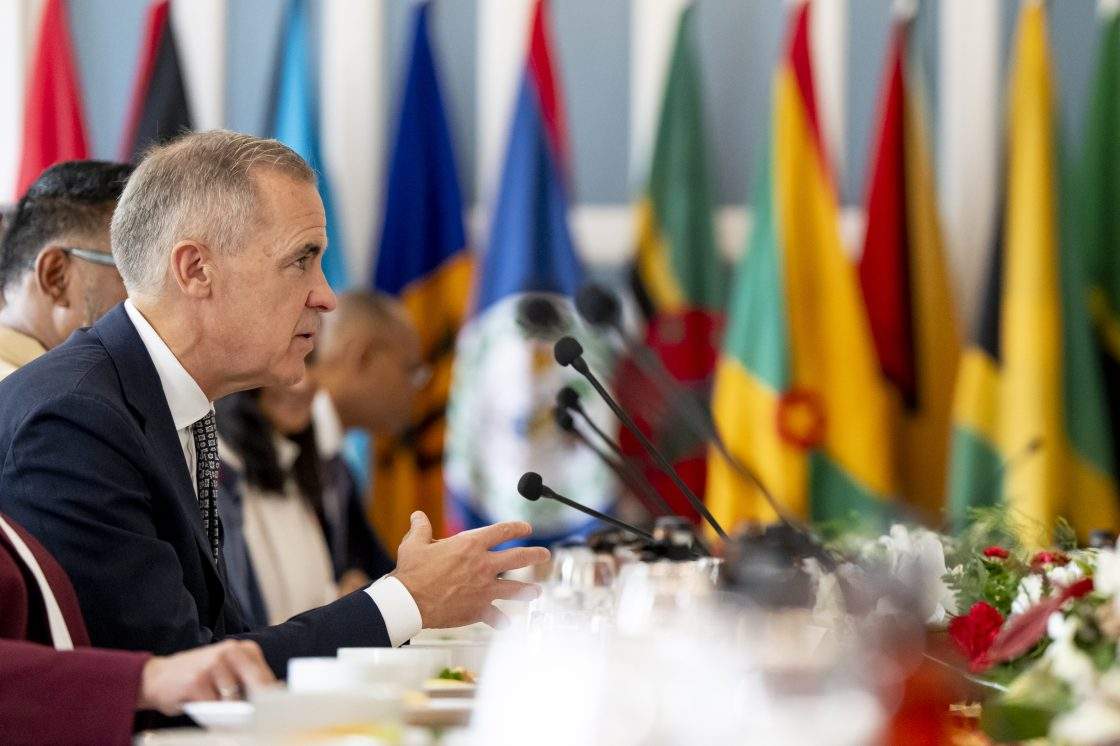
Mark Carney’s diplomatic engagement with Commonwealth leaders in Antigua and Barbuda represents a calculated pivot toward middle-power coalition building amid fracturing global trade norms. Rather than serving as a ceremonial gathering, this summit functions as an operational stress test for economic resilience, climate finance mechanisms, and institutional relevance across 56 member states. The core objective is to convert shared historical ties into binding multilateral agreements on debt restructuring and sovereign risk mitigation.
Standard geopolitical coverage treats Commonwealth meetings as nostalgic exercises in soft power. That framing misses the underlying economic mechanics driving Ottawa’s current foreign policy. As traditional multilateral bodies like the World Trade Organization face paralysis, middle powers and Small Island Developing States (SIDS) require alternative venues to negotiate regulatory alignment, capital mobilization, and supply chain security.
The Structural Deficit of Traditional Multilateralism
To understand the logic behind Carney’s agenda in St. John’s, one must examine the failure of legacy international financial institutions to address asymmetric economic shocks. Small Island Developing States face a compounding debt trap: high vulnerability to extreme weather events destroys physical infrastructure, forcing governments to borrow at punitive interest rates to fund reconstruction, which subsequently crowds out productive capital investment.
The standard market response penalizes these nations for geographic exposure they did not create. Credit rating agencies downgrade sovereign debt following climate disasters, triggering automated capital flight. Carney, drawing on his background in central banking and global climate finance, approaches this not as a humanitarian issue, but as a systemic market failure requiring structural intervention.
The Three Pillars of Commonwealth Economic Alignment
The discussions in Antigua and Barbuda center on three distinct operational mechanisms designed to correct these market distortions:
- Blended Finance and Risk-Sharing Facilities: Private institutional capital remains sidelined from developing markets due to currency volatility and perceived political risk. The proposed framework uses sovereign guarantees from AAA-rated Commonwealth members like Canada to absorb first-loss tranches, thereby lowering the cost of capital for private infrastructure investors.
- Climate-Resilient Debt Clauses (CRDCs): When a member state experiences a verified meteorological catastrophe, debt service payments are automatically suspended for a predetermined period. This preserves immediate fiscal liquidity for emergency response without triggering a formal sovereign default.
- Regulatory Harmonization for Cross-Border Trade: Beyond finance, the Commonwealth maintains a structural advantage known in international economics as the "Commonwealth Advantage"—the empirical observation that bilateral trade costs between member states are roughly 21 percent lower due to shared legal systems, language, and administrative standards. Operationalizing this requires updating digital trade protocols and mutual recognition of professional credentials.
Deconstructing the Geopolitical Leverage
Canada’s engagement in the Caribbean is not purely altruistic; it is a strategic countermeasure against expanding geopolitical influence from rival superpowers in the Western Hemisphere. Over the past decade, state-backed infrastructure financing from non-Commonwealth actors has altered the debt profiles and diplomatic alignments of several Caribbean nations.
By offering transparent, rules-based financing alternatives in Antigua and Barbuda, Ottawa seeks to achieve two concrete outcomes:
- Securing Diplomatic Votes in Global Bodies: The Commonwealth represents nearly one-third of the United Nations General Assembly. Maintaining cohesion among these voting blocs is essential for advancing Canadian priorities on international maritime law, human rights, and global taxation standards.
- Diversifying Supply Chains and Critical Inputs: As North American industrial policy shifts toward "friend-shoring," stabilizing peripheral markets within the hemisphere reduces reliance on volatile trans-Pacific logistics corridors.
The Mechanics of Sovereign Debt Restructuring
A primary bottleneck in resolving SIDS debt distress is creditor coordination. Modern sovereign debt is fragmented across bilateral lenders, multilateral development banks, and private bondholders. When a nation seeks debt relief, private creditors frequently hold out for full repayment, delaying restructuring and prolonging economic stagnation.
Carney’s financial diplomacy focuses on standardizing collective action clauses and expanding the mandate of the Commonwealth Debt Recording and Management System (Meridian). By centralizing debt transparency, debtor nations gain empirical clarity over their liabilities, reducing the information asymmetry that predatory lenders exploit during liquidity crises.
The Constraints of the Commonwealth Model
While the strategic logic is sound, the execution faces severe structural limitations. Analysts must separate diplomatic rhetoric from institutional capacity.
First, the Commonwealth lacks a binding enforcement mechanism. Unlike the European Union, which possesses a central bank, a unified court system, and strict fiscal convergence criteria, the Commonwealth operates strictly by consensus. Any financial facility agreed upon in Antigua and Barbuda relies entirely on the voluntary appropriations of its wealthiest members—primarily the United Kingdom, Canada, and Australia.
Second, domestic political constraints in donor nations limit the scale of capital deployment. High interest rates and domestic fiscal deficits in Ottawa and London restrict the political appetite for large-scale foreign aid commitments. The strategy depends heavily on catalytic capital—using small amounts of public money to mobilize massive pools of private institutional wealth. If private asset managers determine that the risk-adjusted returns remain insufficient despite sovereign guarantees, the blended finance model will stall.
Third, historical friction within the bloc complicates consensus. Ongoing debates regarding reparatory justice for the transatlantic slave trade create diplomatic friction between Caribbean nations and the British Crown. While Canada occupies a distinct position, the broader political capital spent managing historical grievances can divert negotiating bandwidth away from technical trade and finance agreements.
Operationalizing the Outcomes
For policymakers, institutional investors, and trade analysts monitoring the Antigua and Barbuda summit, the success of Carney’s strategy cannot be measured by the tone of the final communique. Instead, evaluation requires tracking three specific empirical indicators over the next four quarters:
- Adoption Rates of CRDCs: Monitor the number of bilateral and multilateral loan agreements that formally incorporate hurricane and disaster pause clauses. Without contractual codification, verbal commitments hold zero balance-sheet value.
- Capital Mobilization Ratios: Track the exact dollar amount of private institutional capital committed to Commonwealth climate facilities relative to public sovereign guarantees. A ratio below 3:1 indicates market skepticism toward the risk-sharing structure.
- Bilateral Trade Volume Growth: Measure non-commodity trade flows between Canada and CARICOM members following the implementation of updated digital customs protocols.
To maximize the return on this diplomatic expenditure, Ottawa must bypass broad, non-binding declarations and execute targeted bilateral pilot programs. Establishing a dedicated, AAA-backed Caribbean infrastructure guarantee facility—restricted initially to compliant, transparent jurisdictions—will demonstrate proof of concept, attract institutional pension capital, and establish a replicable template for the broader Commonwealth bloc.