The scanner beeps.
For nearly three years, that high-pitched electronic chirp has sounded less like a tool of commerce and more like a warning bell. You stand at the end of the conveyor belt, watching cereal boxes, laundry detergent, and milk slide toward the bagging area, and you feel that familiar tightening in your chest. Your jaw clenches. Your eyes dart to the digital display above the cashier's shoulder, watching the total climb with a velocity that feels personal, insulting, and relentless. Also making headlines lately: Navigating Structural Stress At The Panama Canal.
We all know this feeling. It is the low-grade, ambient anxiety of an economy where prices ran away from wages and never looked back.
Now consider a hypothetical couple—let us call them Mark and Elena, representing the median household living in a mid-sized Midwestern suburb. For thirty consecutive months, Mark and Elena have practiced financial triage. They traded name-brand coffee for store-brand bags that taste like toasted cardboard. They delayed replacing the grinding brake pads on their twelve-year-old sedan. They stopped ordering appetizers on their rare date nights, then stopped going out for date nights altogether, and finally stopped buying the good berries at the grocery store because six dollars for a handful of raspberries felt like a mockery of their hard work. Further information on this are explored by Bloomberg.
Then came July.
Mark and Elena were supposed to keep their heads down. The experts said so. The professional forecasters—men and women who spend their days looking at yield curves, interest rate spreads, and debt-to-income ratios—predicted that American shoppers would remain hunkered in their defensive trenches. The consensus was clear: lingering inflation, high borrowing costs, and global uncertainty would keep consumer sentiment depressed.
The experts were wrong.
They were not just slightly off by a few decimal points. They were comprehensively, historically wrong about the emotional state of the American public. When the University of Michigan released its July Consumer Sentiment Index, the numbers did not just edge upward. They surged. They blew past expectations with a force that rattled forecasting models from Wall Street to Washington, registering one of the sharpest upward revisions in recent memory.
Why?
What happened between June and July that made millions of people like Mark and Elena quietly put the name-brand coffee back into their carts?
The Flawed Arithmetic of Dread
To understand why the July sentiment surge caught the financial world off guard, you have to understand how economic forecasting works—and why it so often fails to capture the human heart.
Economists love aggregates. They build intricate models using historical averages, assuming that human beings operate like rational calculators. If prices are higher than they were three years ago, the calculator says the human should be miserable. If mortgage rates are sitting near twenty-year highs, the calculator says the human should feel trapped.
But human beings do not experience the economy as a static comparison to a distant past. We experience it as a trajectory.
We are creatures of momentum.
When inflation was peaking, the psychological torment was not merely that a gallon of milk cost four dollars and fifty cents. The torment was the sheer unpredictability of it. Would it cost five dollars next week? Six dollars by autumn? When prices rise without a ceiling, every trip to the store feels like an ambush. You cannot budget for chaos. That lack of control breeds a specific kind of exhaustion—what behavioral psychologists recognize as learned helplessness.
In July, that helplessness began to evaporate.
The raw data behind the sentiment surge reveals something profound about our collective psychology. Year-ahead inflation expectations—the number that measures how much worse consumers think things will get—dropped sharply. It was not that prices suddenly collapsed to 2019 levels. No one woke up on a Tuesday morning to find ninety-cent gasoline or three-dollar movie tickets.
Instead, the bleeding stopped.
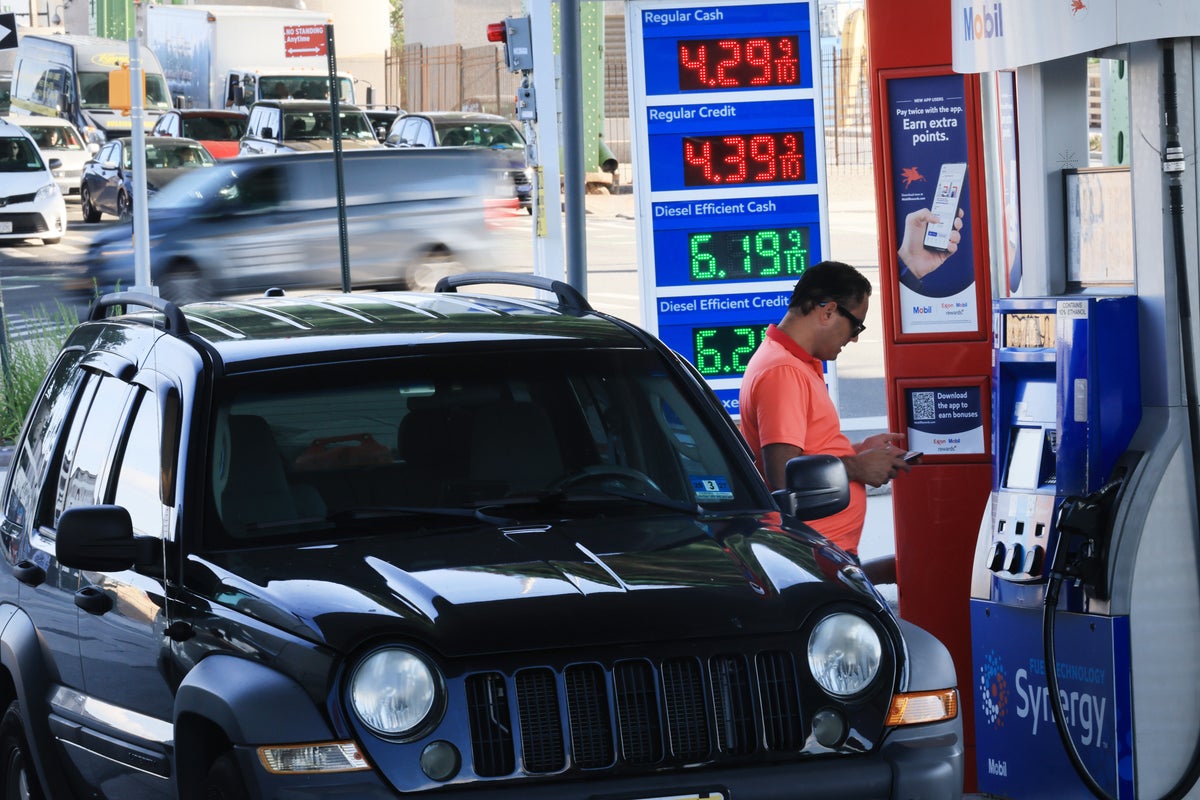
Prices at the pump stabilized. The cost of eggs settled into a predictable range. More importantly, wages—which had been lagging behind inflation for over two years—finally began to cross the line, growing faster than the cost of living. For the first time in thirty months, the average worker's paycheck bought slightly more at the end of the month than it did at the beginning.
The trajectory had changed. And in the human mind, a change in trajectory is everything.
The Weight of the Backpack
Think of inflation fatigue like carrying a fifty-pound backpack on a ten-mile hike up a steep mountain trail.
For the first mile, your shoulders ache. By the fifth mile, your knees are shaking and your lungs are burning. If someone walks up to you on mile six and removes five pounds from that pack, you are still carrying forty-five pounds of rocks. Mathematically, you are still heavily burdened.
But for the next five hundred yards, you feel like you can fly.
That is what happened to American consumer confidence in July. The economists were busy weighing the forty-five pounds still in the pack, marveling at how heavy it was, and predicting that the hiker would collapse. They failed to notice the relief of the five pounds being lifted.
Let us return to our hypothetical couple, Mark and Elena.
In mid-July, Mark gets his standard bi-weekly paycheck. It reflects the three percent cost-of-living adjustment he received in the spring. For months, that raise was swallowed whole by utility bills and car insurance premiums. But this month, the electric bill is flat. The price of chicken breasts at the supermarket has not changed since May.
On Friday night, Mark and Elena do not discuss their budget with voices tight with resentment. They do not pull up their banking app with squinted eyes, bracing for impact.
Elena suggests taking their daughter to the community pool, and afterward, buying pizza from the local shop down the street. Not the frozen pizza from the discount freezer aisle. The hot, greasy, boxed pizza with the garlic crust.
Mark pauses. He runs the mental math—that internal, silent abacus we all carry in our heads. Three months ago, he would have said no. He would have cited the credit card bill or the uncertainty about his company's quarterly earnings.
This time, he says yes.
That single word—yes—repeated across thirty million kitchen tables, is what blew past economic expectations in July.
The Self-Fulfilling Prophecy of Optimism
Why should anyone care about an abstract sentiment index? Why does it matter if people feel better about the economy if structural challenges like housing affordability and national debt remain unresolved?
Because in a modern economy, feeling is fact.
Consumer spending accounts for roughly seventy percent of the United States Gross Domestic Product. Seventy percent. That means the entire architecture of American prosperity does not rest on gold bullion stored in deep vaults, nor does it rest on algorithms humming in server farms.
It rests on mood.
When consumer sentiment is dark, fear acts as a contagion. A family decides to hold off on buying a new washing machine, choosing instead to nurse the rattling old unit along for another year. Because millions of families make that same choice, appliance manufacturers see orders dry up. They reduce their shifts from five days a week to four. The factory worker, seeing her hours cut, decides she cannot afford to paint her house. The local painter loses a contract, so he cancels his family vacation. The hotel clean-up crew loses hours.
The cycle feeds on itself. Dread builds its own reality.
But the reverse is equally true, and far more powerful.
When consumer confidence surges unexpectedly, it triggers a virtuous ripple across the commercial landscape. Consider what happens next:
- The local pizzeria hires a weekend delivery driver because Friday night orders are consistently up twenty percent.
- That delivery driver uses his tips to replace his bald front tires.
- The independent auto repair shop sees enough steady tire sales to finally offer its mechanics a small raise.
- The mechanic takes his family out to the movies on a Sunday afternoon.
Nothing about this cycle requires a miracle. It simply requires the absence of terror. When people stop waiting for the bottom to drop out, they begin to invest in the present. They replace the worn-out shoes. They book the dental appointment they had been putting off. They tip the waiter an extra three dollars.
The July sentiment numbers were a massive, collective exhale.
The Blind Spot of the Professional Class
There is a deeper, slightly uncomfortable truth hidden inside the July data—one that explains why the forecasting class was so thoroughly blindsided.
It is a story about disconnection.
Many of the analysts who predict consumer behavior do not live the same financial lives as the people they are analyzing. When you work in a corporate office where your primary economic exposure is the performance of your investment portfolio, your mood is tied to interest rates and stock market multiples. Over the past year, high interest rates have made headlines look grim. The news cycle has been saturated with talk of impending recessions, yield curve inversions, and corporate downsizings.
If you spend ten hours a day reading financial commentary, you will inevitably conclude that the sky is falling.
But the average citizen does not live inside a financial terminal.
The average citizen judges the economy by three distinct metrics:
- Can I find a job, or keep the one I have?
- When I fill up my car with gas, does it ruin my week?
- Is my bank balance higher or lower than it was on this day last month?
In July, all three of those practical metrics flashed green for a critical mass of the population. Unemployment remained stubbornly, resiliently low. People who wanted work could find it. Gas prices had retreated from their terrifying highs and stabilized. And because wages had crept up while goods inflation cooled, that checking account balance on the last day of the month had a little bit of breathing room.
The experts were looking at the weather radar, predicting a hurricane based on barometric pressure systems a thousand miles away. Meanwhile, the people on the ground simply looked out their windows, saw that the rain had stopped, and decided to go for a walk.
The Fragile Art of Recovery
We must be careful not to mistake relief for total victory.
Admitting that things are getting better is not the same as declaring that everything is fine. For millions of lower-income families, the July surge in sentiment is still a rumor heard from a distance. Housing costs remain notoriously high. Credit card interest rates are punishing for anyone carrying a balance. The psychological scars of thirty months of inflation do not vanish overnight.
There is a strange, lingering survivor's guilt in the modern economy. We are almost afraid to admit we are doing okay, lest we jinx the recovery or appear insensitive to those who are still struggling.
But denying the reality of an improvement is just as dangerous as ignoring a crisis.
When we refuse to acknowledge that inflation is cooling and that real earnings are rising, we trap ourselves in a state of permanent cynicism. We allow political narratives and algorithmic doom-scrolling to override the evidence of our own daily lives.
The data from July tells us something vital about American resilience. It proves that we are not permanently broken by economic shocks. We do not require perfection to feel hopeful. We only require fairness. We only require the sense that if we work hard and budget wisely, the ground beneath our feet will remain solid.
The Sunday Evening Light
Let us leave the data tables behind. Let us forget the Michigan index scores, the basis points, and the consensus forecasts.
Go back to Mark and Elena's kitchen.
It is Sunday evening, just before dusk. The house is quiet. Their daughter is asleep upstairs, her hair smelling faintly of chlorine from the community pool. The empty pizza box sits on the recycling bin.
Mark is sitting at the kitchen table with his laptop open. On the screen is their online banking dashboard. For two and a half years, this Sunday night ritual was a moment of quiet despair—a tense calculation of which bills could be postponed by a week, which credit card could absorb another hundred dollars for groceries, and how they would survive if the car's check-engine light ever started flashing.
Tonight is different.
The bills are queued up for payment. The mortgage is scheduled. The car insurance is paid. Mark looks at the line labeled Ending Balance.
There is a number there. It is not a fortune. It is not enough to retire on, or to buy a second home, or to take a luxury vacation to Europe. But after every single liability for the month has been subtracted, the number is positive. There are three hundred and forty-two dollars left over.
Mark does not call Elena over to celebrate. There are no fireworks.
He simply closes the laptop. He pushes his chair back from the table, walks to the sink, and pours himself a glass of water. He looks out the window at the suburban street, watching the streetlights flicker on against the deep blue of the summer evening. His shoulders drop an inch. His jaw relaxes.
That is what happened in July. Not an economic boom. Not a speculative bubble.
Just thirty million people closing their laptops on a Sunday night, looking out into the gathering dark, and realizing they are going to be okay.