Silence.
That is the first thing you notice when the needle drops on a modern pop ballad—not the absence of sound, because there is plenty of noise, plenty of sub-bass rattling the floorboards and hi-hats skittering like nervous insects across a glass table, but the eerie, sterilized silence where a human pulse used to live. You can hear the pitch-correction software ironing every tremor out of a singer’s throat until their heartbreak sounds like a navigation app telling you to make a legal U-turn. We have spent the last twenty years building a musical architecture so obsessed with perfection that we accidentally locked vulnerability outside in the rain.
I remember sitting in my parked car outside a grocery store in East Los Angeles three winters ago, engine idling, rain drumming against the windshield, listening to a local radio station play a track I had never heard before. A horn section swelled—not crisp and quantized, not sampled from a digital pack, but slightly ragged at the edges, warm as a wool blanket pulled out of a cedar chest. Then came a voice. High, aching, unashamedly tender, singing about wanting to be someone’s everything without a single ounce of modern irony to shield the singer from looking foolish.
My hands stayed on the steering wheel long after the song ended. I felt embarrassed. Not for the singer, but for myself—for how guarded I had become, how accustomed I was to consuming music that kept an emotional escape hatch open at all times.
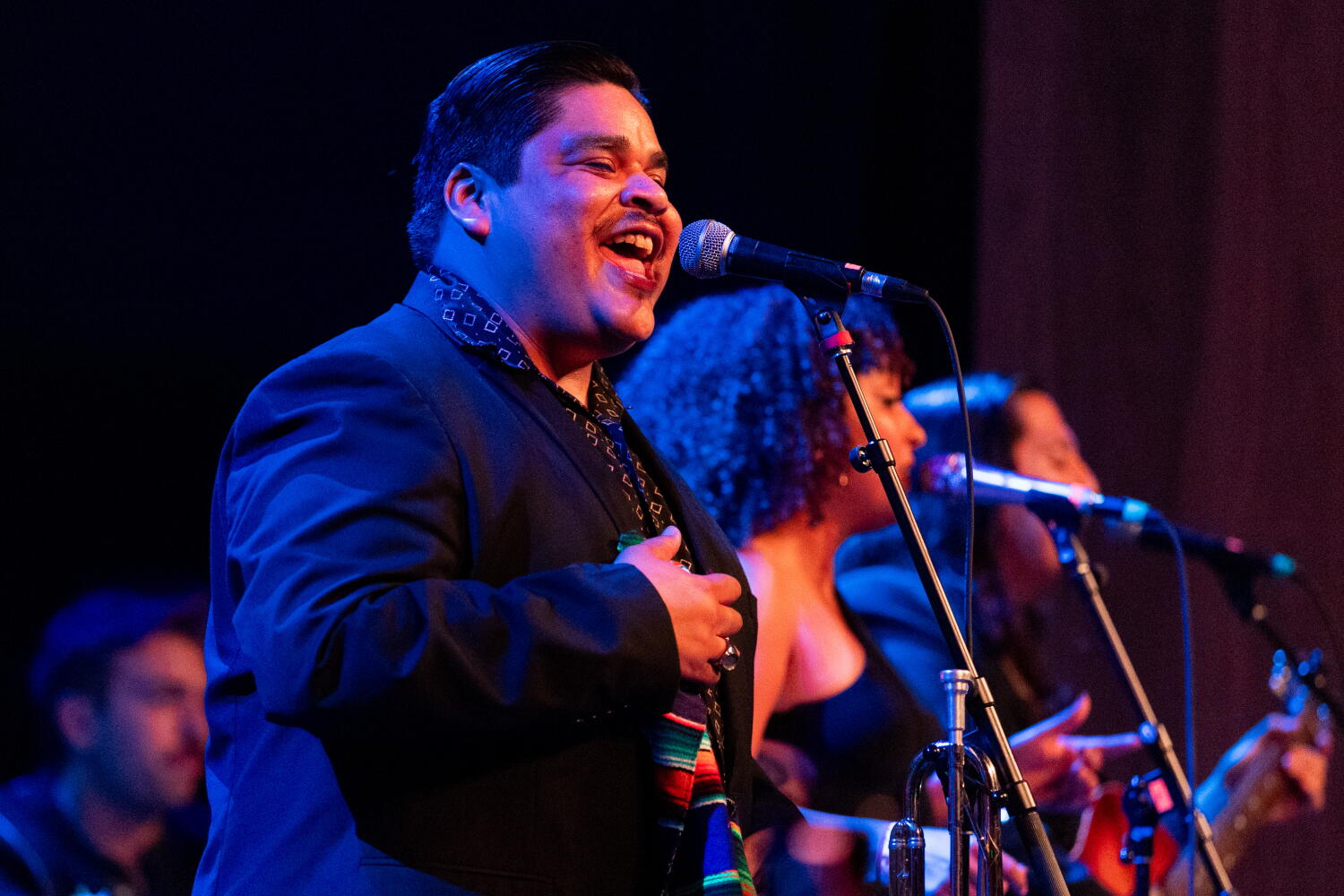
That song came from Thee Sinseers, a soul collective rooted in East Los Angeles and fronted by multi-instrumentalist, producer, and vocalist Joey Quinones. When their debut full-length album, Sinseerly Yours, arrived in 2024 on Colemine Records, it felt less like a nostalgia trip and more like a rescue mission. Now, with Love Stories, the band pushes deeper into that territory, proving that old-school sweet soul is neither a museum artifact nor a gimmick for vinyl collectors. It is a vital language for people who are tired of pretending they do not care.
The Architecture of Guarded Hearts
To understand why Love Stories hits like a sudden confession in a crowded room, you have to look at what happened to romantic music over the past two decades. Somewhere along the way, earnestness became social suicide.
Consider a hypothetical listener—let’s call her Elena, twenty-nine, working a mid-level design job, scrolling through dating apps at midnight with her thumb moving faster than her pulse. Elena’s playlists are full of songs about "situationships," emotional detachment, and leaving before you get left. That music serves a real defensive purpose; if you never admit you want something permanent, nobody can humiliate you when it falls apart. Modern production mirrors that armor. Compression flattens dynamic range so a whisper and a scream occupy the exact same volume. Auto-Tune removes the micro-fluctuations in pitch that happen when a human throat tightens around a memory.
We traded intimacy for invulnerability.
Thee Sinseers reject that trade entirely. Built around Joey Quinones—whose falsetto carries the bruised sweetness of classic 1960s and 1970s lowrider soul—the band operates like a living, breathing organism. Alongside core members including vocalist Adriana Flores, bassist Bryan Ponce, guitarist Christopher Manjarrez, and a tight-knit horn section featuring Eric Johnson and Francisco Flores, Quinones approaches recording the way a carpenter approaches reclaimed oak. You do not sand away the knots. The knots are the proof that the tree actually grew.
When you listen to Love Stories, you hear air moving through brass tubes. You hear fingers sliding across bass strings. You hear two vocalists—Quinones and Flores—trading lines not like competitors trying to out-sing each other on a televised talent show, but like two people sitting across a kitchen table at two in the morning, trying to figure out how to stay together when rent is due and pride gets in the way.
East Los Angeles and the Weight of Lineage
None of this happens in a vacuum. The "souldies" revival—a movement centered largely in Southern California that reclaims the golden era of Chicano soul, doo-wop, and sweet soul—has been building momentum for years, propelled by labels like Penrose Records and Colemine Records alongside groups like Thee Sacred Souls and The Altons.
Yet calling Thee Sinseers a "revival" band misses the point. Revival implies bringing back something dead. In East Los Angeles, that music never died; it simply lived inside family garages, Sunday afternoon barbecues, and the chrome-trimmed dashboards of classic Chevrolets cruising Whittier Boulevard.
Think of the difference between a movie set and an actual neighborhood. A revivalist builds a facade out of plywood and paints it to look like 1968. Quinones and his bandmates grew up inside the actual house. Their musical vocabulary—drawing from legends like Brenton Wood, Smokey Robinson, The Delfonics, and Ralfi Pagan—was absorbed through family record collections and community memory.
"People think sweet soul is just slow dancing and heartbreak," a longtime friend of mine who restores vintage audio gear in Boyle Heights once told me while soldering a capacitor onto a 1972 Marantz receiver. "It’s actually survival music. When the world outside treats you like you’re invisible, walking into a room and singing a song that says my feelings matter, my tenderness is sacred—that’s a quiet kind of rebellion."
That insight unlocks the entire emotional architecture of Love Stories. Every track on the record treats ordinary domestic devotion as an epic scale. Where contemporary culture often equates passion with chaos, toxicity, and dramatic breakups, Thee Sinseers find their highest drama in commitment, apology, patience, and the terrifying act of trusting another human being with your softest parts.
Inside the Sound of Love Stories
Listen closely to how Quinones constructs an arrangement, and you realize how deceptive simplicity can be.
In modern digital production, engineers routinely stack eighty or a hundred tracks onto a single song—layered synths, sub-drops, vocal doubles, rhythmic clicks—creating a wall of sound that impresses the ear for ten seconds and exhausts the brain within two minutes. Analog soul works on the opposite principle, much like a well-written short story where every sentence carries weight because nothing extraneous is cluttering the page.
On Love Stories, space is an active instrument.
A rimshot cracks against the snare like a screen door shutting on a warm evening. A vibraphone shimmers underneath the verse, holding a single chord while the bassline walks up the neck with unhurried confidence. When the horns enter, they do not blast; they bloom, answering the vocal melody like a sympathetic friend nodding across the room.
And then there is the vocal interplay between Joey Quinones and Adriana Flores.
Most duets in popular music are staged as spectacles. Thee Sinseers treat vocal harmony as conversation. When Flores steps forward, her voice brings a grounded, warm clarity that balances the soaring ache of Quinones’s falsetto. Together, they capture the full spectrum of real romance—not the airbrushed fantasy of perfume commercials, but the lived reality of relationships where love is both a refuge and a daily choice.
I found myself struggling, on my first few listens, to separate my own nostalgia from what the band was actually doing. It is easy to fall in love with warm tape saturation and vintage microphones simply because they remind us of a past we never had to survive. I worried, briefly, that Love Stories might feel too comfortable, too polite in a world currently on fire.
Then I paid attention to the lyrics.
There is nothing polite about admitting you are afraid of losing someone. There is nothing comfortable about singing without irony when every cultural signal tells you to keep your cool. Beneath the velvet arrangements sits an unflinching honesty about longing, regret, and the vulnerability required to build a life with someone else.
Why Humanity Needs Imperfection
Why does this matter beyond the boundaries of a single album or a specific genre?
Because we are living through an era of synthetic intimacy. Algorithms curate our matches, generative models write our apologies, and social media trains us to perform happiness rather than inhabit it. When everything around us is optimized, frictionless, and generated on demand, anything visibly made by flawed human hands takes on an almost startling moral weight.
Think about a handmade ceramic mug versus a mass-produced plastic cup. The plastic cup is lighter, cheaper, virtually unbreakable, and completely identical to ten million others. The ceramic mug has a slight wobble on the base, a thumbprint pressed near the handle where the potter lifted it off the wheel, and a glaze that pooled unevenly in the kiln. You reach for the ceramic mug every single morning because holding it reminds you that another person existed in space and time and made something real.
Love Stories is that ceramic mug.
When a horn player takes a breath a fraction of a second late, or when a vocal note bends slightly toward raw emotion rather than mathematical pitch, the listener’s nervous system registers something profound: A human being was here. Nobody smoothed this out with a mouse click. Nobody hid behind an algorithm.
That is why crowds at Thee Sinseers shows look the way they do. Look out across the floor at one of their concerts and you will see twenty-two-year-old indie kids standing shoulder-to-shoulder with couples in their sixties who slow-danced to these exact chord progressions in high school gymnasiums fifty years ago. Teens in baggy Dickies and vintage tees stand next to music nerds dissecting bass tones, all swaying to the same unhurried groove.
Music rarely bridges generations anymore. Streaming algorithms have fractured us into hyper-specific micro-demographics, each sealed inside its own acoustic echo chamber. Yet tenderness turns out to be universal. Everybody knows what it feels like to wait by a phone. Everybody knows what it feels like to wish they had said the right thing before the door closed.
The Courage to Mean It
Let’s return for a moment to Elena—our hypothetical twenty-nine-year-old scrolling through dating apps at midnight, exhausted by irony and half-heartedness.
Imagine she puts on headphones and lets Love Stories play from start to finish. No skipping tracks. No background multitasking. Just forty minutes inside a room where people still believe that devotion is worth singing about at full volume.
At first, the earnestness might make her flinch. Sincerity always feels awkward when you have spent years wearing armor. By the third song, though, her shoulders drop an inch. By the midpoint of the record, when the horns swell behind a chorus built on pure, unguarded longing, the armor feels heavier than the vulnerability it was supposed to protect.
That is the quiet triumph of Thee Sinseers. Joey Quinones and his bandmates are not trying to reinvent the wheel, nor are they chasing viral snippets engineered to last fifteen seconds on a vertical video feed. They are building songs meant to outlive the news cycle—songs you can play while cooking dinner on a Tuesday, driving home from a hospital shift at dawn, or holding someone close in a dimly lit living room after a hard year.
They remind us that soul music was never really about retro aesthetics, vintage suits, or analog gear. Those are just the tools. The real work happens in the space between the notes, in the willingness to stand in front of strangers and tell the truth about what the human heart actually wants.
Late at night, long after the amplifiers cool down and the last vinyl sleeve slides back onto the shelf, a faint hiss remains in the groove before the tonearm lifts—just air, warmth, and the unmistakable sound of someone breathing before they sing.