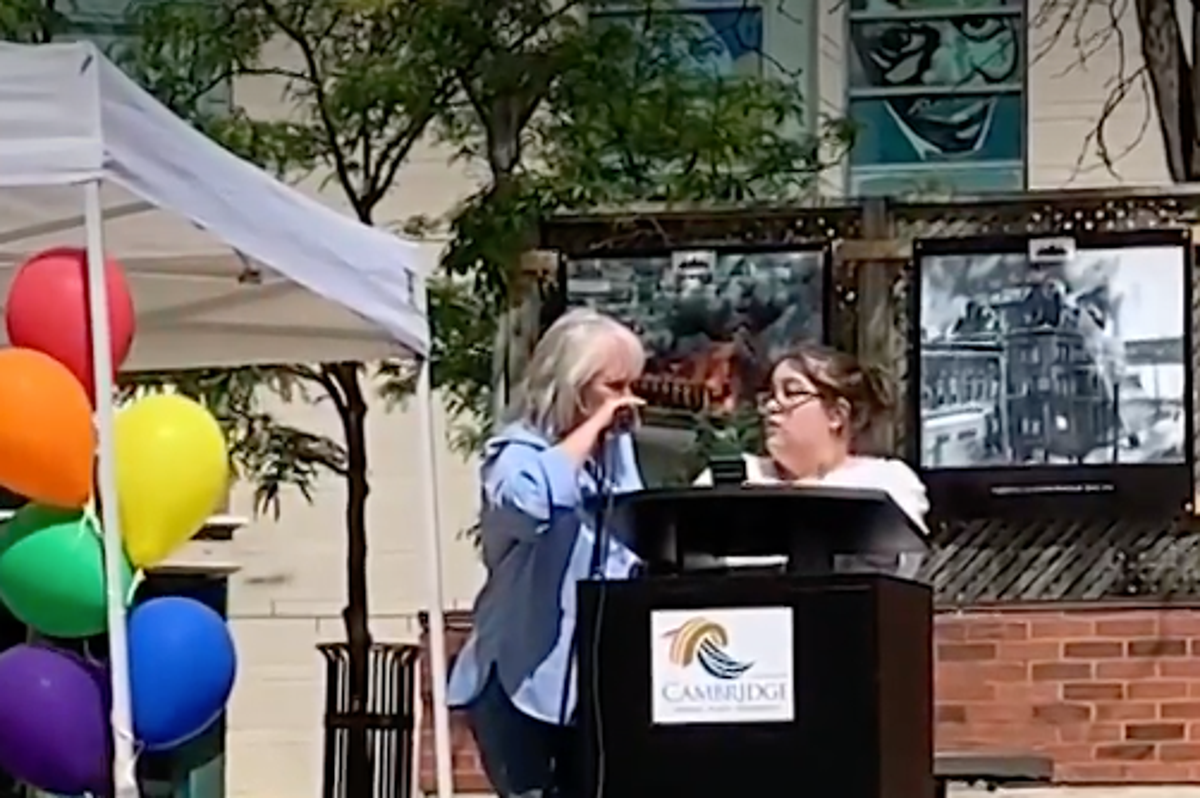
The media outrage machine found its perfect target this week when Cambridge Mayor Jan Liggett stepped up to a microphone, grabbed it from a 17-year-old nonbinary speaker named Sophie Mills, and said, "I'm not going to allow you to continue."
The internet did exactly what it always does. It mobilized a swift, predictable wave of condemnation. Editorial pages filled up with letters calling the act "dismissive," "rude," and a textbook example of systemic silencing. The consensus was immediate, tidy, and completely superficial: a powerful adult bureaucrat used brute force to suppress a marginalized youth at an event meant to celebrate inclusion.
This lazy narrative misses the real systemic failure playing out on that stage.
The outrage focused entirely on the optics of the interruption rather than the structural hypocrisy of the event itself. What happened in Cambridge was not an isolated incident of mayoral rudeness. It was the natural, inevitable friction that occurs when genuine, messy grassroots political grievance collides with the sterilized, risk-averse machinery of corporate and municipal allyship. By treating Pride as a harmless, photo-op-friendly civic festival, municipal governments have created an environment where actual political speech is viewed as a breach of etiquette.
The mayor’s mistake was simply saying out loud what the entire apparatus of performative allyship is designed to enforce: keep it comfortable.
The Myth of the Neutral Platform
To understand why the mainstream analysis is broken, look at the justification the mayor offered in the heat of the moment. After cutting off Mills—who was criticizing Ward 6 Councillor Adam Cooper for sharing a mocking meme about pronouns—Liggett said, "[Cooper has] already gone through what he needs to go through and I don't think it's helpful."
This defense relies on a pervasive, deeply flawed premise: that public forums organized by institutions exist to facilitate personal healing and neat resolution. In this view, once an integrity commissioner issues a report, a council votes on a ten-day pay suspension, and a sensitivity training session is scheduled, the issue is legally and socially closed. The ledger is balanced.
This is bureaucratic fantasy. For an institution, a disciplinary process is a mechanism to mitigate risk and close a file. For the community affected by an elected official's rhetoric, the harm does not vanish when the HR paperwork is filed. By bringing up the councillor's actions, Mills was doing exactly what public speakers at political events have done for decades: holding power accountable in a public space.
When municipal governments invite marginalized youth to speak at a flag-raising ceremony, they are rarely looking for raw, unvarnished truths about the friction within their own chambers. They are looking for inspirational narratives of resilience that reflect well on the institution's brand. They want the optics of inclusion without the discomfort of accountability. The moment a speaker uses the provided platform to name specific actors within that institution, the illusion of the neutral, benevolent platform shatters.
The Commodification of Grievance
I have seen organizations spend thousands of dollars on diversity consultants, corporate branding campaigns, and elaborate public ceremonies, only to panic the moment an actual stakeholder voices a grievance that cannot be solved by a press release. This is the core paradox of modern institutional allyship. It demands the presence of marginalized voices for validation but demands those voices adhere to strict, unwritten rules of respectability politics.
When the state or a corporation sanitizes a protest movement into a celebration, it strips that movement of its utility. Pride did not begin as a parade sponsored by major banks and policed by municipal guidelines. It began as a riot against state-sanctioned harassment.
Historical Reality:
Stonewall Riots (1969) ──> Radical, Disruptive, Political Friction
                                │
                                ▼
Modern Civic Pride (2026) ──> Institutionalized, Sanitized, Risk-Averse
By reframing a commemorative political space as a sterile civic ceremony where "politeness" is the supreme virtue, leaders create a trap. If you speak politely about generic struggles, you are applauded. If you speak precisely about local political reality, you are deemed "disrespectful" and unplugged.
The mayor’s action was a clumsy, overt display of this dynamic, but the dynamic itself operates quietly in boardrooms and city halls every day. It manifests as vetted speeches, curated panels, and heavily moderated Q&A sessions designed to ensure that nothing "unhelpful" ever reaches the microphone.
The Downside of Institutional Space
There is a lesson here for advocacy groups who continue to seek validation from institutional spaces. Following the interruption, Grand River Pride—a local advocacy group that had already distanced itself from the city-led event due to a perceived lack of structural accountability—hosted a separate flag-raising event on a local street. It was there, away from the city hall microphone and municipal oversight, that Mills was able to deliver the full, unedited speech.
This contrast reveals an uncomfortable truth that many mainstream commentators are reluctant to admit: true political speech and institutional sanction are frequently incompatible.
The downside of operating entirely outside institutional frameworks is obvious: you lose the massive reach, the official validation, and the access to resources that a city hall or a corporate sponsorship provides. It is far harder to build momentum on a street corner than it is on the steps of a government building with a city-provided sound system.
Seeking that institutional validation always comes with an invisible tax. That tax is paid in compliance, moderation, and the understanding that you do not bite the hand that holds the microphone. When advocacy groups treat municipal flag-raisings as the pinnacle of achievement, they hand over control of the narrative to officials whose primary loyalty is to the stability of the institution, not the liberation of the community.
Stop Asking for Permission to Speak
The mainstream critique of the Cambridge incident demands an apology from the mayor, a code of conduct review, and perhaps another round of sensitivity training for city staff. This response is entirely inadequate because it operates within the same broken framework that caused the problem. It assumes the solution is to make the gatekeepers of institutional spaces more polite, rather than questioning why we are relying on those gatekeepers in the first place.
If an activist requires a politician's permission, a politician's microphone, and a politician's schedule to air a grievance, then that activist is not engaged in political action—they are participating in pageantry.
The premise of the "People Also Ask" entries surrounding these events usually boils down to: How can public officials better handle uncomfortable speakers? That is the wrong question. The real question is: Why are advocacy movements continuing to compromise their messaging for the sake of a photo-op on government property?
Do not look to city halls or corporate boardrooms to provide a safe space for radical truth-telling. Their structural purpose is to maintain order, balance budgets, and minimize legal liability. Expecting them to enthusiastically host speeches that disrupt their internal harmony is a failure of political literacy.
The path forward requires less focus on demanding better behavior from defensive politicians and more focus on building independent, self-sustained platforms that cannot be turned off with a switch. If the message can be silenced by a single person grabbing a microphone, the problem isn't just the person grabbing it—it's the fact that they owned the microphone in the first place. Stop asking institutions for permission to hold them accountable. Build your own stage, bring your own sound system, and speak directly to the people who actually need to hear it.