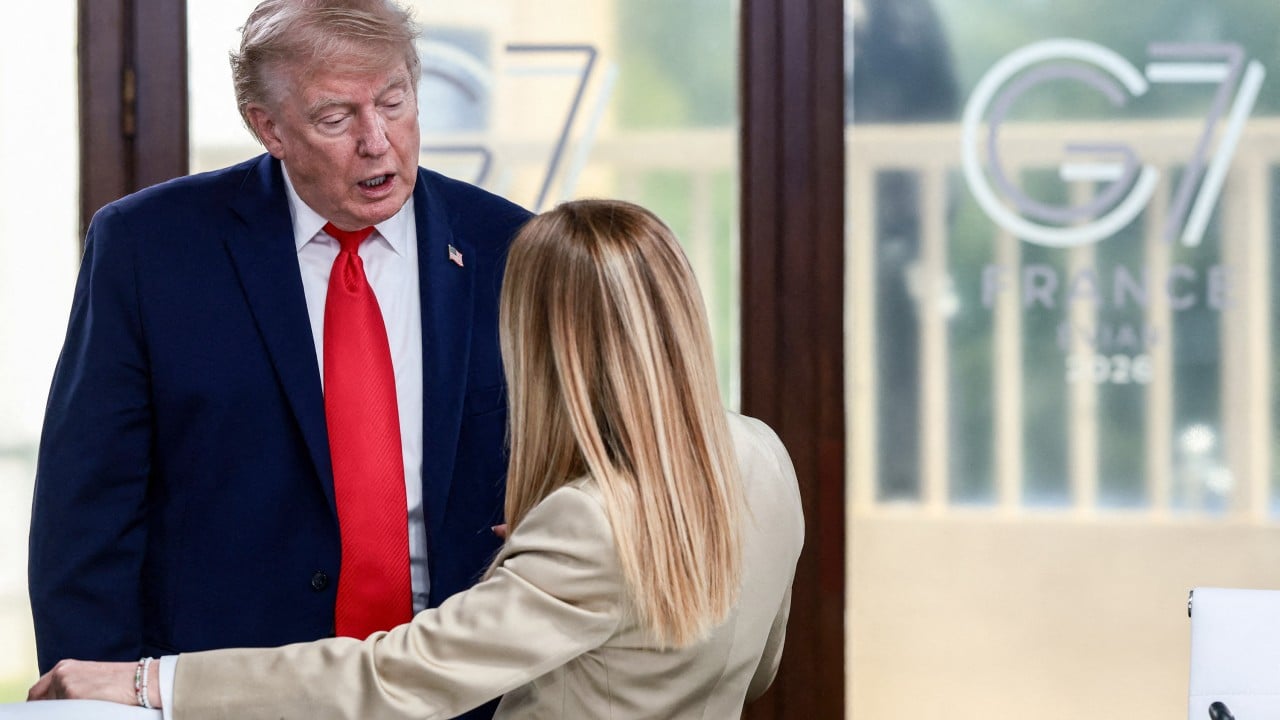
The mainstream political press has degraded itself into a celebrity gossip rag.
For the past forty-eight hours, the international news cycle has been completely consumed by a single, childish premise: did Italian Prime Minister Giorgia Meloni "beg" U.S. President Donald Trump for a smartphone snapshot at the G7 summit in France, or did Trump invent the entire story out of thin air?
Reporters are tracking Instagram captions like they are teenage diary entries. They are hyper-analyzing body language from broadcasted couch interviews on Italy's La7 network. They are treating a massive, structural fracture in the Western military alliance as if it were an episode of a reality television show.
This lazy consensus is completely wrong. It misses the entire point of how modern international relations function.
This public explosion has absolutely nothing to do with personal vanity, hurt feelings, or a photo-op. It is a brutal, calculated, and entirely predictable public divorce over the mechanics of hard power, military logistics, and sovereign defense boundaries. The photo narrative is merely the smoke; the fire is a deep structural disagreement over the U.S. military operations in Iran and the operational compliance of NATO allies.
If you are reading the news to figure out who is telling the truth about a camera flash, you are asking the wrong question entirely.
The Illusion of Right-Wing Ideological Solidarity
The media fell in love with a highly flawed narrative in 2025: the idea that shared populist rhetoric guarantees geopolitical alignment. When Meloni attended Trump’s second inauguration as the sole European head of state in attendance, the pundit class assumed a permanent axis of right-wing cooperation had been established.
I have watched political analysts waste millions of dollars in corporate risk assessments betting on this exact brand of superficial ideological alignment. It fails every single time because it ignores the fundamental law of statecraft: national interest always trumps political brotherhood.
Meloni’s political brand inside Italy relies on a fierce defense of national sovereignty. Trump’s political brand relies on an aggressive "America First" transactional model. These two positions are fundamentally incompatible the moment a real geopolitical crisis hits.
The immediate catalyst for this rupture was not a photo at Évian. It was Italy’s refusal to grant the United States unrestricted access to Italian airbases, landing strips, and runways during the recent military actions against Iran.
When Washington expected its "close ideological ally" to immediately hand over the keys to its sovereign logistics infrastructure, Rome drew a hard line. Meloni protected Italian airspace and base autonomy to avoid dragging her country into a wider Middle Eastern war that the Italian public overwhelmingly opposed. Trump viewed this not as a sovereign choice, but as a direct betrayal of a relationship funded by hundreds of billions of American defense dollars.
The Real Cost of Sovereign Runways
Let us strip away the diplomatic theater and look at the actual operational mechanics at play.
The United States maintains a massive military footprint in Italy. Bases like Aviano Air Base and Naval Support Activity Naples are critical logistical nodes for any sustained American projection of power across the Mediterranean and into the Middle East. However, the use of these bases for offensive operations not tied directly to a collective NATO article 5 defense requires explicit bilateral authorization from the Italian government.
[U.S. Operational Request] ──> [Italian Airbase Access] ──> [Denied for Iran Operations] ──> [Trump Decouples Diplomatic Cover]
When the U.S. moved against Iran, Rome exercised its legal right of refusal.
To understand why Trump chose to weaponize a "photo claim" on Italian television, you have to understand his specific negotiation playbook. He rarely attacks an ally on complex, dry logistical treaties because the public does not care about bilateral basing agreements. Instead, he translates a highly technical grievance into a humiliating personal narrative designed to strip away his opponent's political leverage.
By claiming Meloni "begged" for a photo because he "felt sorry for her," Trump deliberately targeted her core political asset: her reputation as a strong, unyielding defender of Italian national pride. It was a calculated attempt to diminish her standing both domestically and among European peers, punishing her for the logistical roadblock she threw in front of the U.S. military.
Dismantling the Punditry on Domestic Popularity
The public retort from Meloni was swift. Writing on social media, she stated that her popularity depends strictly on her ability to defend Italy’s national interest, not on her proximity to Washington. She explicitly noted that Italy's military bases are governed by strict agreements that cannot be violated as long as she is Prime Minister.
Predictably, the political press is framing this as Meloni "losing her cool." This is another fundamental misunderstanding of the domestic landscape she is navigating.
The Real Status of Italian Public Opinion
- The Judicial Referendum Hit: Meloni’s domestic standing did take a genuine hit following the defeat of her judicial overhaul referendums earlier this year.
- The Anti-War Consensus: The Italian electorate is deeply cynical about American military interventions in the Middle East.
- The Sovereign Dividend: By publicly fighting back against an American president who is perceived as overreaching, Meloni is executing a textbook domestic reset.
For Meloni, being insulted by an American president over her refusal to cede Italian runways is a massive political gift. It allows her to neutralize accusations from her left-wing opposition that she is merely a puppet of Washington. It reinforces her narrative that she is the sole protector of Italian sovereignty against foreign dictation.
Trump’s Truth Social counter-attack—where he explicitly tied her falling poll numbers to her lack of cooperation in the Iran conflict—actually confirms this dynamic. He wrote that she wanted to repair relations "in order to get her numbers up." But the reality is exactly the reverse: fighting Washington is the quickest way for an Italian leader to stabilize their numbers during a domestic foreign policy crisis.
The Diplomatic Fallout is Features, Not Bugs
The corporate press is treating the cancellation of Foreign Minister Antonio Tajani’s trip to the United States as an accidental, catastrophic breakdown in diplomacy. Tajani called Trump’s words "grave and offensive to all of Italy."
This cancellation was not an emotional overreaction; it was a highly scripted diplomatic maneuver.
In foreign affairs, when a superpower president publicly humilates a middle-power prime minister on television, the middle power must respond with a proportional escalation to preserve its international credibility. If Tajani had boarded that plane to Washington, it would have signaled to every capital in Europe that Italy could be publicly bullied without consequence. By canceling the tour, Rome signaled that base access and national dignity are non-negotiable, even if it means a prolonged freeze in transatlantic communications.
The downside to this contrarian reality is obvious and dangerous. Italy relies heavily on the U.S. security umbrella, and a prolonged diplomatic freeze threatens intelligence sharing, joint counter-terrorism operations, and defense procurement pipelines. But pretending that this is a personal ego clash prevents anyone from addressing the actual structural rot in the alliance.
The Structural Breakdown of NATO Transatlantic Defense
The broader question underlying this entire spat is one that the media refuses to address honestly: Is the current structure of NATO sustainable when the domestic priorities of its members completely diverge on non-European conflicts?
Trump’s long-standing grievance that the United States contributes hundreds of billions of dollars to protect "so-called" allies who refuse to cooperate when the U.S. asks for operational help is a standard feature of his foreign policy. From a strictly transaction-based American perspective, his logic is coherent. If Washington pays for the defense of Europe, Washington expects Europe to provide the logistical runway when America goes to war.
But from the European perspective, NATO is a defensive alliance designed to protect European soil from direct aggression, not a blank check for American geopolitical campaigns in the Middle East. Meloni’s stance reflects a growing consensus among European leaders that they can no longer afford to blindly underwrite American foreign policy choices that leave Europe to deal with the immediate fallout, such as refugee crises, disrupted energy supplies, and heightened domestic terror threats.
The "photo fight" is just the chosen language for a much deeper argument about the expiration date of post-Cold War security arrangements.
Stop Asking if She Begged
The media will continue to hunt for the original un-dubbed audio from the La7 interview. They will continue to badger press secretaries about who initiated the conversation on that sofa in France. They will continue to write empty analytical pieces about the psychology of right-wing populism and the fragile egos of world leaders.
Ignore all of it.
The next time you see a headline about a world leader snubbing another over a photo-op or a social media comment, look immediately for the underlying logistics treaty, the denied airspace request, or the stalled trade negotiation. The theater of international politics exists precisely to distract the public from the cold, transactional reality of how power is actually wielded.
The U.S. demanded Italian airbases for a war Rome did not want. Italy said no. Everything else is just entertainment for the masses.