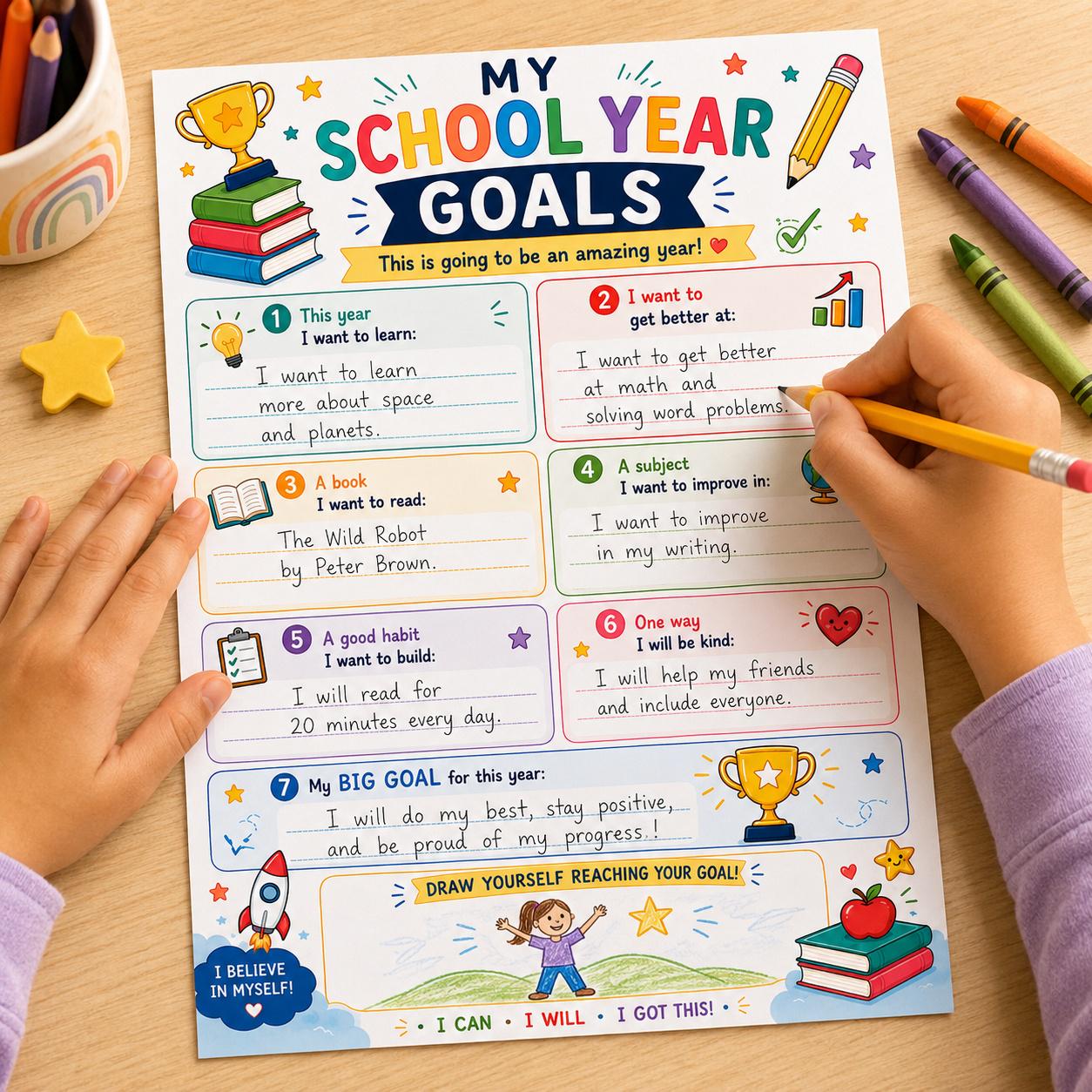
Every August, adults collectively lose their minds and subject innocent children to a medieval torture device known as the annual goal-setting ritual. Walk into any classroom or kitchen table in America, and you will find well-meaning parents and teachers forcing exhausted humans to write down lofty ambitions on neon poster boards. Straight A grades. Reading fifty books. Joining three varsity sports. Becoming fluent in a dead language before Thanksgiving.
It is a complete farce.
I have watched school districts, prestigious private academies, and anxious helicopter parents blow millions of dollars and countless hours trying to engineer the perfect academic achiever. They build elaborate vision boards, color-code spreadsheets, and establish rigid nightly routines. By October third, everyone is crying at the kitchen table over algebra homework while the goal tracker gathers dust behind the recycling bin.
The lazy consensus in education is that failure stems from a lack of discipline or poor motivation. If the kid just tried harder, woke up earlier, or used a better planner, they would hit their targets.
This is garbage. The system is not failing because children lack willpower. The system is failing because the entire premise of academic goal-setting is built on corporate management fantasies that have zero basis in cognitive science. We are treating growing human brains like quarterly sales quotas, and it is destroying our kids' capacity for actual learning.
The Myth of the Infinite Improvement Curve
Let us look at what the standard school year advice actually tells you to do. The typical article on educational goals reads like a Silicon Valley pitch deck. It preaches constant optimization, measurable metrics, and relentless output. Set your targets high, track your daily habits, and never settle for mediocrity.
Except human development does not work on a linear upward trajectory. It is messy, erratic, and deeply non-linear.
When you force a nine-year-old or a seventeen-year-old to commit to rigid annual goals, you trigger a defensive psychological response. You create an environment where the cost of making mistakes becomes catastrophic. A bad grade on a Tuesday quiz is no longer a data point; it is a direct threat to the grand vision board hanging on the bedroom wall.
I consulted with cognitive psychologists and veteran educators who have spent decades tracking student outcomes. The data is clear. High-pressure goal setting in educational contexts frequently correlates with a massive spike in adolescent anxiety and a sharp decline in intrinsic motivation. When children are rewarded solely for hitting external benchmarks, their brains stop engaging with the material for its own sake. They learn how to pass the test, check the box, and forget the information forty-eight hours later.
That is not education. That is compliance training.
Why Your Smartest Strategy is Absolute Chaos
If rigid goals are a trap, what is the alternative? Do we just abandon all structure and let teenagers play video games until graduation?
Of course not. But we need to flip the entire framework upside down. Instead of asking what goals a student should achieve this year, we should be asking how to build an intellectual appetite that survives contact with reality.
Real expertise does not come from mapping out a thirty-six-week curriculum of perfection. It comes from radical curiosity paired with sustained, unstructured boredom.
Think about the most effective autodidacts in history. Did they start their school year by outlining a meticulous GPA target? No. They chased obsessions down dark alleys. They ruined dinner parties asking weird questions. They failed spectacularly at things they cared about until the friction of failure forced them to figure out how things actually worked.
When you prioritize systems of inquiry over targets of achievement, the metrics take care of themselves.
Let us break down the exact mechanics of how to dismantle the traditional goal-setting model and replace it with something that actually produces functional, resilient humans.
1. Burn the Vision Board
The first thing you need to do is throw away the visual reminders of perfection. When a student stares at a poster demanding straight A's and a packed extracurricular resume, their brain registers those demands as a permanent judgment of their self-worth.
Instead, establish a single operational constraint: daily engagement. Do not measure success by whether you got an A on the chemistry midterm. Measure success by whether you can explain how a chemical bond works to a skeptical twelve-year-old without checking your notes.
The downside of this approach is that it makes parents deeply uncomfortable. You cannot neatly frame a conversation about intellectual curiosity and hang it on the refrigerator. You cannot quantify it on a college application form with a single neat percentage. It requires adults to tolerate ambiguity, and most adults are terrified of ambiguity.
2. Redefine Failure as Calibration
We tell children it is okay to fail, but our entire grading architecture screams the exact opposite. Every red ink mark on a paper tells the student that they are deficient.
We need to treat errors the way software engineers treat bug reports. When code crashes, the engineer does not sit in the corner and cry about being a bad human being. They run a traceback, isolate the corrupted variable, and rewrite the function.
During the school year, when a concept or a class goes sideways, stop treating it as a character flaw. Treat it as a diagnostic signal. If algebra is collapsing, the problem is rarely that the student is lazy. The problem is usually a missing foundational block from three years prior. Go backward. Fix the foundation. Stop trying to outrun a broken basement by adding another floor to the house.
3. Embrace Strategic Ignorance
You cannot learn everything, and pretending that students need to master every single subject with equal intensity is a recipe for burnout.
The industrial education model was designed in the nineteenth century to produce factory workers who could follow instructions and tolerate repetition. It rewards compliance above all else. If you want your child to thrive in an economy defined by artificial intelligence and rapid automation, compliance is a liability.
Teach them how to ruthlessly ignore what does not matter. Teach them how to dive deep into niche domains that fascinate them, even if those domains have nothing to do with their current grade point average. A student who spends six months mastering the mechanics of open-source software development or Renaissance art history on their own terms has acquired a cognitive toolkit that no standardized test can measure or replace.
The Honest Cost of Contrarian Learning
I have to be completely transparent with you about the risks of this approach.
When you strip away the comforting illusions of traditional goal-setting, you remove the guardrails. You will have semesters where your child's grades dip because they spent three weeks reading every book they could find on marine biology instead of studying for their history finals. You will face panic-stricken phone calls from guidance counselors who do not understand why your teenager is questioning the foundational assumptions of the textbook instead of memorizing the glossary.
It is uncomfortable. It is messy. It requires you to stand your ground against a culture that equates busyness with brilliance.
But the alternative is worse. The alternative is churning out another generation of burnt-out, anxious high-achievers who have mastered the art of the checklist but lost the capacity for original thought.
Stop asking what grades they are going to get. Stop worrying about whether their resume looks like a corporate brochure.
Let them break things. Let them get obsessed. Let them fail in directions that actually matter.