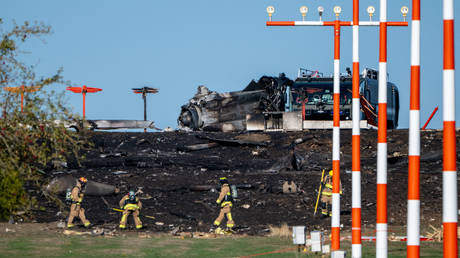
Another day, another aviation headline. An American F-16 Fighting Falcon goes down on approach to Spangdahlem Air Base in western Germany, the pilot punches out safely, media outlets scramble for stock footage of burning wreckage, and the internet erupts into synchronized gasps. Pundits demand answers about mechanical failure, pilot fatigue, or NATO operational strain.
Save the theater.
The lazy consensus treats every tactical jet crash as an unpredictable anomaly—a shocking rupture in an otherwise infallible system of aerial dominance. That viewpoint is historically illiterate and technologically naive. Modern supersonic fighters are not family sedans or commercial airliners built for passive redundancy and benign glide ratios. They are heavily armed, highly unstable lifting bodies driven by single, brutal powerplants operating at thermal and structural extremes.
When an F-16 goes down during a routine training rotation, the public acts surprised because they misunderstand the fundamental contract of military aviation. This is not a malfunction of safety protocols. It is the statistical price of admission for maintaining a global power projection machine.
Let us look at the architecture of the aircraft itself. In military aviation circles, the F-16 has earned a brutally honest nickname over decades of service: the lawn dart. That moniker does not stem from poor engineering; it stems from uncompromising physics. To achieve high maneuverability, the aircraft was designed with relaxed static stability. Computers constantly correct its flight path because, left to its own aerodynamic devices, it wants to swap ends. Couple that with a single engine and a tight glide envelope, and you have a machine that leaves zero margin for human or mechanical error, especially during the high-workload landing phase.
When you fly a single-engine fighter on approach after a grueling tactical intercept drill, you are balancing on the edge of a razor. If the turbine stalls, oil pressure drops, or a digital fly-by-wire channel glitches at five hundred feet, you do not coast to a gentle stop on the shoulder. You drop out of the sky.
Yet the mainstream narrative insists on framing these incidents as isolated institutional failures. Committees assemble. Investigations drag on for months. Officials issue sterile press releases promising thorough reviews of maintenance logs and crew rest periods. This ritual serves a psychological purpose for civilian leadership: it maintains the comforting illusion that military hardware can be made entirely safe if we just write enough checklists.
That is a dangerous delusion.
If you eliminate the risk of a crash, you eliminate combat readiness. The training required to keep pilots proficient in modern electronic warfare, dogfighting, and tactical delivery cannot be simulated away in a quiet room with triple-redundant virtual reality headsets. G-forces cannot be coded into a laptop. Spatial disorientation cannot be felt safely while sitting in an air-conditioned simulator pod. True readiness demands flying real metal through real air at high subsonic and supersonic speeds, pushing engines past their comfort zones, and forcing pilots to make split-second ejection decisions when things go sideways.
Training accidents are the tax paid for operational competence. When air forces sanitize their procedures to the point where crashes drop to absolute zero, their combat effectiveness drops to absolute zero right alongside them. A military that refuses to risk losing jets in training is a military that will lose entire wars in reality.
Consider the geopolitical theater where these incidents occur. Spangdahlem and other European installations sit at the friction points of modern superpower competition. The operational tempo for these squadrons has not slowed down; it has intensified. Crews are juggling persistent rotational deployments, rapid response posture adjustments, and complex multinational exercises designed to signal deterrence across tense borders.
When an airframe fails in this environment, pointing fingers at routine maintenance misses the structural forest for the single burning tree. The machine was wrung out, as it was designed to be. The pilot did what the training mandated: saved their own life via the ejection seat rather than riding a dying airframe into the ground to protect a multi-million-dollar asset from public relations fallout.
Stop asking how we can prevent every tactical aircraft from ever touching the earth unintentionally. Start asking whether our forces are flying hard enough to maintain an actual edge. Until then, treat these headlines for what they are: the noisy, violent, entirely predictable cost of keeping the peace through superior firepower.