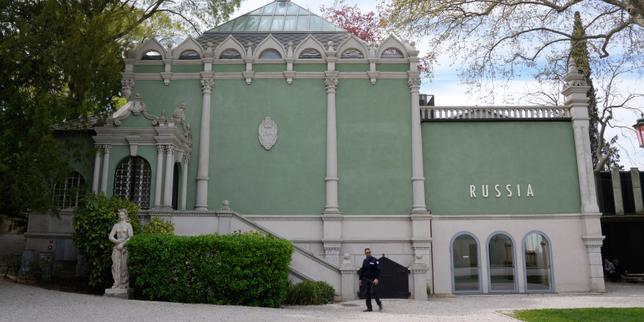
The liberal intelligentsia is clutching its pearls again. The collective gasp echoing through the Giardini della Biennale isn't about the aesthetics of a sculpture or the brushwork of a painting. It’s about the "scandal" of the Russian Pavilion’s return to the Venice Biennale. Critics are lining up to pen the same tired, predictable essay: that art is being "weaponized" and that a cultural platform is being "hijacked" for geopolitical posturing.
They are late to the party. By about five hundred years.
To suggest that the Russian Pavilion’s presence is a sudden, shocking shift toward art-as-warfare is to ignore the entire history of cultural diplomacy. It assumes there was ever a "pure" era where the Venice Biennale was just a polite gathering of creative souls. It wasn’t. It isn't. It never will be. The outrage machine is currently fueling a narrative that the sanctity of art is being violated, when in reality, the only thing being violated is a comfortable, naive delusion.
The Myth of the Neutral Canvas
The prevailing argument—the "lazy consensus"—is that international art festivals should be sanctuaries of global harmony. This is a fairy tale told to donors.
Since its inception in 1895, the Venice Biennale has functioned as a soft-power Olympics. The very structure of the event—national pavilions organized by state governments—is a literal map of geopolitical ego. To act surprised that a state uses its allocated space to project a specific image during a time of conflict is like acting surprised that a sovereign nation has a flag.
The Russian Pavilion isn’t "breaking" the Biennale. It is fulfilling the Biennale’s original, gritty purpose: the projection of national identity through the lens of high culture. When France or the United States uses their pavilions to highlight progressive values or internal critiques, they are doing exactly what Russia is doing—using art to curate a global perception. One is just more palatable to the current Western palate than the other.
Soft Power is Still Power
Critics claim that by allowing the pavilion to open, the Biennale is "legitimizing" a regime. This logic is fundamentally flawed because it ignores how power actually works in the 21st century.
Isolation is a blunt instrument that rarely yields the intended results in the cultural sphere. When we talk about "Cultural Diplomacy," we aren't talking about being nice. We are talking about the strategic management of a nation's reputation. Joseph Nye, who coined the term "soft power," didn't describe it as a kumbaya session; he described it as the ability to get what you want through attraction rather than coercion.
If the Russian Pavilion is a tool of propaganda, then every other national pavilion is also a tool of propaganda. The difference is the quality of the message. By demanding the closure of a pavilion, critics aren't defending art; they are calling for the suspension of the very competition of ideas they claim to value.
Imagine a scenario where we only allowed "virtuous" nations to exhibit. Who holds the yardstick of virtue? The host country? A committee of curators? If you start purging pavilions based on current military actions or human rights records, the Giardini would be a ghost town within a decade. The Biennale’s strength isn't its purity—it's its messy, often uncomfortable reflection of the world as it actually exists.
The Aesthetic Obsession with Morality
There is a growing, stifling trend in the art world to prioritize the "moral resume" of the artist or the state over the work itself. We have moved from the "Death of the Author" to the "Sanctification of the Sponsor."
This moralizing prevents us from actually seeing the art. When a pavilion opens under a cloud of controversy, the work inside becomes invisible. It is treated as a radioactive object. This is a failure of criticism. A sharp industry insider doesn't look at the Russian Pavilion and see a "pretext for war." They see a desperate attempt at relevance in a global market that has already moved on.
The real "war by other means" isn't happening in the pavilion; it’s happening in the headlines surrounding it. The outrage generates more attention for the pavilion than the art ever could on its own. The boycotters are the most effective PR agents the Russian state has right now.
The Failure of Cultural Sanctions
Let's talk about the "battle scars" of cultural boycotts. I’ve seen institutions burn through millions in funding and decades of relationship-building to "take a stand," only to find that the target of their ire was completely unaffected.
Cultural sanctions are often a performance for an internal audience. They make the West feel good about itself without requiring any actual sacrifice. Closing a pavilion doesn't change a single thing on the ground. In fact, it often backfires. It fuels the "besieged fortress" narrative that nationalist regimes use to consolidate domestic power.
When you kick an artist or a pavilion off the international stage, you aren't silencing a government. You are cutting off the few remaining threads of communication that exist outside of military channels. It is a strategic error masquerading as a moral victory.
The "People Also Ask" Fallacy
If you look at the common questions floating around this topic, you see a pattern of flawed premises:
- "Should art be political?" This is the wrong question. Art is inherently political because it exists in a world of limited resources and competing interests. The real question is: "Why are we only noticing the politics now?"
- "Does the Biennale support war by hosting certain countries?" No. The Biennale supports the existence of an international forum. Blaming the venue for the participants' actions is a category error. It’s like blaming a stadium for a foul on the pitch.
- "Can art change the world?" Not in the way you think. It won't stop a tank. But it can expose the fragility of the ego that sent the tank in the first place. By closing the pavilion, you lose the chance to see that fragility.
The Inconvenient Truth of the Art Market
The art world loves to pretend it is a meritocracy of talent and spirit. In reality, it is a high-stakes asset class. The Venice Biennale is the ultimate trade show.
The pavilions are marketing suites. The curators are brand managers. The collectors are the venture capitalists. When we strip away the flowery language about "humanity" and "dialogue," we are left with a brutal competition for cultural capital. Russia’s return isn't a disruption of this system; it is a desperate attempt to stay in the game.
If we were honest, we would admit that the discomfort around the pavilion isn't about peace—it’s about the fact that the mask of the art world has slipped. We are forced to look at the machinery of influence that usually runs silently in the background of every exhibition, regardless of the country of origin.
Stop Demanding a Safe Space
The Biennale was never meant to be a "safe space." It was designed as a confrontation. It is a place where the friction of different worldviews is supposed to generate heat.
By demanding the exclusion of "bad actors," the art world is effectively lobotomizing itself. It is choosing a curated, sanitized version of reality over the complex, ugly truth. If the Russian Pavilion represents a "war by other means," then let the war happen on the walls and the floors of the gallery. Let the work be seen, scrutinized, and, if it is mediocre propaganda, let it be laughed at.
The most devastating response to state-sponsored art isn't a locked door. It's an empty room and a scathing review.
The outrage over the pavilion’s reopening reveals a profound insecurity in Western cultural institutions. We are so afraid of the "wrong" ideas that we would rather burn the forum down than engage with them. This isn't strength. It's a retreat.
The Biennale is a mirror. If you don't like what you see in the Russian Pavilion, don't blame the mirror. And certainly don't try to cover it up with a cloth of moral superiority. The "pretext for war" has always been there, hidden in plain sight, in every pavilion, in every year. If you're just noticing it now, you haven't been paying attention.
Stop looking for purity in a place built on the architecture of power. Accept that art is a weapon, and then decide if you have the stomach to stay in the fight. Or just keep writing your "scandalized" op-eds while the rest of us deal with the world as it is.