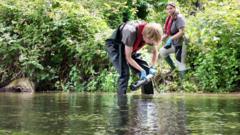
The environmental tech sector has a expensive obsession with watching ecosystems die in high definition.
Every few months, a new press release makes the rounds. A tech consortium or a local water authority partners up to deploy "revolutionary" real-time monitoring networks along England’s historic chalk streams. They install internet-connected sensors, build slick cloud dashboards, and congratulate themselves on protecting the planet. Read more on a similar issue: this related article.
It is a comforting narrative. It is also a massive, resource-sucking distraction.
Data is not an action plan. Knowing precisely what second a nitrate spike hits a delicate riverbed does absolutely nothing to stop the pollution from flowing. We are spending millions of pounds building the world's most sophisticated digital autopsies for our waterways, while the actual structural drivers of river degradation are ignored. Further journalism by Gizmodo delves into related views on this issue.
The Illusion of the Real-Time Fix
The prevailing consensus among corporate sustainability boards and local governments is simple: you cannot manage what you cannot measure. Therefore, continuous measurement must equal management.
This logic is fundamentally broken.
Chalk streams are rare global assets; roughly 85% of them flow through southern and eastern England. They are defined by their clear, mineral-rich, alkaline waters fed by underground chalk aquifers. They are incredibly fragile. When a water company dumps untreated sewage into a chalk stream during a storm event, or when agricultural runoff floods the system with phosphates, the damage happens instantly.
Imagine a scenario where a real-time sensor network detects a massive spike in ammonia at 2:00 AM on a Tuesday. The sensor registers the spike. The data transmits to the cloud. An automated alert triggers and lands in an engineer's inbox.
What happens next? Nothing.
By the time an agency sends a human being to investigate, the plume of pollution has already washed downstream, suffocating the macroinvertebrates and coat-tailing into the local fish populations. The sensor did not protect the chalk stream. It merely time-stamped its destruction.
I have watched public agencies and private utilities burn through hundreds of thousands of pounds on these telemetry vanity projects. The money goes to software licensing fees, ruggedized hardware maintenance, and data analysts. Meanwhile, the actual physical infrastructure of the river—the wetlands that filter runoff, the modern wastewater treatment plants that handle capacity—remains decrepit.
The Flawed Questions We Keep Asking
Look at the standard inquiries driving this market. People constantly ask: "How can we use IoT technology to monitor river health?" or "What is the best way to get real-time water quality alerts?"
These are completely the wrong questions. They assume that a lack of information is our bottleneck.
It isn't. We already know exactly what is killing chalk streams.
- Over-abstraction: Pumping too much water out of the underground aquifers to supply households, leaving rivers dry.
- Agricultural Runoff: Excess fertilizers and sediment washing off plowed fields.
- Sewage Overflows: Outdated treatment infrastructure overwhelmed by population growth and heavy rainfall.
We do not need a sensor to tell us that a wastewater treatment plant built for a town of 10,000 people is going to spill when that town grows to 30,000. We do not need a machine-learning model to predict that farming right up to the edge of a riverbank will cause siltation.
Answering the alert question misses the point entirely. The brutal reality is that real-time monitoring is often used as a political shield. It allows regulators and corporations to claim they are taking digital action today while delaying the expensive, disruptive physical interventions required to actually save the environment.
The Hard Physics of Water Pollution
To understand why monitoring fails as a cure, look at the chemistry of river health. Traditional water testing relies on spot sampling. Critics argue spot sampling misses intermittent pollution events. They are right.
But the tech-driven alternative—continuous surrogate monitoring—has massive technical vulnerabilities that vendors love to gloss over. Continuous sensors do not directly measure complex chemicals like specific pesticides or heavy metals in real time. Instead, they measure proxies like turbidity (cloudiness), electrical conductivity, pH, and dissolved oxygen.
[Pollution Event] ➔ [Sensor Measures Proxy (Turbidity/pH)] ➔ [Data Processing] ➔ [Delayed Human Intervention]
These proxies are notoriously noisy. High turbidity can be caused by a catastrophic industrial spill, or it can be caused by a flock of swans stirring up mud upstream. Biofouling is another constant battle. Within days of deployment, wild river organisms grow over sensor lenses and probes, drifting the calibration and creating false positives or, worse, false negatives.
Keeping these networks accurate requires a relentless cycle of manual cleaning and recalibration. The operational costs are staggering. If you divert a finite environmental budget into maintaining a fleet of finicky digital gadgets in a muddy river, you are actively robbing funds from physical river restoration.
Shift Capital from Silicon to Soil
If we stop funding the monitoring theater, what should we do instead? We must pivot from passive observation to active engineering.
1. Enforce Mandatory Riparian Buffer Zones
Instead of tracking agricultural runoff with sensors, eliminate the runoff at the source. Governments need to mandate and fund wide, uncultivated buffer zones of native trees and deep-rooted grasses along every kilometer of a chalk stream. These natural barriers physically trap sediment, absorb phosphates, and shade the water to keep temperatures low, providing real resilience against climate shifts.
2. Implement Aggressive Low-Tech Silt Traps
Siltation smothers the gravel beds that salmon and trout need for spawning. Simple, low-tech interventions like woody debris dams and constructed wetlands slow river flow in key areas, forcing sediment to drop out of suspension before it reaches pristine habitats. These require zero battery changes, zero cloud subscriptions, and they work every second of the day.
3. Reconstruct Aquifer Recharge Infrastructure
The root cause of low flows in chalk streams is our reliance on groundwater abstraction. Capital must be aggressively redirected into building massive winter storage reservoirs and graywater recycling systems. If we stop sucking the aquifers dry, the natural spring flows of the chalk streams return, diluting ambient pollution naturally through sheer volume.
The Downside of True Restoration
Adopting this contrarian approach is not easy, and it comes with real trade-offs.
Unlike a software rollout, physical infrastructure changes take years to show measurable results. Planting a woodland buffer zone does not give a corporate communications team a shiny dashboard they can showcase in an annual ESG report next month. It requires difficult conversations with the agricultural lobby regarding land use. It requires water companies to commit billions to concrete and steel upgrades rather than millions to tech startups.
It forces us to accept that fixing natural systems requires unglamorous, heavy physical labor.
Data-driven environmentalism has failed to move the needle because it treats nature like a software system that needs optimization. A chalk stream is not a network to be debugged. It is a biological entity that is being physically crushed by human demands.
Stop watching the collapse in real time. Take the sensors out of the water and put the shovels in the ground.