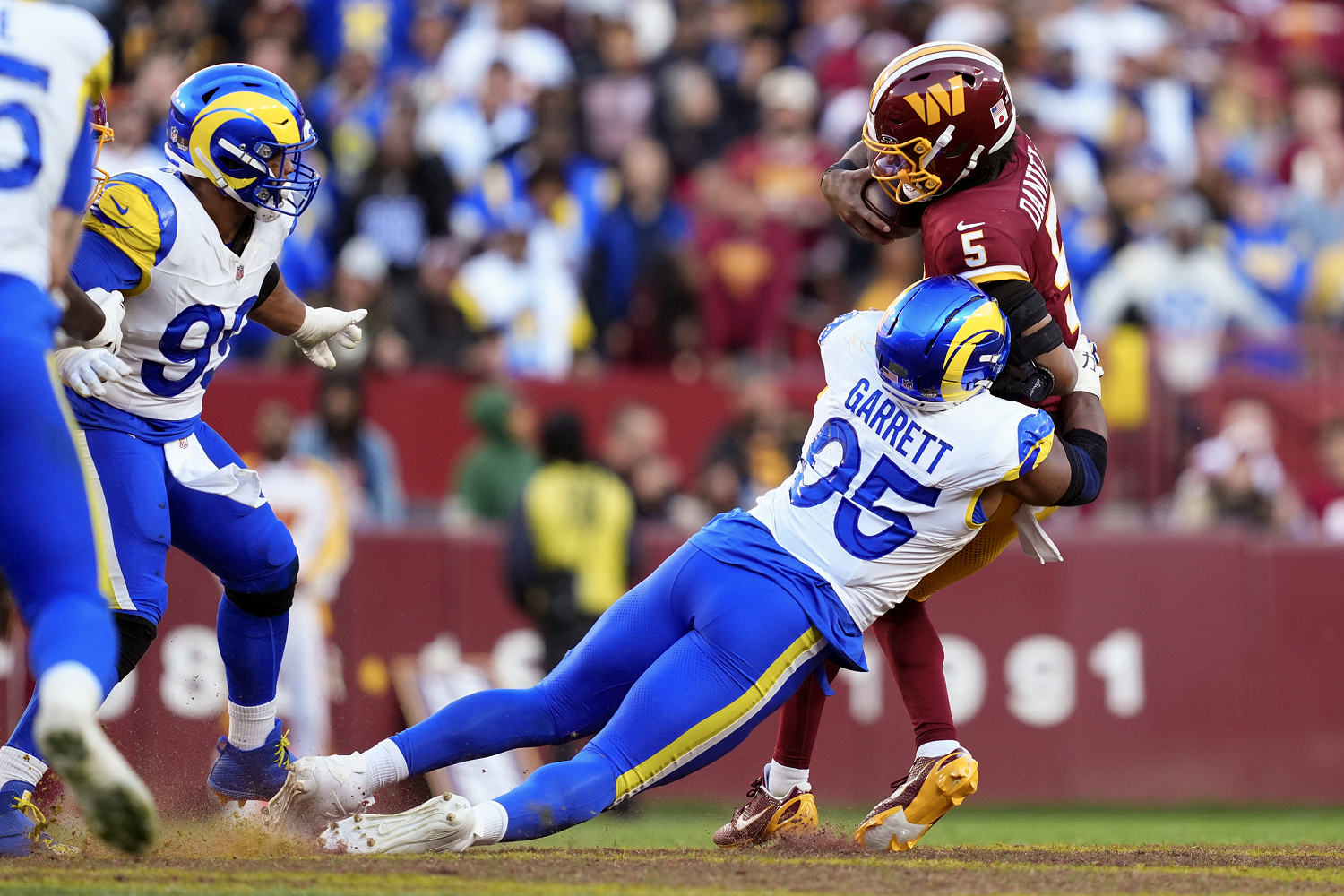
Box scores are where football analysis goes to die. Every Monday morning after NFL Week 9, the sports media echo chamber fires up the same tired narratives. They look at a final score, glance at a couple of splash plays, and declare a unit "fixed" or a team "resilient."
The consensus narrative around Week 9 is predictable. Analysts are tripping over themselves to praise a supposed defensive renaissance for the Los Angeles Rams while applauding the Chicago Bears for gritty survival tactics. Both takes miss the structural reality of how football games are actually won and lost over a seventeen-game grind. Also making news in this space: Marco Bezzecchi Ruined Marc Marquez’s Championship Party Under the Lusail Lights.
If you buy into the hype that the Rams solved their defensive issues or that the Bears proved their championship mettle by hanging on for dear life, you are reading the scoreboard instead of watching the tape.
The Myth of the Midseason Defensive Boost
When a struggling defense strings together a few stops in November, the lazy take is that the unit has turned a corner. In the NFL, defensive performance is notoriously noisy from week to week. Unlike offense, which relies on proactive execution and timing, defense is inherently reactive. A single tipped pass, a missed blocking assignment by a backup guard, or a quarterback slipping on wet turf can swing defensive efficiency metrics by thirty percent in a single afternoon. More insights into this topic are explored by Yahoo Sports.
True defensive transformation requires personnel upgrades at the point of attack or a fundamental overhaul in coverage communication. Neither happens overnight in Week 9.
Variance vs. Structural Improvement
I have spent over a decade breaking down All-22 film for front offices and betting syndicates, and the single most expensive mistake an evaluator can make is confusing variance with structural growth. When you look closely at what people call a "defensive boost" for Los Angeles, you have to separate scheme execution from opponent incompetence.
To measure whether a defense has actually improved, you ignore raw points allowed and look at three specific metrics:
- Unblocked Pressure Rate: Are defenders winning one-on-one matchups in under 2.5 seconds, or are sacks coming from coverage breakdowns and quarterbacks holding the ball too long?
- Early-Down Success Rate: Is the defense forcing third-and-long situations, or are they getting bailed out by self-inflicted offensive penalties?
- Explosive Play Prevention: Are safeties maintaining leverage over the top, or did opposing receivers simply drop open vertical shots?
When a defense relies on late-down turnovers or red-zone field goal stands to keep the score low, they are walking a tightrope without a net. Regression to the mean is undefeated in the National Football League.
The Zone Coverage Trap
Modern defensive coordinators love to disguise two-high safety shells to bait quarterbacks into throwing underneath. When it works, the defense looks disciplined and opportunistic. The broadcast booth praises the coordinator for "tightening the screws."
What they miss is the hidden cost of playing passive, bend-don't-break football. By conceding the intermediate middle of the field and relying on open-field tackling, a defense surrenders control of the clock. You are betting that the opposing offense will eventually make a mistake before they march eighty yards in fourteen plays. Against bottom-tier quarterbacks, that bet pays off. Against elite offensive play-callers in January, that exact same defensive philosophy gets shredded for thirty-five points.
Why "Holding On" Is a Red Flag for Chicago
Let's address the second half of the Week 9 consensus: the idea that the Chicago Bears deserve credit for "holding on" to secure a victory.
In sports media, surviving a late collapse is framed as a character-building exercise. Pundits call it "learning how to win" or "showing grit." Front office executives and sharp analysts call it something else entirely: warning signs of a fragile roster.
Good teams put inferior opponents away in the third quarter. When a team spends the final ten minutes of the fourth quarter clinging to a one-score lead, burning timeouts to fix defensive alignment issues, and praying for a missed kick or an errant throw, they did not display toughness. They displayed an inability to close.
The Anatomy of Prevent Offense
The primary culprit behind these nail-biting finishes is almost always conservative play-calling with a lead. Coaching staffs become terrified of losing rather than aggressive about winning.
Imagine a scenario where a team holds a ten-point lead with eight minutes remaining in the fourth quarter. Instead of continuing to attack the weak spots in the opponent's secondary that built the lead in the first place, the offensive coordinator shifts into heavy personnel. They run the ball straight into stacked eight-man boxes on first and second down, setting up predictable third-and-seven passing situations.
This approach fails for three undeniable reasons:
- It surrenders possession value: Three-and-outs take less than ninety seconds off the game clock, handing extra possessions directly to a desperate offense playing with four-down urgency.
- It exhausts the defense: Asking a defensive line to rush the passer forty times a game while the offense goes three-and-out guarantees fourth-quarter fatigue. Pass rushers lose their first-step explosiveness, and cornerbacks lose their recovery speed.
- It invites variance: Keeping an opponent within one score means a single blown coverage, a roughing-the-passer flag, or a fluke bounce on a punt return flips the entire outcome of the game.
The Quarterback Development Bottleneck
For a team like Chicago, the obsession with simply surviving games often masks deeper issues in offensive infrastructure. When an offense stalls out late in games, it exposes a lack of answers against zero-blitzes and tight man coverage.
If a coaching staff does not trust their quarterback to throw the ball on first down to ice a game, that tells you everything you need to know about their internal evaluation of the passing game. You cannot hide a stagnant drop-back passing attack behind a strong running game forever. Eventually, you will face an opponent that stops the run on early downs, forcing you to throw into predictable passing windows.
Redefining the Questions Fans Should Be Asking
If you want to understand where the Rams and the Bears actually stand at the midpoint of the NFL season, you have to stop asking surface-level questions.
Are the Rams actually a playoff contender now?
This is the wrong question. In a watered-down conference, almost any team with competent coaching and a healthy starting quarterback can sneak into a wild-card spot. The real question is whether the Rams possess a single unit capable of dictating terms against a top-three seed. Right now, their defensive front still lacks the interior rotational depth to hold up against elite zone-blocking schemes over four quarters. A good afternoon in Week 9 does not erase structural roster holes created by years of trading away top-100 draft picks.
Do ugly wins count the same as pretty wins in the standings?
In the literal sense, yes. A win is a win in the playoff tiebreakers. In the predictive sense, no. Point differential and net yards per play are vastly superior predictors of future success than raw win-loss records. Teams that consistently win one-score games by "holding on" almost always experience a massive correction the following season—or worse, in the final month of the current season when the schedule toughens.
The Contrarian Playbook for Midseason Evaluation
If you are evaluating rosters, betting lines, or fantasy assets heading into the second half of the NFL calendar, throw out the Week 9 narrative. Use an objective framework that strips away emotional storytelling.
1. Audit Trenches Over Skill Positions
When watching a game, keep your eyes on the defensive tackles and offensive guards for ten consecutive snaps. Ignore the ball. If the Rams' interior defensive line is getting washed down the line of scrimmage on double teams, their secondary's performance is irrelevant. Conversely, if the Bears' offensive line cannot generate a push in short-yardage situations late in the game, their fourth-quarter struggles will continue regardless of who is carrying the ball.
2. Track Red-Zone Touchdown Efficiency
Field goals are drive killers in the modern NFL. Any team that settles for three points inside the opponent's ten-yard line is leaving massive equity on the table. When a defense holds an opponent to field goals, look at why it happened. Did the defense make a brilliant play, or did the offense drop a touchdown pass in the flat? One is repeatable skill; the other is pure luck.
3. Monitor Snap Counts and Fatigue Metrics
November is when the physical toll of the NFL season begins to separate deep rosters from top-heavy ones. Look at the snap counts for edge rushers and cornerbacks. If a team is playing its top defenders over eighty-five percent of the snaps just to survive Week 9, those players will have dead legs by Week 15.
The Caveat to the Contrarian View
To be completely transparent, there is one major flaw in relying strictly on underlying efficiency metrics and structural film study: human psychology and coaching adaptability.
Football is not played on a spreadsheet. Sometimes, a flawed defensive unit genuinely gains confidence from a lucky break, leading to faster communication and more decisive tackling in subsequent weeks. Similarly, a young team that survives a chaotic fourth quarter can sometimes use that shared trauma to clean up situational mistakes on the practice field. Analytics tell you what is most likely to happen based on historical precedent, not what is guaranteed to happen in a locker room full of hyper-competitive athletes.
The Bottom Line on Week 9
Stop rewarding teams for clearing a low bar. The Los Angeles Rams did not suddenly transform into an elite defensive juggernaut, and the Chicago Bears did not unlock some secret formula for championship toughness by barely escaping with a victory.
Both teams showed you exactly who they are: flawed, mid-tier rosters fighting to stay relevant in a parity-driven league. Until Los Angeles proves they can generate consistent four-man pressure against top-tier offensive lines, and until Chicago proves they can execute an aggressive two-minute offense to put opponents away, treat their Week 9 narratives as pure noise.
Burn the box scores, turn on the All-22 tape, and bet against the hype.