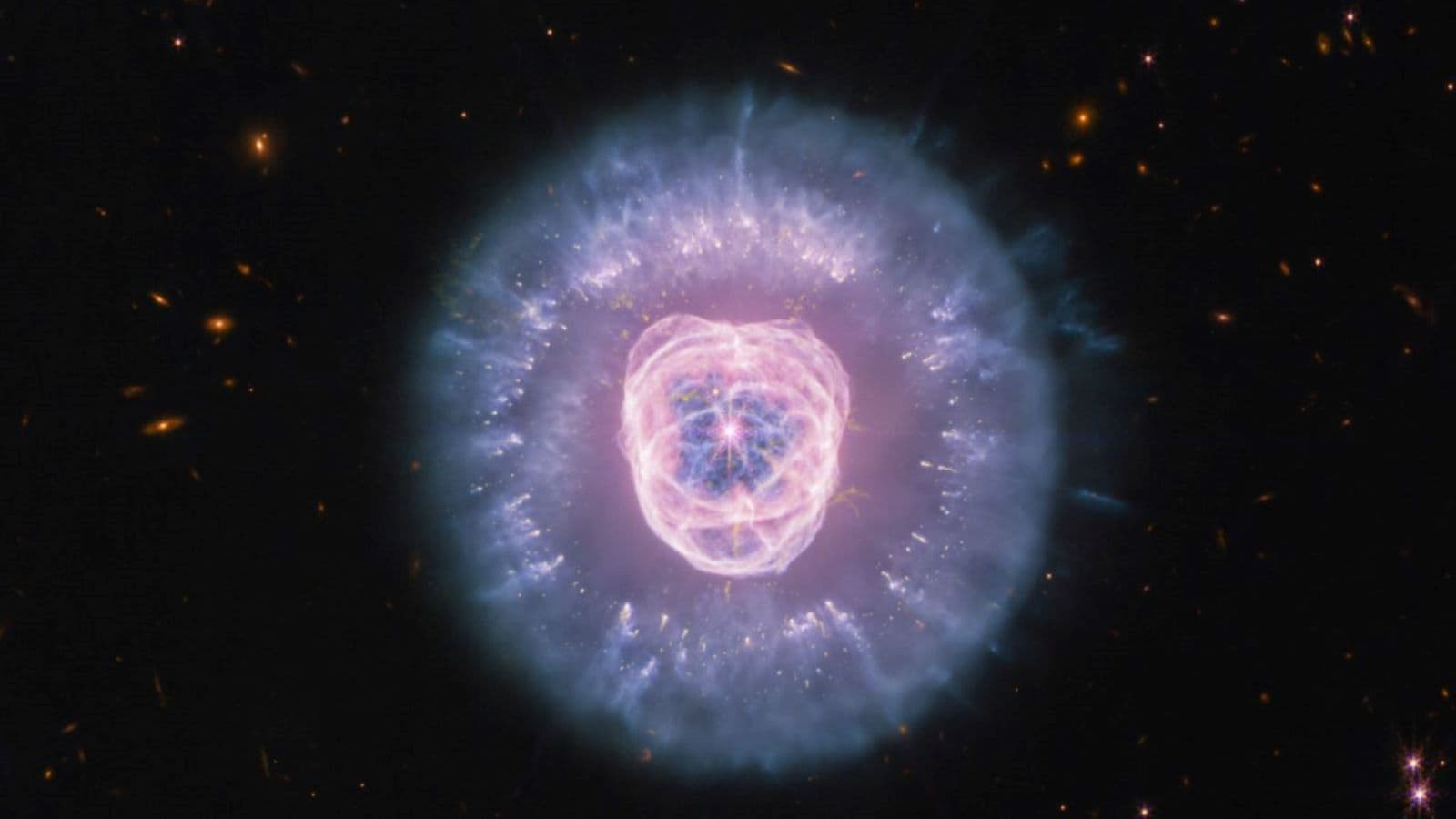
Every few weeks, the internet collectively loses its mind over another glossy infrared snapshot from the James Webb Space Telescope. The latest victim of this mass aesthetic hypnosis is the Lion Nebula. Outlets are hyperventilating over the cosmic dust, the glowing pillars, the celestial feline roaring through the vacuum of deep space.
It is a massive distraction.
Public relations teams at space agencies love these high-resolution glamour shots because they sell budgets to politicians who cannot read a balance sheet. But treating astronomy as a digital art gallery turns actual astrophysics into a spectator sport for people who want a new phone wallpaper. When you stare at the pretty colors, you miss the engineering marvel, the violent reality of stellar birth, and the brutal truth that those images are fake.
Let us dismantle the illusion right now.
The Photoshop Fallacy
We need to talk about what you are actually looking at when you gaze at a Webb image. The James Webb Space Telescope does not see in color. It captures photons in the infrared spectrum, which is entirely invisible to the human eye.
Imagine a scenario where you float right next to the telescope in a space suit, staring directly at the Lion Nebula region. You would see absolute, pitch-black nothingness, peppered with faint, ghostly smudges if your eyes adjusted.
The vibrant crimsons, blazing golds, and electric blues splashed across your social media feeds are artistic interpretations. Technicians and science communicators map infrared wavelengths to visible light channels. They boost contrast, saturate hues, and layer exposures to create a visual meal that satisfies human psychological hunger for patterns.
There is nothing inherently wrong with false-color imaging. It is a necessary tool for data visualization. But pretending you are looking at a natural photograph is a con. It creates a profound scientific literacy gap. The public thinks the universe is a neon-lit art installation, and when they learn how the sausage is made, they feel cheated. Stop treating color palettes as gospel. Start looking at the actual spectral data underneath the marketing gloss.
The Lion is Eating Itself
The mainstream narrative loves to paint star-forming regions like the Lion Nebula as cozy nurseries where baby suns are gently rocked to sleep by interstellar gravity.
Total nonsense.
A star-forming region is not a nursery. It is a slaughterhouse.
When massive stars ignite inside these molecular clouds, they unleash brutal stellar winds and torrents of ultraviolet radiation. This radiation blasts apart the very gas and dust that birthed them. The lion metaphor is deeply ironic because the nebula is tearing itself to pieces from the inside out. The pillars and ridges you admire in the Webb photos are not monuments of creation; they are scorched, eroding wreckage fighting a losing battle against radiation pressure.
If you want to understand how our own solar system formed four and a half billion years ago, stop romanticizing the chaos. Our sun was born in a violent stellar cluster where neighboring giants constantly battered our protoplanetary disk with cosmic shrapnel. We survived a cosmic demolition derby. The Lion Nebula is undergoing that exact same brutal process right now. It is a chaotic demolition site, not a petting zoo.
Why the Hype Machine is Ruining Astronomy
By packaging the universe as a series of pretty pictures for easy consumption, we strip away the grueling intellectual labor required to decode the cosmos.
When headlines scream about a new Webb image, they focus entirely on the aesthetics. They rarely explain the spectroscopy, the dust grain composition, or the kinetic energy transfer equations that astrophysicists spend decades calculating. It treats the taxpayer-funded flagship of modern engineering like an Instagram influencer dropping a new photo shoot.
This superficial consumption has real-world costs. When the budget cycle rolls around, agencies feel compelled to prioritize flashy instruments that deliver immediate visual gratification over unglamorous instruments that yield hard, boring tabular data. But the data is where the truth lives.
We do not need another glossy portrait of a cloud of gas to prove that billions of dollars of engineering works. We need to respect the public enough to talk about the physics without hiding behind a rainbow of digital color correction.
Next time a breathtaking cosmic portrait drops, skip the comment section praising the universe's interior designer. Look past the neon pigments. Acknowledge the violence, study the spectroscopy, and realize that nature is not trying to look pretty for your screen. It is too busy tearing itself apart.