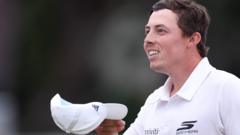
Matt Fitzpatrick just bagged $3.6 million for winning the RBC Heritage at Harbour Town. The headlines are screaming about a "massive payday" and how "money is talking" in the PGA Tour’s new Signature Event era. They want you to believe the tour has finally caught up to the LIV Golf gold rush. They want you to think the players are finally winning the financial war.
They are lying to you.
The $3.6 million figure is a vanity metric. It’s a gross revenue number that ignores the brutal, high-overhead reality of being an independent contractor in a sport that suddenly has an identity crisis. While the "lazy consensus" media celebrates the optics of a $20 million purse, they’re missing the structural rot underneath. Professional golf isn’t getting richer; it’s getting more expensive, more volatile, and more desperate.
The Taxman and the 40 Percent Trap
Last week, Fitzpatrick finished T-18 at the Masters. On paper, he earned a respectable sum. In reality, he lost over $130,000 of that check immediately to tax obligations before he even stepped onto the plane for Hilton Head.
When you see a "Signature Event" winner holding a giant check for $3.6 million, you aren't seeing the net. You’re seeing a number that will be cannibalized by:
- Federal and State Taxes: Depending on the venue (South Carolina’s 7% top bracket vs. California’s 13.3%), nearly half is gone.
- Caddie Cuts: 10% for a win. That’s $360,000 off the top for Billy Foster.
- Management and Legal: 5% to 10% for the agencies that "leverage" these wins.
- The Traveling Circus: Private travel, coaches, physios, and data analysts—the very "analytical approach" Fitzpatrick is praised for—don't come cheap.
By the time the dust settles, a $3.6 million win looks more like a $1.8 million net. Still a king’s ransom? Sure. But compared to the guaranteed, tax-sheltered, upfront signing bonuses of $100 million-plus being handed out by the PIF, the PGA Tour’s "response" is like bringing a toothpick to a nuclear silo.
The Myth of Market Value
The competitor narrative suggests that increased purses are a sign of health. It’s the opposite. It’s a sign of a panicked monopoly trying to overpay for loyalty it never earned.
The PGA Tour didn't raise these purses because their "product" became 50% more valuable in 24 months. They raised them because they had to subsidize the top 1% of players to prevent a total talent exodus. This is a classic "loss leader" strategy, but the Tour isn't a tech startup with infinite runway. It’s a member-run organization cannibalizing its own future reserves to keep Scottie Scheffler and Matt Fitzpatrick from checking their DMs.
If the market were actually dictating these prices, TV ratings would be up. They aren't. They are stagnant or declining. The "Signature Events" are essentially gated communities. By removing the cut and limiting the field, the Tour has killed the one thing that made golf relatable: the meritocratic fear of going home broke.
Why Equity is the Real Scam
Everyone is talking about the SSG (Strategic Sports Group) investment and the billions being pumped into "PGA Tour Enterprises." Fitzpatrick mentioned that talking to the SSG leadership gave him "clarity."
Here is the clarity nobody wants to admit: Equity in a declining legacy media asset is a shell game. Players are being "paid" in shares of a company that relies on a linear television model that is currently on life support.
Imagine a scenario where the PGA Tour’s media rights deal—currently its primary lifeblood—sees a 30% haircut in the next cycle because the "limited field" format bored the casual fan to death. Those equity shares won't be worth the pixels they're displayed on. LIV players took the cash. PGA Tour players took a "promise" of future value in an industry (cable sports) that is shrinking. Who really won?
The Data Delusion
Fitzpatrick is lauded for his "methodical" and "analytical" approach. He tracks every shot. He increased his swing speed by 5 mph. He treats golf like an engineering problem. This is admirable, but it’s also a symptom of the problem.
When the game becomes purely about "Strokes Gained" and "Optimized Launch Conditions," it loses the soul that attracts sponsors. If every player becomes a carbon-copy ball-striking robot obsessed with their "net worth after winning," the "volume" Fitzpatrick is turning up isn't music—it’s white noise.
The "money is talking," but it’s mostly just screaming "Help."
The Bottom Line Nobody Admits
The current path is unsustainable. You cannot have $20 million purses for 70-man fields indefinitely when the underlying viewership doesn't justify the spend. We are witnessing the "Pro Golf Bubble." Fitzpatrick is smart to grab the $3.6 million while it's still being offered, but don't mistake a temporary payout for a stable ecosystem.
The real contrarian truth? The PGA Tour players who stayed are working twice as hard for money that is worth half as much as the "blood money" they turned down. They are chasing "prestige" in a sport where prestige is being rapidly liquidated for cash.
Stop celebrating the prize money. Start asking who is going to pay for it in 2028.


